

Key Takeaways
- Substance and severity decide the setting, not preference. Severe alcohol or benzodiazepine withdrawal is medically dangerous and belongs in inpatient care. Mild-to-moderate opioid withdrawal often does fine outpatient with the right medications.
- Residential clients complete treatment at much higher rates. A national U.S. dataset of 318,924 discharges found 65% of residential clients completed treatment versus 52% of outpatient clients — nearly a 3x advantage after adjusting for other factors (Stahler et al., Addictive Behaviors, 2016).
- Delirium tremens is the reason alcohol detox skews inpatient. Untreated DTs carry mortality of 15–40%; in a monitored hospital setting that drops to under 5% (StatPearls, NIH, 2024).
- For stimulants and cannabis there is no “medical detox” in the alcohol sense. Withdrawal is psychological and uncomfortable but not life-threatening. The value of a residential setting is removing triggers and supporting the high-relapse first week.
- One Step handles standard detox on-site. Severe alcohol, benzodiazepine, or opioid withdrawal that needs ICU-level monitoring is detoxed first at our partner hospital — which has intensive and intermediary intensive care units — before transfer to our residential programme.
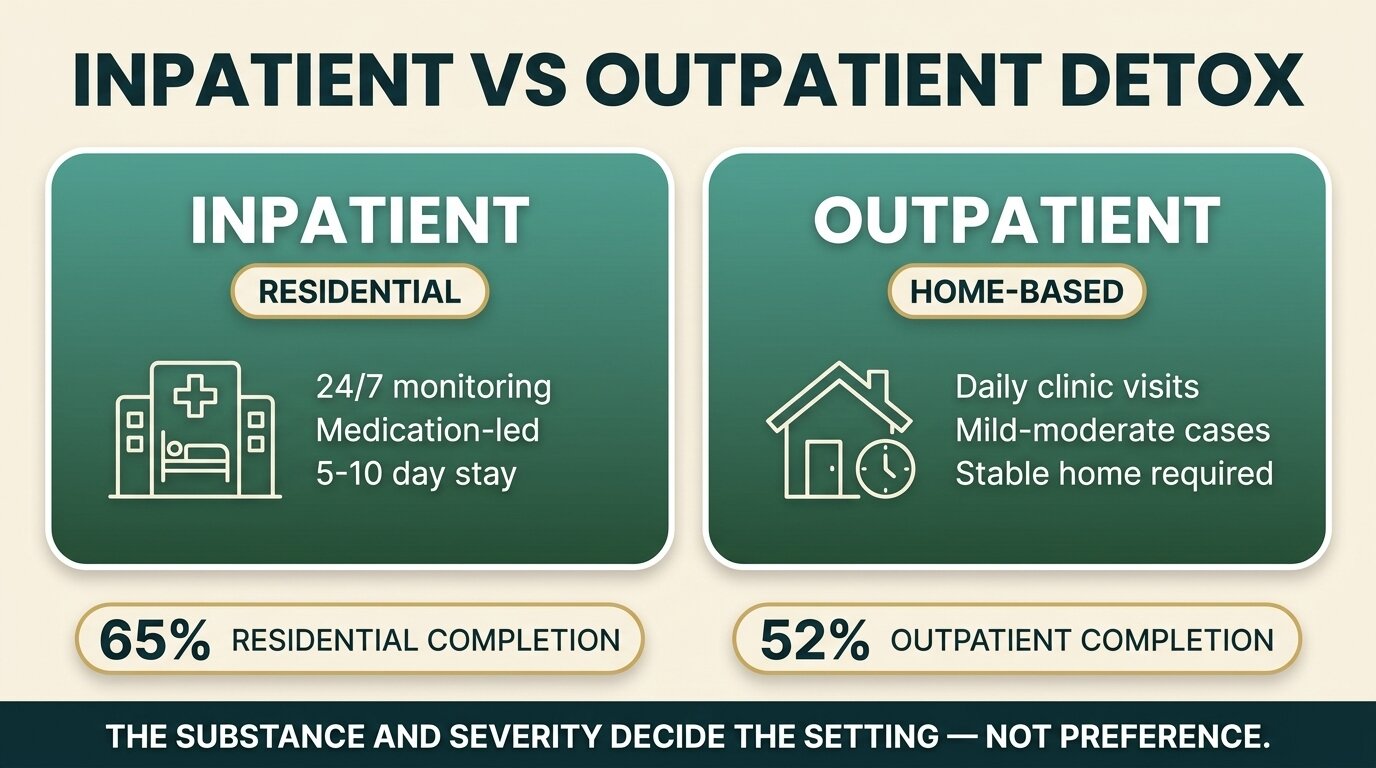
Inpatient detox is residential and monitored; outpatient detox is home-based with scheduled medical visits. Which one is safer depends almost entirely on what you’re withdrawing from and how heavy the use has been. Alcohol and benzodiazepines can kill you in withdrawal — those usually need inpatient. Opioids are agonising but rarely fatal — outpatient with buprenorphine or methadone often works. Stimulants and cannabis have no “medical” withdrawal at all, so the setting matters for relapse prevention, not safety. The big completion-rate study to know: residential treatment finishes at 65% versus 52% for outpatient, with the advantage strongest for opioid users (Stahler et al., Addictive Behaviors, 2016).

What Is Inpatient Detox?
Inpatient detox is full-time residential withdrawal management. You live on-site for the duration of acute withdrawal — typically 5 to 10 days — with clinical staff present, scheduled medication administration, and immediate access to help if symptoms escalate. It’s the setting used when withdrawal carries a real risk of seizures, delirium, or medical complications that need to be caught early.
The defining features are physical distance from the substance, structured medication management (benzodiazepines for alcohol, buprenorphine or methadone for opioids, slow taper for benzodiazepines), and an environment where someone notices if your blood pressure spikes, your tremor worsens, or you start hallucinating. SAMHSA’s TIP 45 calls this the “medical model” of detox — physicians and nursing staff, medication-led, monitored (SAMHSA TIP 45, 2015).
Inpatient detox typically sits within a residential rehab programme, so the day you finish withdrawal you transition straight into therapy — no gap, no return to the home environment that fed the addiction. That continuity matters: the 72 hours after a completed outpatient detox is one of the highest relapse risk windows in addiction medicine.
What Is Outpatient Detox?
Outpatient detox is medically supervised withdrawal where you stay at home and attend scheduled clinic visits — often daily for the first few days, then tapering to every two or three days. A doctor or nurse practitioner prescribes withdrawal medication (typically a benzodiazepine taper for alcohol, buprenorphine for opioids), monitors vitals and symptoms, and adjusts the dose at each visit.
It works for people with mild-to-moderate dependence, a stable home, a sober support person on hand, no history of seizures or DTs, and no significant medical or psychiatric comorbidity. Most alcohol use disorder treatment in the U.S. happens outpatient — NIAAA notes about half of patients with AUD have some withdrawal symptoms when they stop, but only a smaller proportion need intensive inpatient detox to manage them safely (NIAAA, 2024).
The trade-off is honest: outpatient detox is cheaper and lets people keep working, but it leaves you in the environment where you drank or used, with the substance still accessible, often within walking distance of the dealer or the liquor store. Completion rates reflect that exposure.
Which Is Safer for Each Substance?
Safety depends entirely on the substance and the severity of dependence. Alcohol and benzodiazepines have the most dangerous withdrawal syndromes — seizures and delirium tremens — and severe cases need inpatient care. Opioid withdrawal feels horrific but rarely kills anyone, so the setting question is really about completion, not survival. Stimulants and cannabis don’t have medical withdrawal at all; the setting matters for relapse prevention.
| Substance | Mild–moderate use | Severe / high-risk use | Why |
|---|---|---|---|
| Alcohol | Outpatient feasible with monitoring | Inpatient strongly preferred | History of DTs, seizures, or kindling makes outpatient unsafe |
| Benzodiazepines | Outpatient slow taper | Inpatient for high doses or accelerated taper | Withdrawal seizures, protracted symptoms; tapers run weeks to months |
| Opioids | Outpatient with buprenorphine or methadone | Inpatient if polysubstance use or unstable home | Rarely life-threatening; medication availability and environment drive setting choice |
| Stimulants (cocaine, meth) | Supportive setting, either | Residential preferred for the crash week | No medical detox needed; relapse risk peaks days 2–7 when depression hits hardest |
| Cannabis | Outpatient or residential | Residential helps with sleep and irritability | Withdrawal is psychological — insomnia, anger, anxiety — but never medically dangerous |
Alcohol
This is the substance where the setting question really matters. Alcohol withdrawal can produce seizures, autonomic instability, and delirium tremens — the most dangerous withdrawal syndrome in addiction medicine. Untreated DTs carry mortality of 15–40%; with proper medical care that drops to under 5% (Newman & Stahl, StatPearls / NIH, 2024). If there’s a history of DTs, prior withdrawal seizures, daily heavy drinking for years, or significant medical comorbidity, outpatient detox is the wrong call regardless of cost.
Benzodiazepines
Benzodiazepine withdrawal is unpredictable and can cause seizures at any point in a taper. ASAM’s 2025 joint clinical practice guideline says most patients can taper outpatient with dose reductions of 5–10% every 2–4 weeks, but inpatient care is warranted when there’s imminent risk of harm, complicated co-occurring conditions, or severe withdrawal is occurring or anticipated (ASAM Benzodiazepine Tapering Guideline, 2025). High daily doses (the equivalent of 20+ mg of diazepam) or any history of withdrawal seizures push the decision to inpatient.
Opioids
Opioid withdrawal is brutal — chills, cramps, anxiety, restless legs, GI distress — but it doesn’t kill people the way alcohol withdrawal does. The Cochrane review on opioid detox setting is honest about how thin the evidence is: only one small trial of inpatient vs outpatient could be analysed, and all the inpatients relapsed within three months (Day et al., Cochrane Database of Systematic Reviews, 2005). The bigger point: NIDA states medication should be the first line of treatment for opioid use disorder — methadone, buprenorphine, or extended-release naltrexone — combined with behavioural therapy. Detoxification alone, without medication-assisted treatment to follow, generally leads to resumption of use (NIDA, 2024).
Stimulants (cocaine, methamphetamine, amphetamines)
There is no medical detox for stimulants in the alcohol sense — no medication taper, no withdrawal seizure risk, no protocol that requires a hospital bed. What stimulant withdrawal does produce is a brutal crash: fatigue, hypersomnia, increased appetite, profound depression, and intense craving lasting roughly 3 to 5 days, with anhedonia and craving sometimes persisting weeks. The setting question is purely about whether you can stay away from the substance during the crash window — which is when most relapse happens. Residential is helpful for this, not strictly necessary.
Cannabis
Cannabis withdrawal is real (it’s in the DSM-5) but it isn’t dangerous. Sleep disturbance, irritability, anger, anxiety, decreased appetite — symptoms peak around days 2 to 6 and largely resolve by week 2. No detox medication regimen exists. The value of a residential setting here is environmental: heavy cannabis users often have years of habit cues at home, and the first sleepless, irritable nights are exactly when people reach for the substance again.
The substance dictates the safety question; the home environment dictates the completion question. I’ve seen people detox safely from severe alcohol dependence as outpatients because they had a sober spouse and a daily clinic visit — and I’ve seen people relapse from opioids in week one of outpatient because the dealer lived two doors down. The decision is rarely about willpower. It’s about what the body needs medically and what the surroundings will tolerate behaviourally.
Dr. Worapakthorn KongpesalaphunConsultant Psychiatrist, One Step Rehab

Which Setting Gets Better Outcomes?
Residential detox produces substantially higher treatment completion rates than outpatient. The largest U.S. analysis — 318,924 discharge records from publicly funded programmes — found 65% of residential clients completed treatment versus 52% of outpatient clients. After adjusting for confounders, residential clients were nearly three times more likely to complete (Stahler et al., Addictive Behaviors, 2016).
The advantage wasn’t uniform across substances. Opioid users showed the biggest residential benefit. Cannabis users showed the least. Alcohol sat in the middle. That pattern fits what front-line clinicians see: opioid dependence has such strong environmental cues and such accessible supply that removing the person from the environment changes outcomes more than removing the person from any other substance.
| Factor | Inpatient detox | Outpatient detox |
|---|---|---|
| Up-front cost | High (residential days + clinical staff) | Low (clinic visits, prescription) |
| Completion rate (national U.S. data) | ~65% (residential treatment) | ~52% |
| Relapse risk first 30 days | Lower — no substance access during stay | Higher — substance and triggers accessible |
| Hidden costs if it fails | Low — most who finish detox transition to treatment | Failed detox often means ER visit, restart cycle, lost work |
| Total cost if attempt fails twice | Rare — high single-event cost | Often higher than one inpatient stay would have been |
The honest cost-benefit calculation: inpatient detox is more expensive on the invoice, but failed outpatient detox isn’t free — it usually costs an emergency room visit, lost work, family fallout, and another attempt. Two failed outpatient detoxes often add up to more than one successful inpatient stay.
Not sure which level of care fits your situation? Talk to our team — we’ll walk through the substance, severity, and home environment and give you a straight answer, even if the answer is “you don’t need us, you need a hospital first.”
How Do the ASAM Criteria Decide Level of Care?
The ASAM Criteria are the standard framework U.S. clinicians use to match a patient to a level of care. The 4th edition, released in 2024, assesses six dimensions — intoxication and withdrawal potential, medical conditions, emotional and behavioural conditions, readiness to change, relapse potential, and recovery environment — and matches the result to a withdrawal management level from 1-WM (ambulatory) up to 4-WM (medically managed intensive inpatient) (ASAM Criteria, 4th Edition, 2024).
In plain English, the ASAM framework asks four practical questions:
- How bad is the withdrawal likely to be? Past DTs, seizures, daily heavy use for years, or high benzodiazepine doses push toward inpatient.
- What other medical or psychiatric conditions are in play? Pregnancy, uncontrolled hypertension, active suicidal ideation, severe depression all push toward inpatient.
- What’s the home environment? A sober spouse and a stable house enables outpatient. Living with active users or alone with the substance pushes toward inpatient.
- What’s the history of previous detox attempts? Two or more failed outpatient detoxes is itself a criterion for stepping up the level of care.
If a patient answers wrong on any of these — past seizures, polysubstance use, unstable home, or repeated failed detox — the criteria say inpatient. The framework exists precisely because reading the substance label alone doesn’t tell you what the person needs.

How Does One Step Handle Detox?
One Step is a residential rehab in Chiang Mai. We run on-site detox for most clients as part of the residential programme, with regular medical check-ins from our visiting psychiatrist and staff support on-site throughout withdrawal. The fee is around ฿280,000/month (~$8,500 USD) — see our pricing page for what’s included and what isn’t. Medication prescribed during your stay is billed separately, like flights and visa fees.
The substances we handle on-site as part of the residential programme include alcohol (mild to moderate dependence), opioids on a medication-assisted protocol, stimulants (cocaine, methamphetamine, amphetamines) with supportive care, ketamine, cannabis, and most polysubstance use that doesn’t include severe alcohol or benzodiazepine dependence. The intake assessment determines what’s appropriate before you arrive — we don’t accept clients we can’t safely detox.
For those with severe alcohol, benzodiazepine, or opioid withdrawal — past DTs, prior withdrawal seizures, high benzodiazepine doses, or significant medical complications — we may detox you first at our partner hospital, which has intensive and intermediary intensive care units. Once acute withdrawal is medically stable, you transfer to One Step for the rehab programme. The handover happens with our intake team coordinating directly with the hospital so there’s no gap in care.
What we don’t offer is standalone outpatient detox. Our model is residential — you stay with us for the full programme, typically 28 to 60 days, with detox as the opening phase. If outpatient detox is what fits your situation best, the right setting is a clinic in your home country with a doctor you can see daily.
For more on what residential treatment looks like once detox is finished, see our treatment programme, the daily schedule, and our take on inpatient vs outpatient rehab — which covers the rehab phase, not the detox phase. For the detox-specific picture, the detox and stabilisation page covers our protocol in more detail, and our companion posts on whether detox centres treat all addictions, reducing relapse risk during withdrawal, side effects of alcohol detoxification, and what to expect from alcohol detox go deeper on specific scenarios.
Frequently Asked Questions
Common questions about choosing between inpatient and outpatient detox.
Sometimes. Mild alcohol dependence with no history of seizures or delirium tremens, a stable home, and a sober support person can be managed outpatient with daily clinic visits and a benzodiazepine taper. Anything beyond that — past DTs, years of daily heavy drinking, prior withdrawal seizures, or significant medical comorbidity — needs inpatient. Unmonitored alcohol detox at home is one of the most common preventable causes of withdrawal mortality in addiction medicine.
Acute withdrawal typically lasts 5 to 10 days depending on the substance. Alcohol acute withdrawal is 3 to 7 days. Opioid withdrawal is 4 to 10 days. Benzodiazepine tapers run far longer — weeks to months. But the inpatient stay covers only the acute phase; the rehab programme that follows is usually 28 days or longer.
If it works the first time, yes. If it doesn’t, often no. A failed outpatient detox typically means an emergency room visit, lost work, family fallout, and a second attempt. Two failed outpatient detoxes can add up to more than the cost of one successful inpatient stay. The honest comparison is total cost across the full recovery attempt, not the cost of a single try.
Not in the same sense as alcohol or opioids. Stimulant withdrawal has no withdrawal seizure risk and no medication taper protocol. What it has is a brutal crash — exhaustion, depression, intense craving — lasting 3 to 5 days. The value of a residential setting is removing access to the drug during the highest relapse-risk window, not managing a medical emergency.
Detox handles the body. Rehab handles the rest. Detox is the medical management of acute withdrawal, typically lasting 5 to 10 days. Rehab is the structured therapeutic programme that follows — group therapy, individual counselling, relapse prevention, often 28 days or longer. NIDA is explicit that detox alone, without subsequent treatment, generally leads to resumption of drug use. Detox is the door; rehab is the room.
Yes, and you should if symptoms escalate. Worsening tremor, hallucinations, confusion, vital sign instability, or a seizure are all reasons to move to inpatient immediately — typically by going to an emergency department first. Outpatient detox protocols include explicit criteria for when to escalate; following them is more important than completing the outpatient plan you started with.
No. One Step is a residential programme — detox happens on-site as the opening phase of a full rehab stay. If outpatient detox is what fits your situation, the right setting is a clinic in your home country with a doctor you can see daily. For severe withdrawal cases needing more than standard residential monitoring, we coordinate detox at our partner hospital before transfer to our programme.
Written by
Worapakthorn Kongpesalaphun, MD., Ph.D.
Dr. Worapakthorn Kongpesalaphun is a Thai Licensed Medical Doctor and Expert in Preventive Medicine (Community Mental Health) with extensive experience in addiction treatment and public health management. He holds multip...
Learn more about Worapakthorn