

Key Takeaways
- Alcohol detox side effects range from mild anxiety and insomnia to life-threatening seizures and delirium tremens — severity depends on how much and how long you’ve been drinking.
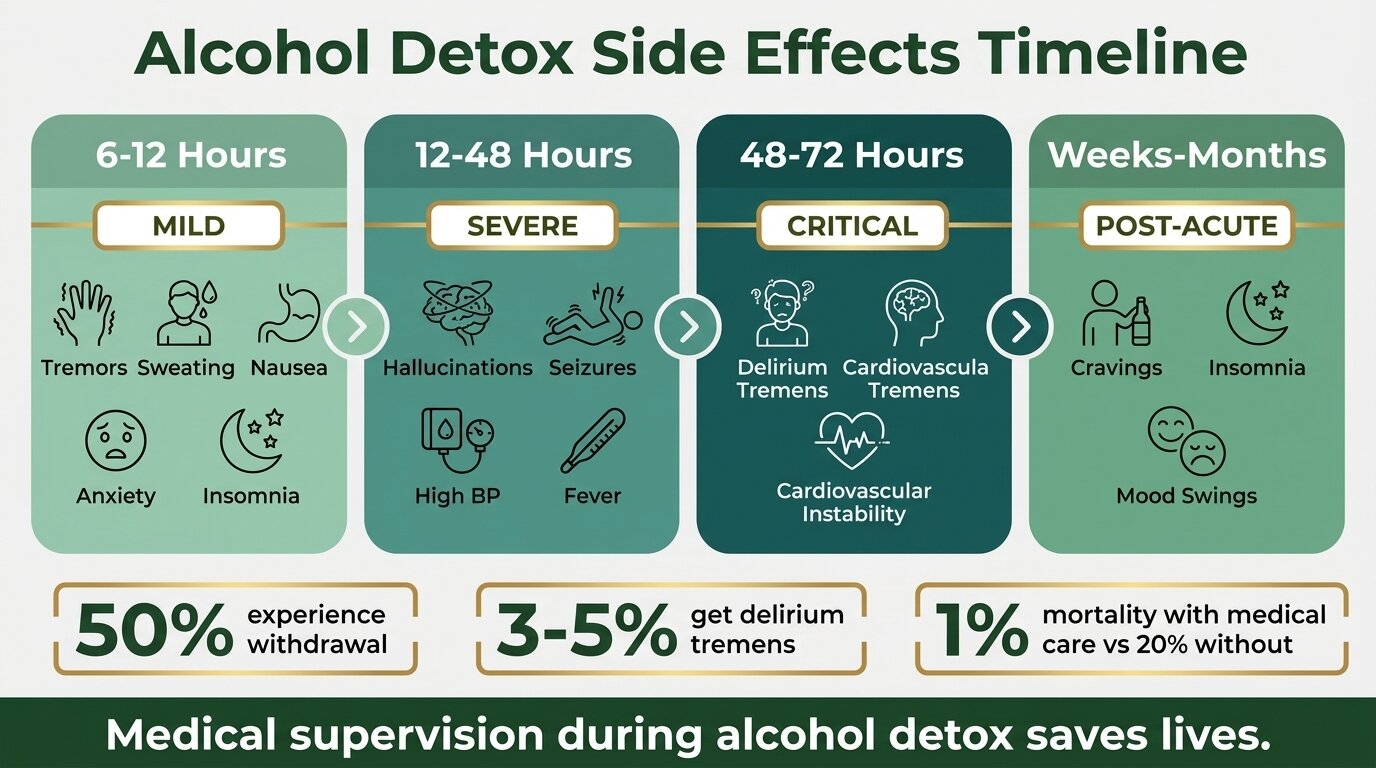
- Approximately half of people who suddenly stop heavy drinking will experience some form of withdrawal, and 3–5% of those progress to the most dangerous stage: delirium tremens.
- The acute withdrawal window runs roughly 6–72 hours after your last drink, with seizure risk peaking between 8 and 48 hours.
- Post-acute withdrawal symptoms — anxiety, poor sleep, cravings, difficulty concentrating — can persist for weeks or months, and they’re a major reason people relapse.
- Medical detox doesn’t eliminate side effects, but it manages the dangerous ones so your body can stabilise safely. At One Step, most clients detox on-site under medical supervision.
Alcohol detox has real side effects — some uncomfortable, some dangerous, and a few potentially fatal. That’s not a scare tactic; it’s the medical reality of what happens when a brain that’s adapted to daily alcohol suddenly goes without it. Approximately half of people who abruptly stop or reduce heavy drinking will develop alcohol withdrawal syndrome (Canver et al., StatPearls, 2024). The side effects vary enormously — from a rough few days of shaky hands and insomnia to a medical emergency — and understanding what’s coming is the first step toward getting through it safely. If you’re considering alcohol treatment in Thailand, knowing exactly what detox involves helps you prepare for the process rather than fear it.
What Actually Causes Side Effects During Alcohol Detox?
Alcohol detox side effects are caused by your brain’s sudden loss of a chemical it had adapted to depend on. Alcohol enhances the brain’s inhibitory system (GABA) and suppresses its excitatory system (glutamate). When alcohol is removed, both systems are thrown out of balance — too little inhibition, too much excitation — producing the tremors, anxiety, and potentially seizures that define withdrawal (Jesse et al., Acta Neurol Scand, 2017).
Think of it as your brain running with the brakes off. Alcohol was pressing the brake pedal for months or years. Your brain compensated by pressing harder on the accelerator. Remove the brakes, and the accelerator is still floored. That imbalance is what produces every side effect on this list — from mild hand tremors to full-blown seizures.
The severity depends on several factors: how heavily you drink, how many years you’ve been drinking, whether you’ve gone through withdrawal before, your overall health, and whether you have a history of seizures. Previous withdrawal episodes are especially significant — each one makes the next worse through a phenomenon researchers call the kindling effect (Trevisan et al., Alcohol Health Res World, 1998).
What Are the Early Side Effects of Alcohol Detox?
Early alcohol detox side effects begin 6–12 hours after the last drink and include anxiety, hand tremors, nausea, sweating, insomnia, and rapid heartbeat. These are the mildest symptoms, but they are still physically unpleasant and often the stage where people give up and drink again to stop the discomfort (Canver et al., StatPearls, 2024).
Here’s what that first window typically looks like:
6–12 hours after the last drink
- Anxiety and restlessness — often the first sign, ranging from background unease to full-blown panic. Your brain’s excitatory system is starting to overfire without alcohol to dampen it.
- Hand tremors — mild shaking that worsens when you extend your fingers. This is the symptom most people recognise as “the shakes.”
- Nausea and vomiting — your gut is reacting to the same chemical imbalance. Some people also experience diarrhoea.
- Sweating — particularly at night. Profuse sweating that soaks through clothing is common, even if the room is cool.
- Insomnia — difficulty falling and staying asleep, often lasting well beyond the acute withdrawal phase. Research shows that 52% of people in early abstinence experience insomnia (Bahji et al., J Stud Alcohol Drugs, 2022).
- Rapid heart rate — your cardiovascular system is responding to the surge in excitatory brain activity.
- Headache — usually throbbing, often mistaken for a hangover in the first few hours.
For people with mild alcohol dependence, these may be the only symptoms they experience, and they typically peak within 24–48 hours. But for heavy, long-term drinkers, these early symptoms are often just the beginning.
What Are the Moderate to Severe Side Effects?
Moderate to severe alcohol detox side effects emerge 12–48 hours after the last drink and can include hallucinations, significant blood pressure spikes, fever, and withdrawal seizures. This is the window where detox becomes medically dangerous and where unsupervised withdrawal can turn fatal (Jesse et al., Acta Neurol Scand, 2017).
12–48 hours: The danger zone
- Hallucinations — visual, auditory, or tactile hallucinations occur in 3–10% of people during severe withdrawal (Trevisan et al., Alcohol Health Res World, 1998). Unlike delirium tremens, the person is usually aware the hallucinations aren’t real. Visual hallucinations are the most common — people report seeing insects, shadows, or moving shapes.
- Seizures — more than 90% of alcohol withdrawal seizures occur within 48 hours of the last drink (Trevisan et al., Alcohol Health Res World, 1998). They’re typically generalised tonic-clonic seizures (the full-body convulsion type) and can occur without warning. A seizure during withdrawal quadruples the mortality rate (Jesse et al., Acta Neurol Scand, 2017).
- High blood pressure and fever — systolic blood pressure can spike significantly, and body temperature may rise above 38°C (100.4°F). Both are signs that the nervous system is in overdrive.
- Severe agitation — beyond normal anxiety, this involves intense physical restlessness and inability to sit still, sometimes accompanied by confusion.
| Timeframe | Common side effects | Risk level |
|---|---|---|
| 6–12 hours | Anxiety, tremors, nausea, sweating, insomnia, headache, rapid heartbeat | Mild to moderate — uncomfortable but not usually dangerous |
| 12–24 hours | Worsening of all early symptoms, possible hallucinations | Moderate — medical monitoring recommended |
| 24–48 hours | Peak seizure risk, high blood pressure, fever, severe agitation | High — medical supervision essential |
| 48–72 hours | Delirium tremens risk peaks, confusion, cardiovascular instability | Highest — can be life-threatening without medical care |
| 5–7 days | Most acute symptoms resolving, lingering anxiety, sleep disruption | Decreasing — ongoing monitoring still recommended |

What Is Delirium Tremens and Who Gets It?
Delirium tremens (DTs) is the most severe and life-threatening form of alcohol withdrawal, affecting approximately 3–5% of people who develop withdrawal syndrome. It typically begins 48–72 hours after the last drink and involves severe confusion, agitated hallucinations, dangerous cardiovascular instability, and high fever. Without treatment, the mortality rate is historically as high as 20%; with modern medical care, it drops to around 1% (Canver et al., StatPearls, 2024).
DTs are different from earlier hallucinations in a critical way: the person is deeply confused and does not know the hallucinations aren’t real. They may become combative, pull out IV lines, or attempt to leave. The cardiovascular system can become dangerously unstable — blood pressure and heart rate can fluctuate wildly, and cardiac arrhythmias are possible.
Risk factors for developing delirium tremens include:
- History of previous DTs or withdrawal seizures
- Drinking heavily for many years
- Being over 40
- Concurrent medical illness or infection
- Previous detox attempts (the kindling effect — each withdrawal increases severity)
- More than 48 hours since last drink with ongoing symptoms
This is the reason alcohol detox is considered the most medically dangerous of all substance withdrawals. Opioid withdrawal is miserable but rarely fatal. Alcohol withdrawal can kill. That single fact is why medical supervision during alcohol detox isn’t optional for heavy drinkers — it’s the difference between discomfort and a medical emergency.
“The unpredictability of alcohol withdrawal is what makes it so dangerous. Someone who’s had a mild withdrawal before can have a severe one the next time — especially if they’ve been through multiple detox episodes. Each round of withdrawal can sensitise the brain, lowering the threshold for seizures. This is why we always assess withdrawal history before starting detox, and why we monitor closely even when the initial presentation looks mild.”
Dr. Worapakthorn KongpesalaphunConsultant Psychiatrist, One Step Rehab
What Side Effects Continue After the Acute Phase?
Post-acute withdrawal syndrome (PAWS) produces symptoms — including anxiety, insomnia, difficulty concentrating, irritability, and alcohol cravings — that can persist for 4–6 months or longer after acute detox is complete. These lingering effects are a primary driver of relapse because they erode the motivation and mental clarity that early recovery demands (Bahji et al., J Stud Alcohol Drugs, 2022).
Most people expect detox to be the hard part and assume that once they get through the first week, they’re done. The reality is less straightforward. While the physical danger ends within 5–7 days, your brain is still recalibrating for months.
Common post-acute side effects include:
- Sleep disruption — 52% of people in early abstinence experience insomnia, with 33% experiencing prolonged insomnia through the first five months (Bahji et al., J Stud Alcohol Drugs, 2022)
- Anxiety and mood swings — mood and anxiety symptoms are most pronounced during the first 3–4 months of sobriety
- Anhedonia — difficulty feeling pleasure. Nearly 20% of people in early recovery report this, and it’s most severe in the first 30 days
- Cravings — most intense during the first 3 weeks, but they can resurface for months, often triggered by stress, social situations, or environmental cues
- Cognitive difficulties — problems with memory, attention, and decision-making that gradually improve but can persist for weeks
Understanding that post-acute withdrawal is real — not laziness, weakness, or “just being in a bad mood” — is critical. For a broader look at the entire withdrawal process, including what to expect day by day, see our guide to alcohol detox and withdrawal. These are neurological symptoms with a biological basis. They resolve, but they take time, and they’re a legitimate reason to stay in a structured treatment environment rather than white-knuckling through early sobriety alone.
Worried about what detox will feel like? Talk to our team — we’ll tell you exactly what to expect based on your situation.

How Does Medical Detox Manage These Side Effects?
Medical detox manages alcohol withdrawal side effects through structured monitoring and medication — most commonly benzodiazepines — that replace some of alcohol’s calming effect on the brain while it readjusts. This doesn’t eliminate all symptoms, but it prevents the dangerous ones (seizures, delirium tremens, cardiovascular collapse) and significantly reduces the severity of the uncomfortable ones (Canver et al., StatPearls, 2024).
The standard approach involves:
Assessment and monitoring
Medical teams use validated scoring tools to track withdrawal severity over time. Rather than giving the same dose to everyone, modern protocols adjust medication based on how the person is actually responding — a symptom-triggered approach that results in less total medication used and shorter treatment duration.
Medication
Benzodiazepines (such as diazepam or chlordiazepoxide) are the first-line treatment. They work on the same GABA receptors that alcohol affects, easing the brain’s excitatory overdrive. Doctors may also prescribe anti-nausea medication, thiamine (vitamin B1) to prevent neurological complications, and other medications to manage specific symptoms like high blood pressure or insomnia.
Hydration and nutrition
Chronic heavy drinking depletes electrolytes, vitamins, and minerals. Detox protocols include IV fluids when needed and nutritional supplementation — particularly thiamine, folate, and magnesium, which are commonly deficient in people with alcohol dependence.
| Factor | Medical detox | Unsupervised (at home) |
|---|---|---|
| Seizure risk | Managed with medication; emergency response immediately available | No medication; seizure can occur without warning when alone |
| Delirium tremens | Caught early through monitoring; treated before it escalates | May not be recognised; can become fatal without intervention |
| Comfort | Symptoms reduced with medication; significantly more tolerable | Full intensity; often unbearable, leading to drinking to stop symptoms |
| Completion rate | Higher — medical support and structured environment reduce dropout | Lower — discomfort and cravings frequently lead to resuming drinking |
| Transition to treatment | Direct pathway into rehab programme | No structured follow-up; gap between detox and treatment |
How Does One Step Handle Alcohol Detox?
At One Step, most clients with alcohol dependence detox on-site as part of their residential programme. The detox phase is integrated with the rehab programme — you’re not in a separate medical unit waiting to “qualify” for therapy. From day one, you have access to the full clinical team, group sessions, and the daily structure of our structured treatment programme that makes early sobriety manageable.
Here’s what that looks like in practice:
- Medical assessment on arrival — our visiting psychiatrist reviews your drinking history, previous withdrawal episodes, and any co-occurring medical or mental health conditions. This determines your detox protocol.
- Symptom monitoring — regular medical check-ins throughout the acute withdrawal window. Medication is adjusted based on how you’re actually responding, not a fixed schedule.
- Medication management — prescribed medications to manage withdrawal symptoms, reduce seizure risk, and address nutritional deficiencies. Medication costs are billed separately from the programme fee (approximately ฿280,000/month, ~$8,500 USD).
- Structured daily routine — even during detox, you follow the daily schedule as much as your condition allows. Morning meditation, group therapy, physical activity, meals at set times. Structure helps stabilise your nervous system faster than lying in a room alone.
- Integrated therapy — you don’t wait until detox is “complete” to start therapeutic work. CBT and DBT techniques, group process, and individual counselling begin alongside medical stabilisation.
For clients with severe alcohol dependence — particularly those with a history of withdrawal seizures or delirium tremens — we may detox you first at our partner hospital, which has intensive and intermediary intensive care units, before you transfer to One Step for the rehab programme. This applies to a small percentage of clients who need ICU-level monitoring that a residential rehab can’t safely provide.
The programme fee does not include medication prescribed during your stay, flights, visas, or personal expenses. For a full breakdown, see our pricing page. What the fee does cover: accommodation, all therapy sessions (individual and group), activities and excursions, meals, and 12 months of aftercare after discharge.

Can You Reduce the Side Effects of Alcohol Detox?
You cannot eliminate alcohol detox side effects entirely, but their severity can be significantly reduced through medical supervision, proper nutrition, hydration, and — critically — not attempting to detox alone if you’re a heavy or long-term drinker. The single most effective way to reduce side effects is to detox under medical care where symptoms are monitored and treated as they emerge.
Beyond medical management, several factors make a meaningful difference:
- Don’t try to taper on your own. Self-managed tapering (gradually reducing your drinking) rarely works as planned. The pull to drink more is too strong once alcohol is in your system, and miscalculating the taper can still trigger severe withdrawal.
- Nutrition matters more than you think. Heavy drinking depletes B vitamins, magnesium, and electrolytes. Nutritional support during detox — especially thiamine supplementation — reduces neurological complications. For more on how nutrition supports recovery, see our post on the dopamine diet and addiction recovery.
- Stay hydrated. Sweating, vomiting, and diarrhoea during withdrawal cause significant fluid loss. Water and electrolyte drinks help, but severe dehydration may need IV fluids.
- Physical activity when you’re able. Light movement — a walk, stretching, gentle yoga — can help manage anxiety and aid sleep once the acute phase passes. At One Step, physical activity is built into the daily programme, including Muay Thai, swimming, and gym sessions.
- Don’t go through repeated withdrawals. The kindling effect means each withdrawal episode sensitises your brain to have worse symptoms the next time. If you’ve attempted detox before and relapsed, getting proper residential treatment rather than cycling through more withdrawals is one of the most important things you can do for your long-term health.
When Do Alcohol Detox Side Effects Become a Medical Emergency?
Alcohol detox side effects become a medical emergency when seizures occur, when confusion deepens into delirium (the person doesn’t know where they are or what’s real), when body temperature rises above 38.5°C (101.3°F), or when the heart rate or blood pressure becomes dangerously unstable. Any of these require immediate medical attention — not a “wait and see” approach.
Seek emergency medical help if you or someone you’re with experiences:
- A seizure of any kind
- Confusion, disorientation, or inability to recognise familiar people
- Hallucinations that the person believes are real
- Fever above 38.5°C (101.3°F)
- Chest pain or irregular heartbeat
- Uncontrollable shaking or agitation
- Loss of consciousness
This isn’t exhaustive, and it’s not a substitute for medical assessment. The point is simple: alcohol withdrawal can escalate quickly and unpredictably. If you’re detoxing at home and something feels seriously wrong, don’t wait. The consequences of over-reacting are minimal. The consequences of under-reacting can be fatal.
Frequently Asked Questions About Alcohol Detox Side Effects
Common questions about what to expect during alcohol detoxification.
Acute alcohol withdrawal symptoms typically begin 6–12 hours after the last drink, peak around 24–72 hours, and resolve within 5–7 days for most people. However, post-acute withdrawal symptoms — including anxiety, insomnia, and cravings — can persist for weeks to months. The total timeline depends on the severity of dependence and individual health factors.
Yes. Alcohol withdrawal can be fatal, primarily from seizures, delirium tremens, or cardiovascular collapse. Historically, the mortality rate for delirium tremens was as high as 20%. With modern medical treatment, it drops to around 1%. This is why medical supervision during detox is strongly recommended for anyone with heavy or prolonged alcohol dependence.
For people with mild alcohol dependence and no history of seizures or complicated withdrawal, home detox may be safe with medical guidance. For heavy, long-term drinkers or anyone with previous withdrawal complications, home detox carries serious risks. Seizures can occur without warning, and delirium tremens requires immediate medical intervention that isn’t available at home.
Benzodiazepines (such as diazepam or chlordiazepoxide) are the first-line treatment for alcohol withdrawal. They calm the same brain receptors that alcohol affects, reducing seizure risk and easing anxiety. Doctors may also prescribe thiamine (vitamin B1) to prevent neurological damage, anti-nausea medication, and blood pressure medication depending on individual symptoms.
Yes. A phenomenon called the kindling effect means that each episode of alcohol withdrawal can sensitise the brain, making subsequent withdrawals more severe. People who have gone through multiple detox cycles are at higher risk for seizures and delirium tremens than first-time detoxers with the same drinking history. This is one reason residential treatment — not repeated unsupervised detox attempts — is recommended.
Detox is the medical process of safely withdrawing from alcohol — it addresses physical dependence and typically lasts 5–7 days. Rehab is the therapeutic programme that follows, addressing the psychological, behavioural, and social factors driving the addiction. Detox alone, without rehab, has very high relapse rates because it treats the body but not the underlying patterns. For more on what the rehab phase involves, see our complete guide to inpatient alcohol rehab.
There is no exact threshold, but withdrawal typically occurs in people who have been drinking heavily and regularly — generally more than 8 drinks per day for several weeks or longer. Duration and pattern matter as much as quantity. Even moderate drinkers who have consumed alcohol daily for years may experience mild withdrawal symptoms when they stop. If you’re unsure, consult a doctor before stopping abruptly.
Written by
Worapakthorn Kongpesalaphun, MD., Ph.D.
Dr. Worapakthorn Kongpesalaphun is a Thai Licensed Medical Doctor and Expert in Preventive Medicine (Community Mental Health) with extensive experience in addiction treatment and public health management. He holds multip...
Learn more about Worapakthorn