

Key Takeaways
- No — detox centres don’t treat every addiction the same way. The medical risk profile is completely different for alcohol, benzodiazepines, and opioids than it is for cocaine, meth, ketamine, or cannabis.
- Three substances require medical detox: alcohol, benzodiazepines, and opioids. Stopping any of these abruptly can trigger seizures, delirium, or severe physical illness.
- Stimulants, ketamine, and cannabis need supportive detox, not medical detox. Withdrawal is rough psychologically but not life-threatening — no medication taper required.
- Behavioural addictions (gambling, gaming, sex, food) don’t involve detox at all. There’s no substance to clear from the body. Treatment is psychological from day one.
- At One Step, we handle alcohol, opioid, and benzo detox on-site for moderate cases. Severe withdrawal goes to our partner hospital first — which has intensive and intermediary intensive care units — before transfer to us for the rehab programme.
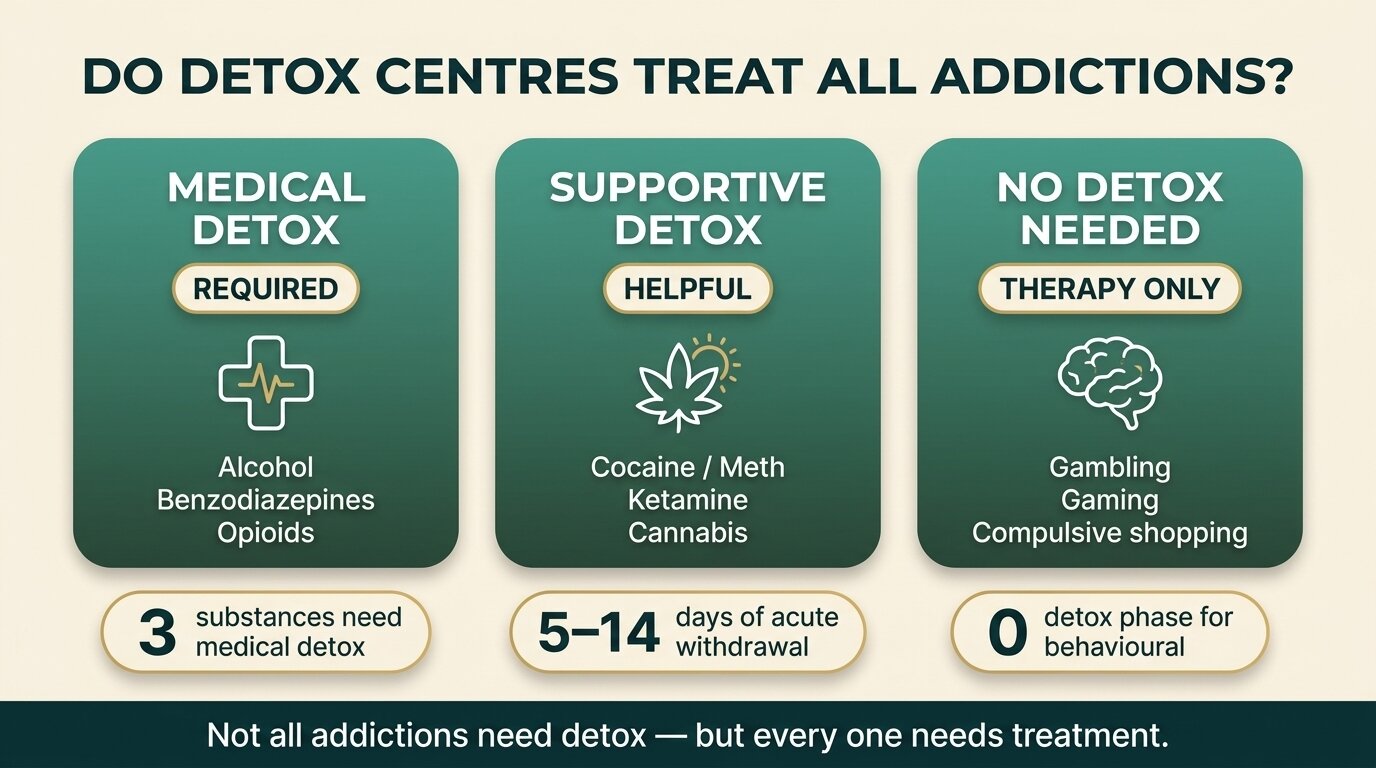
No. Detox centres do not treat every addiction the same way, because not every addiction needs medical detox. Alcohol, benzodiazepines, and opioids carry real withdrawal risks — seizures, delirium, severe physical illness — and need medical management. Cocaine, methamphetamine, ketamine, and cannabis cause unpleasant but not dangerous withdrawal; they need supportive care, not medication-managed detox. Behavioural addictions like gambling have no detox phase at all (NIDA, 2024). Understanding which category your situation falls into is the first step in choosing the right level of care.
Which Addictions Actually Need Medical Detox?
Medical detox — withdrawal managed with medication and clinical oversight — is medically necessary for three substance categories: alcohol, benzodiazepines (Xanax, Valium, Klonopin), and opioids (heroin, oxycodone, fentanyl). Stopping these abruptly can cause seizures, delirium tremens, dangerous blood pressure spikes, or severe physical illness. Stimulants, cannabis, and dissociatives cause distressing but not life-threatening withdrawal.
The distinction matters because it changes what kind of facility you need. A treatment centre that markets itself as “treating all addictions” is technically true at the rehab level, but at the detox stage, the medical reality varies sharply by substance.
| Substance | Detox Type Needed | Main Risk Without It |
|---|---|---|
| Alcohol | Medical detox (benzodiazepines, vitamins, monitoring) | Seizures, delirium tremens, death |
| Benzodiazepines | Medical detox (slow cross-taper) | Seizures, psychosis, prolonged severe anxiety |
| Opioids | Medical detox (buprenorphine or methadone taper) | Severe physical illness, dehydration, relapse-overdose risk |
| Cocaine / Meth | Supportive detox (rest, nutrition, psych support) | Depression, suicidal thoughts (psychological, not medical) |
| Ketamine | Supportive detox | Mood crash, anxiety, intense cravings |
| Cannabis | Supportive detox | Irritability, insomnia, appetite loss |
| Gambling / behavioural | None — therapy from day one | N/A (no physical withdrawal) |

Why Do Alcohol, Benzos, and Opioids Need Medical Detox?
Alcohol, benzodiazepines, and opioids change how your brain regulates itself. With alcohol and benzos, the brain compensates by reducing its own calming GABA activity. Stopping suddenly leaves the nervous system unbraked — that’s what causes seizures and delirium tremens. Opioid withdrawal isn’t usually fatal on its own, but the symptoms are severe enough that most people relapse to stop the suffering, with overdose risk.
For alcohol, the American Society of Addiction Medicine’s clinical guideline recommends benzodiazepine-based withdrawal management with symptom monitoring; severe cases need inpatient care to prevent seizures and delirium (Lindsay et al., J Addict Med, 2020). For benzodiazepines, a 2025 joint clinical guideline confirms that anyone who has taken them daily for more than a month should never stop abruptly — a slow taper over weeks to months is standard (Brunner et al., J Gen Intern Med, 2025). For opioids, medical detox using buprenorphine or methadone is the evidence-based approach, both to manage symptoms and to bridge into longer-term treatment.
The point isn’t that these substances are “worse” addictions. It’s that the physical withdrawal phase carries real medical risk and needs proper management. You can read more about what a structured addiction detox in Thailand actually involves, or specifically about alcohol detox and withdrawal if that’s the relevant substance.
The mistake I see most often is people thinking detox difficulty equals addiction severity. It doesn’t. A daily cocaine user has a serious addiction but a relatively safe withdrawal. A person on prescribed benzodiazepines for two years can have a low-key social life and still face seizures if they stop without supervision. The medical risk lives in the substance’s pharmacology, not the person’s behaviour.
Dr. Worapakthorn KongpesalaphunConsultant Psychiatrist, One Step Rehab

What About Cocaine, Meth, Ketamine and Cannabis?
Stimulants, ketamine, and cannabis produce real withdrawal — exhaustion, depression, sleep disruption, cravings, irritability — but they don’t trigger seizures, delirium, or organ failure. No FDA-approved medication exists for stimulant withdrawal, and clinical reviews confirm there are no consistent physiological disruptions that require a medical taper (SAMHSA TIP 33, 2021). What helps is sleep, food, structure, and someone watching for the depression that often hits hard in week one.
Cocaine and methamphetamine withdrawal follows a predictable pattern: a “crash” lasting a few days (heavy sleep, low mood, big appetite), then 2–4 weeks of low motivation and intermittent cravings. Methamphetamine withdrawal tends to last longer than cocaine’s. Suicidal thoughts during this phase are common and clinically significant — they need monitoring, not because the body is at medical risk, but because the brain’s reward system has temporarily flatlined (Li et al., Addiction, 2022).
Cannabis withdrawal is now a recognised DSM-5 diagnosis. The dominant symptoms are irritability, anxiety, sleep problems, and appetite loss, peaking within the first week. First-line management is supportive counselling and psychoeducation, not medication (Connor et al., Addiction, 2022). It’s miserable but it’s not dangerous.
The practical implication: someone detoxing from cocaine doesn’t need an ICU. They need a quiet bedroom, decent food, and access to a counsellor when the depression hits. A residential rehab handles this fine — there’s no medical case for hospitalisation.

Do Behavioural Addictions Like Gambling Need Detox?
No. Behavioural addictions — gambling, gaming, sex, compulsive shopping, food — don’t involve a substance leaving the body, so there’s no detox phase. Gambling disorder is the only behavioural addiction formally recognised in DSM-5 alongside substance use disorders, and treatment is psychological from day one (Clark, Ann N Y Acad Sci, 2014).
People recovering from compulsive gambling or sex addiction often describe something that feels like withdrawal: irritability, restlessness, low mood, intense urges. That’s real — the brain’s dopamine system is recalibrating — but it’s not a medical event. There’s nothing to flush out, no medication to taper, no seizure risk. What’s needed is the same thing that works for substance addiction at the therapy stage: CBT, group work, relapse prevention skills, and structure. Our overview of how CBT and DBT work in addiction recovery covers the therapeutic approaches that apply equally to substance and behavioural addictions.
If a “detox centre” claims to detox you from gambling, that’s a marketing label, not a medical service. What they’re actually providing is residential rehab without a substance withdrawal phase.
Not sure which kind of detox you need? Talk to our team — we’ll tell you straight, including if a different level of care would serve you better.
What Does One Step Treat — and What Goes to the Partner Hospital?
One Step is a residential rehab in Chiang Mai that handles standard detox on-site as part of the programme. For most clients — including moderate alcohol, opioid, and benzodiazepine dependence — detox happens at our facility with medication support, regular medical check-ins from our visiting psychiatrist, and full-time clinical staff. Severe cases get medical stabilisation first at our partner hospital, then transfer to us for the rehab programme.
Here’s how we sort cases at intake:
| Situation | Where Detox Happens |
|---|---|
| Moderate alcohol dependence (no DT history, no seizure history) | On-site at One Step with medication and medical check-ins |
| Severe alcohol dependence (heavy daily drinking, prior DTs or withdrawal seizures) | Our partner hospital first — which has intensive and intermediary intensive care units — then transfer to One Step for the rehab programme |
| Opioid dependence (heroin, oxycodone, fentanyl) | On-site for most cases with medication support; severe medical complications go to our partner hospital first |
| Benzodiazepine dependence | On-site for most cases with a structured taper; long-term high-dose users or those with seizure history go to our partner hospital first |
| Cocaine, methamphetamine, ketamine, cannabis | On-site — supportive care, no medical detox needed |
| Behavioural addictions (gambling, gaming, sex) | Straight into the residential treatment programme — no detox phase |
The programme runs around ฿280,000/month (~$8,500 USD). That covers your room, food, therapy sessions, group work, and the structured daily schedule. What it doesn’t cover: medication prescribed by the doctor (you pay for what’s actually prescribed), flights, visa fees, hospital visits, additional counselling sessions, and personal items. If your case requires the medical detox stay at our partner hospital before transferring to us, those hospital costs are also separate. Full details on the pricing page.
For severe alcohol, benzodiazepine, or opioid withdrawal, we may detox you first at our partner hospital — which has intensive and intermediary intensive care units — before you transfer to One Step for the rehab programme. This isn’t a fallback; it’s the safe pathway when ICU-level monitoring is medically indicated. The partner-hospital step typically takes 5–10 days depending on the substance and severity, then you join the residential programme for the bulk of your stay.

How Do You Know What Level of Detox You Need?
The answer depends on three factors: which substance, how much, and for how long. Daily heavy alcohol use for years requires more medical caution than weekend binges. Long-term prescribed benzodiazepine use almost always needs a structured taper. Stimulant and cannabis use, even daily, rarely needs medical intervention. An honest intake assessment looks at history, daily quantity, last use, and any prior withdrawal complications.
Some signals that you need a medically-monitored detox, not a supportive one:
- Prior history of alcohol withdrawal seizures or delirium tremens
- Daily drinking of significant quantities for months or years
- Daily benzodiazepine use for more than 4–6 weeks at therapeutic or higher doses
- Daily opioid use with physical dependence (waking up sick, needing a dose to function)
- Co-occurring serious medical conditions (heart, liver, seizure disorder)
- Pregnancy
If none of those apply and your substance is a stimulant, dissociative, or cannabis, you’re almost certainly not in a medical-detox category — but you still benefit from a structured environment to get through the rough psychological phase without relapsing. That’s what residential rehab provides, with or without medical detox attached. You can compare the trade-offs in our piece on inpatient versus outpatient rehab.
If you or someone you love is struggling with substance dependence, explore how a drug addiction treatment programme can provide the structure, clinical support, and environment needed for lasting recovery.
Frequently Asked Questions
Common questions about which addictions need detox and what to expect from a detox centre.
If you’ve been drinking heavily and daily for an extended period, no — stopping suddenly without medical support can trigger seizures or delirium tremens, both of which can be fatal. Light or moderate drinkers can often quit safely, but if you wake up shaking, sweating, or anxious, that’s withdrawal and you need medical management.
Cocaine withdrawal isn’t medically dangerous in the way alcohol or benzodiazepine withdrawal is — no seizures, no organ failure. The risk is psychological: severe depression and suicidal thoughts during the first 1–2 weeks. Supportive care in a structured setting handles this well, but you shouldn’t go through it alone.
Some people do, with a doctor’s supervision. The problem is that benzodiazepine tapers take weeks to months, and most people in active addiction can’t manage the discipline of a slow taper while also having ongoing access to the drug. A structured detox setting removes that variable and adds clinical monitoring for withdrawal complications.
People stopping compulsive gambling often experience irritability, restlessness, low mood, and intense urges that feel like withdrawal. There’s no physical substance leaving the body though — the brain’s dopamine reward system is recalibrating. It’s a psychological adjustment, not a medical one, and there’s no need for detox medication.
Alcohol detox is typically 5–7 days. Opioid detox is 5–10 days for the acute phase. Benzodiazepine detox is the longest — weeks to months because of the gradual taper required. Stimulant and cannabis “detox” doesn’t have a medical phase, but the rough psychological symptoms last 1–4 weeks depending on the substance.
No. NIDA is explicit that detox is only the first stage of treatment — it gets the substance out of your system but doesn’t address the patterns and triggers that drive addiction. People who detox without follow-up treatment relapse at high rates. Detox should always be the entry point to a structured rehab programme, not a standalone solution.
A detox centre handles the withdrawal phase only — typically 5–14 days of medical stabilisation. A residential rehab includes detox plus the longer therapeutic programme that follows: counselling, group therapy, relapse prevention, and structured living. Most clients need both, which is why facilities like One Step combine them under one programme.
Written by
Worapakthorn Kongpesalaphun, MD., Ph.D.
Dr. Worapakthorn Kongpesalaphun is a Thai Licensed Medical Doctor and Expert in Preventive Medicine (Community Mental Health) with extensive experience in addiction treatment and public health management. He holds multip...
Learn more about Worapakthorn