

Key Takeaways
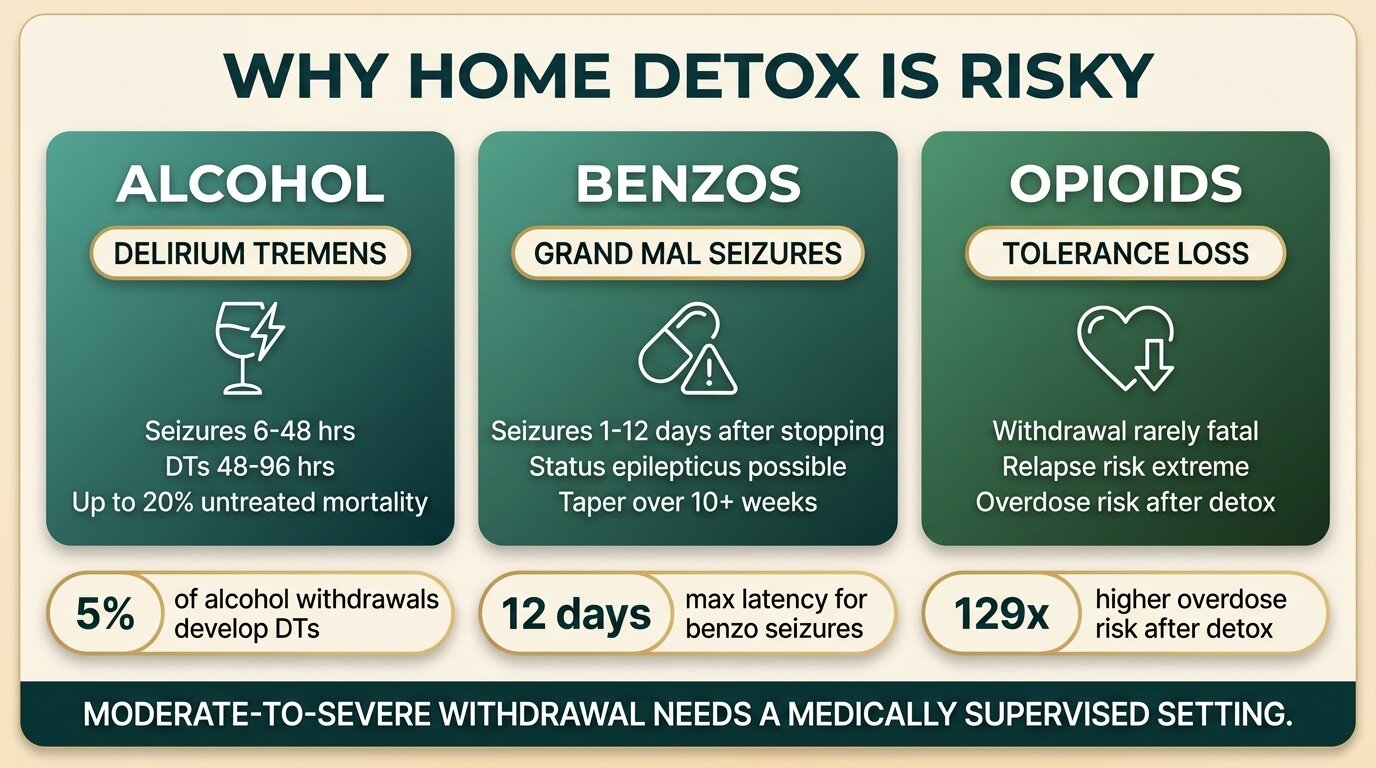
- Severe alcohol withdrawal kills. Delirium tremens occurs in around 5% of alcohol withdrawal cases and carries a 1-4% mortality rate even with hospital treatment, climbing as high as 15-20% when left untreated (Schuckit, NEJM, 2014).
- Stopping benzodiazepines abruptly can cause grand mal seizures 1-12 days after the last dose. Tapering over weeks is medically necessary — leftover prescriptions and folk-remedy plans are not substitutes (Brett & Murnion, Aust Prescr, 2015).
- Opioid home detox is the most lethal kind — not because withdrawal kills you, but because lost tolerance does. Overdose risk is 129 times higher in the two weeks after detox compared with the general population (Joudrey, Addict Sci Clin Pract, 2019).
- The ER is reactive, not a plan. Hospitals stabilise life-threatening withdrawal but they don’t treat the underlying addiction. Medical detox does both at once.
- One Step handles standard detox on-site for alcohol, opioids, and benzodiazepines. For severe withdrawal needing ICU monitoring, we detox you first at our partner hospital — which has intensive and intermediary intensive care units — then you transfer to us for the rehab programme.
Doctors do not recommend home detox for moderate-to-severe alcohol, benzodiazepine, or opioid withdrawal because the medical risks include seizures, delirium, and overdose death. The 2020 ASAM clinical guideline lists ambulatory detox as appropriate only for mild withdrawal with no seizure history and no medical complications — anything beyond that needs a medically supervised setting (ASAM, 2020). This post explains why, substance by substance, and what medical detox actually provides that a bedroom can’t.
It is not a how-to. If you are considering quitting alcohol, benzodiazepines, or opioids, the question is not “how do I do this at home more safely” — it is “where can I do this with the right medical infrastructure.” Read on for the case.
Why Is Home Detox Medically Dangerous?
Home detox is dangerous because three of the most commonly misused substance classes — alcohol, benzodiazepines, and opioids — produce withdrawal syndromes that need active medical management. Alcohol and benzo withdrawal can kill through seizures and delirium. Opioid withdrawal is rarely fatal during the acute phase, but the resulting loss of tolerance creates a window where relapse is far more likely to be lethal.
The mechanism is different for each substance, but the conclusion is the same: an unsupervised bedroom detox swaps a manageable, monitored medical event for an unmanaged one. When something goes wrong at 3 a.m. — a seizure on the bathroom floor, a hallucination, a sudden temperature spike, a relapse with a now-toxic dose — there is no one trained to recognise it, no medication to give, and no plan beyond calling an ambulance.
The 2020 ASAM clinical practice guideline on alcohol withdrawal management states explicitly that ambulatory (outpatient) detox is suitable only for patients with mild withdrawal, no history of withdrawal seizures or delirium, no significant medical comorbidities, and reliable social support. Moderate-to-severe withdrawal, or any of those red flags, requires an inpatient setting. Most people considering home detox fall into the second group, not the first.

Why Is Alcohol Home Detox Especially Dangerous?
Alcohol home detox is dangerous because abrupt cessation in someone with moderate-to-severe alcohol use disorder can trigger withdrawal seizures within 6-48 hours and delirium tremens within 48-96 hours. Delirium tremens occurs in roughly 5% of alcohol withdrawal cases and historically carries a mortality rate of up to 15-20% when untreated — about 1-4% with proper hospital management (Schuckit, NEJM, 2014).
The 2015 review by Mirijello and colleagues in Drugs lays out the physiology: chronic heavy drinking suppresses the brain’s main excitatory system while sustaining the calming GABA system on alcohol’s behalf. When alcohol disappears, the excitatory system rebounds with nothing to balance it. The result, in severe cases, is autonomic hyperactivity (racing heart, soaring blood pressure, dangerous body temperature), seizures, and delirium tremens (Mirijello et al., Drugs, 2015).
Seizure risk peaks about a day after the last drink and is unpredictable — the first sign that home detox is going wrong is often the seizure itself. Delirium tremens comes later, two to four days in, often after the worst seemed past. People who started a home detox feeling like they could handle it are the ones who end up coding in an ambulance on day three.
Our post on alcohol detox and withdrawal covers the timeline in detail, and the post on side effects of alcohol detoxification covers what actually happens during a medically managed taper. The short version: benzodiazepines, given on a schedule tied to a CIWA-Ar withdrawal score, are first-line treatment. You cannot replicate that at home.
The “I had a few beers, I’ll be fine” miscalculation
People underestimate their own risk for two reasons. First, they remember mild hangover-style withdrawals from previous short binges and assume this one will feel the same. Second, the severity of alcohol withdrawal correlates poorly with how high-functioning the drinker looked while drinking. Executives, parents, and professionals who maintained appearances on a bottle of wine a night can land in DTs just as easily as anyone else.
| Severity | Common signs | Appropriate setting |
|---|---|---|
| Mild | Tremor, anxiety, mild sweating, insomnia, no history of seizures | Outpatient with daily medical check-ins may be appropriate |
| Moderate | Pronounced tremor, vomiting, racing heart, high blood pressure, mild confusion | Residential medical detox |
| Severe | History of withdrawal seizures, hallucinations, delirium, fever, autonomic instability | Hospital-based detox with ICU access |
Why Is Benzodiazepine Home Detox Dangerous?
Benzodiazepine home detox is dangerous because abrupt cessation after even a few months of regular use can cause grand mal seizures appearing 1-12 days after the last dose. Withdrawal can also produce prolonged anxiety, insomnia, and protracted symptoms lasting weeks to months — managed safely only through a slow taper over at least 10 weeks under medical supervision (Brett & Murnion, Aust Prescr, 2015).
Benzodiazepines (Xanax, Valium, Klonopin, Ativan, Lorazepam, and others) act on the same GABA system as alcohol. Stopping them cold is mechanically similar to stopping alcohol cold — and just as capable of producing status epilepticus, the medical term for a seizure that doesn’t stop on its own. Status epilepticus is a true emergency. People die from it.
The folk plan that keeps surfacing — “I’ll just space the doses out further and further on my own” — is the right idea executed without the right tools. Genuine tapers require a long-acting benzodiazepine (often diazepam) substituted for whatever the person was taking, then reduced in small steps. The schedule depends on the original dose, the duration of use, and how the person responds. None of that is something a non-prescriber can calibrate from their bathroom cabinet.
Our benzodiazepine addiction treatment page covers what a managed taper looks like in practice. Importantly, benzo tapers are slower than alcohol detox — usually weeks of inpatient or close outpatient supervision, not days.
Why Is Opioid Home Detox Dangerous If Withdrawal Isn’t Usually Fatal?
Opioid withdrawal itself is rarely fatal in healthy adults, but home detox is still dangerous because it produces a sharp loss of tolerance — and the person who relapses afterward at their old dose is at extreme overdose risk. One landmark study found post-release opioid overdose risk was up to 129 times higher in the first two weeks compared with the general population (Joudrey, Addict Sci Clin Pract, 2019).
The Strang et al. study in BMJ, looking specifically at people who completed inpatient opiate detox, found that completers were four times more likely to die of overdose than people who never completed detox at all. The mechanism is straightforward: tolerance to opioid-induced respiratory depression drops rapidly during a few clean days. A dose that produced a normal high a week ago now stops breathing (Strang et al., BMJ, 2003).
This is the cruellest trap of home opioid detox. Someone gets through the acute withdrawal — the days of muscle aches, vomiting, restlessness, and crawling out of their skin — feels proud, then relapses two weeks later using what they remember as a normal amount. They die in their bedroom.
Medical detox addresses both halves of the problem. The acute phase is managed with buprenorphine or methadone induction (or comfort medications and supportive care). Just as important, the aftercare phase includes maintenance medication, supervised tapering options, and the kind of structured environment that makes relapse less likely. Cochrane reviewers concluded that more research is needed on optimal settings for opioid detox, but residential treatment combined with medication is consistently associated with the lowest mortality (Day et al., Cochrane Database Syst Rev, 2005).
For more on opioid withdrawal specifically, see our cluster post on opioid withdrawal symptoms and day-by-day timeline and our opioid rehab page.
Why Does the “I’ll Just Power Through” Plan Usually Fail?
The “power through” plan usually fails because withdrawal is not a willpower problem — it is a brain chemistry problem with physical symptoms severe enough to override willpower in most people. Most home-detox attempts collapse during the worst hours of acute withdrawal, when one drink, one pill, or one bag suddenly looks like the only thing standing between the person and feeling normal again.
What the inside of a failed home detox looks like, in our experience working with people who arrived at One Step after several of them: by hour 36, the tremor and nausea are bad. The person hasn’t slept. They convince themselves “just one drink to take the edge off” is a stopgap rather than a relapse. Within an hour they are drinking again — but now ashamed, secretive, and more convinced than before that they can’t quit. The next attempt is harder, not easier.
This is not a moral failure. It is the predictable outcome of asking the part of someone’s brain that is currently in active withdrawal to make a difficult decision against the part that wants relief. Medical detox solves the problem at its source: with the right medication on the right schedule, withdrawal symptoms become bearable. The willpower question never gets asked, because the brain is no longer screaming for the substance.
People who come to us after a failed home detox almost never describe it as “I tried hard and it didn’t work.” They describe it as “I tried, I broke, and then I felt worse about myself than before I started.” Removing the physical desperation is what medical detox actually does. The willpower part of recovery comes later, after the body is stable.
Dr. Worapakthorn KongpesalaphunConsultant Psychiatrist, One Step Rehab
Not sure whether your situation needs medical detox? Talk to our team — we’ll tell you honestly whether you can manage with outpatient support or whether residential detox is the right call.

What Can’t Home Detox Provide That Medical Detox Can?
Home detox cannot provide the medical infrastructure that makes withdrawal safe: structured monitoring of vital signs and symptom severity, medications calibrated to the withdrawal stage, seizure precautions, IV fluids for dehydration, a controlled environment removed from cues and triggers, and trained staff who can recognise the difference between a hard night and a medical emergency.
Here is what residential medical detox provides that no bedroom can match:
| Component | Medical detox | Home detox |
|---|---|---|
| Vital sign monitoring | Regular checks of pulse, blood pressure, temperature, breathing | Whatever the person remembers to check |
| Symptom severity scoring | Tools like CIWA-Ar (alcohol) and COWS (opioids) used to dose medication appropriately | Guessing |
| Medication management | Benzodiazepine taper for alcohol; long-acting benzo taper for benzo dependence; buprenorphine or methadone induction for opioids | Whatever is in the medicine cabinet, which is usually nothing |
| Seizure response | Trained staff, IV access, anticonvulsants on hand, hospital transfer available | A 999 call and however long the ambulance takes |
| Hydration and nutrition | IV fluids if needed, supervised eating, thiamine and electrolytes for chronic drinkers | Whatever the person manages to keep down |
| Environment | Removed from the substance, the people, and the places associated with using | Same house, same people, same triggers |
| Sleep | Quiet ward, sleep medication when appropriate | Three nights without sleep is normal during alcohol withdrawal |
CIWA-Ar (Clinical Institute Withdrawal Assessment for Alcohol, Revised) and COWS (Clinical Opiate Withdrawal Scale) are not exotic clinical tools — they are simple structured questionnaires that quantify how bad the withdrawal is so medication can be dosed correctly. They are the bare minimum of what a detox setting should be doing. A person at home has no way to score themselves objectively, which is exactly why people in home detox routinely under-medicate or over-medicate with whatever they have on hand.
Do the Folk Remedies for Home Detox Work?
The common folk remedies for home detox — B-vitamins, “lots of water and rest,” tapering with leftover pills, or switching to a “safer” drug — do not work as substitutes for medical detox in moderate-to-severe dependence. Each has a kernel of truth that has been stretched into a dangerous misconception. Below, briefly, why each one fails.
B-vitamins (especially thiamine). Chronic heavy drinkers do need thiamine — deficiency causes Wernicke-Korsakoff syndrome, a serious neurological condition. But thiamine prevents one specific complication; it does not prevent or treat withdrawal seizures, delirium tremens, or autonomic instability. Taking a multivitamin during a home alcohol detox is harm reduction, not safety.
“Lots of water and rest.” Severe alcohol withdrawal can produce sweating, vomiting, fever, and racing heart that dehydrate the body far faster than oral fluids can replace. People in severe withdrawal often cannot keep water down at all. The “rest” part is similarly aspirational — withdrawal insomnia is brutal and lasts for days.
Tapering with leftover prescriptions. A handful of expired Xanax or Valium is not a medically calibrated taper. The doses are wrong, the schedule is wrong, the drug interactions are unknown, and the person is making clinical decisions about their own withdrawal — the worst possible moment for clinical decision-making.
Switching to a “safer” drug. Some people try to ease alcohol withdrawal with cannabis, kratom, or borrowed benzodiazepines. None of these are designed for withdrawal management; some (borrowed benzos especially) can cause secondary dependence; and none address the underlying alcohol use disorder. Two months later the person has two problems instead of one.
“I’ll just go to the gym and sweat it out.” Withdrawal is not a hangover. Vigorous exercise during severe alcohol withdrawal can stress an already strained cardiovascular system and is dangerous, not helpful.
Should I Just Go to the Emergency Room If Withdrawal Gets Bad?
Going to the emergency room for severe withdrawal is the right move once symptoms are dangerous — but it is reactive, not preventive. Emergency departments stabilise the immediate crisis (seizures, dehydration, delirium) but they discharge people back into the same situation that caused the crisis, usually within 24-48 hours, with no treatment plan for the underlying substance use disorder.
The ER cycle is a real pattern. People in heavy alcohol or benzo dependence sometimes end up in emergency departments multiple times — admitted, stabilised on benzodiazepines, discharged, drinking again within days, back in the ER within weeks. Each episode is a separate medical event rather than a treatment plan. Emergency medicine is excellent at acute stabilisation. It is not designed to treat addiction.
Medical detox is the opposite shape: proactive rather than reactive. The withdrawal is managed before it becomes a crisis, and the detox flows directly into a rehab programme that addresses why the substance use began in the first place. That is the difference between surviving withdrawal and beginning recovery.
When Is Residential Detox the Appropriate Option?
Residential detox is the appropriate option for anyone with moderate-to-severe alcohol use disorder, any meaningful level of benzodiazepine dependence, opioid dependence without an existing medication-assisted treatment prescriber, polysubstance use, a history of failed home detox, or a history of withdrawal seizures. These are the populations the ASAM guidelines specifically exclude from ambulatory management (ASAM, 2020).
If any of the following describes the person considering detox, residential medical detox is the appropriate level of care:
- Drinking heavily every day for months or longer
- Any history of withdrawal seizures or delirium during a previous attempt to stop
- Daily benzodiazepine use at meaningful doses (typically 1mg+ Xanax-equivalent, or any prescribed dose used for more than a few months)
- Opioid dependence without an existing buprenorphine or methadone prescriber
- Polysubstance use (e.g., alcohol plus benzos, or opioids plus benzos)
- Significant medical comorbidities — heart disease, liver disease, uncontrolled diabetes, pregnancy
- Previous failed home detox attempts
- No stable home environment, or a home environment full of triggers
The “I should be able to handle this myself” instinct is understandable. It is also the single most common reason people end up in the ER on day three. Choosing residential detox is not weakness — it is calibrating the intervention to the size of the problem.

How Does One Step Handle Detox?
One Step provides on-site medical detox for alcohol, opioid, and benzodiazepine dependence as the first phase of our residential rehab programme. Our consultant psychiatrist sets the medication plan, full-time clinical staff manage day-to-day care, and clients with severe withdrawal needing ICU-level monitoring detox first at our partner hospital — which has intensive and intermediary intensive care units — before transferring to us for the rehab programme.
The infrastructure that makes detox safe at One Step:
- Medical assessment on intake. We score withdrawal severity (CIWA-Ar for alcohol, COWS for opioids) and build the detox protocol around that score, not a one-size-fits-all template.
- Medication management. Benzodiazepine taper for alcohol withdrawal; long-acting benzo substitution for benzo dependence; buprenorphine or comfort medications for opioid withdrawal. Doses adjusted by the consultant psychiatrist.
- Clinical staff on site. Trained staff manage the day-and-night realities of detox — vital signs, hydration, sleep, escalation when symptoms change.
- Partner hospital for severe cases. If withdrawal requires intensive medical monitoring beyond what a residential rehab can provide, we move you to our partner hospital first. They have intensive and intermediary intensive care units. Once stable, you transfer back to One Step for the rehab phase.
- Detox flows directly into treatment. The day you finish the acute detox you are already inside the rehab programme — same building, same staff, same care plan. No discharge into the same environment that started the cycle.
Our programme runs at approximately ฿280,000/month (around $8,500 USD). That covers accommodation, the treatment programme, intake assessment and routine check-ins with our visiting psychiatrist, group and individual therapy, meals, and on-site activities. Medication prescribed during your stay is billed separately — like flights, visas, and personal items — because medication needs vary widely between clients. If a severe detox at our partner hospital is required first, that hospital stay is also billed separately. For the full breakdown, see our pricing page.
For an overview of the full detox process and how it connects to the rehab programme, see our detox and stabilisation page and our treatment programme. If you want to see how detox fits into the rest of the day, our treatment schedule shows what daily life looks like during the rehab phase.
Related Reading
If you arrived here researching detox, these adjacent posts go deeper on specific substances and settings:
- Alcohol Detox & Withdrawal: What to Expect — full timeline of alcohol withdrawal, day by day
- Side Effects of Alcohol Detoxification — what symptoms actually feel like during managed detox
- Do Detox Centres Treat All Addictions? — which substances need formal detox and which don’t
- The Difference Between Alcohol Detox and Alcohol Rehab — why detox alone isn’t a treatment plan
- Inpatient vs Outpatient Rehab — how settings affect outcomes once detox is done
Frequently Asked Questions
Common questions about home detox risks and the medical case for residential detox.
Yes. Alcohol withdrawal seizures and delirium tremens can be fatal. Delirium tremens occurs in around 5% of alcohol withdrawal cases and untreated mortality has historically reached 15-20%. Anyone with daily heavy drinking, prior withdrawal seizures, or significant medical conditions should detox under medical supervision rather than at home.
No. Benzodiazepine tapers require the right substitute drug (often long-acting diazepam), the right starting dose, and a schedule calibrated to how the person responds. Self-tapering with leftover pills usually means wrong dose, wrong drug, and wrong schedule — with grand mal seizures possible 1-12 days after stopping. A medically managed taper takes weeks to months.
Because the danger comes after the detox, not during it. A few days of abstinence rapidly lowers opioid tolerance. If the person relapses at their old dose — a common pattern — that dose can now stop their breathing. Overdose risk after detox can be more than 100 times higher than baseline. Medical detox addresses this with medication-assisted treatment options that prevent this tolerance gap.
Withdrawal from cocaine, ketamine, methamphetamine, and cannabis is unpleasant but not medically dangerous in the same way alcohol, benzodiazepines, and opioids are. The case for residential treatment for those substances is about relapse prevention, psychological stabilisation, and addressing the underlying use — not seizures or DTs. One Step handles those withdrawals on-site without a hospital referral.
You can and should — emergency rooms stabilise life-threatening withdrawal. But the ER is reactive, not a plan. They treat the immediate crisis and discharge, usually within 48 hours, without addressing the underlying addiction. Medical detox is proactive: the withdrawal is managed before it becomes an emergency, and it leads directly into rehab.
Acute alcohol detox typically takes 5-7 days. Opioid detox runs 5-10 days for the acute phase, with longer maintenance options available. Benzodiazepine tapers are the longest — weeks to months, depending on the original dose and duration of use. At One Step, detox is the first phase of a longer residential programme so the body stabilises inside a treatment setting rather than being discharged afterward.
Most clients detox on-site at One Step. For severe withdrawal — heavy alcohol or benzodiazepine dependence, or opioid dependence with serious medical complications — we may detox you first at our partner hospital, which has intensive and intermediary intensive care units. Once stable, you transfer to One Step for the rehab programme. Your intake assessment determines which path applies.
Written by
Worapakthorn Kongpesalaphun, MD., Ph.D.
Dr. Worapakthorn Kongpesalaphun is a Thai Licensed Medical Doctor and Expert in Preventive Medicine (Community Mental Health) with extensive experience in addiction treatment and public health management. He holds multip...
Learn more about Worapakthorn