

Key Takeaways
- Acute meth withdrawal lasts roughly 7-10 days, with severity peaking within the first 24 hours and dropping in a near-linear pattern through week one.
- Meth withdrawal is not life-threatening the way alcohol or benzodiazepine withdrawal can be, but it is psychologically brutal — exhaustion, depression, and suicidal thoughts are common.
- Days 4-10 are the highest-risk relapse window: cravings peak, mood crashes, and most people who try to quit at home use again right here.
- There is no FDA-approved medication for meth withdrawal. The foundation of treatment is supportive care: sleep, food, hydration, a controlled environment, and people who can sit with the person until the crash passes.
- Post-acute symptoms — patchy mood, low energy, sleep disruption, cue-triggered cravings — can come and go for 6-12 months after the last use, especially in heavy long-term users.
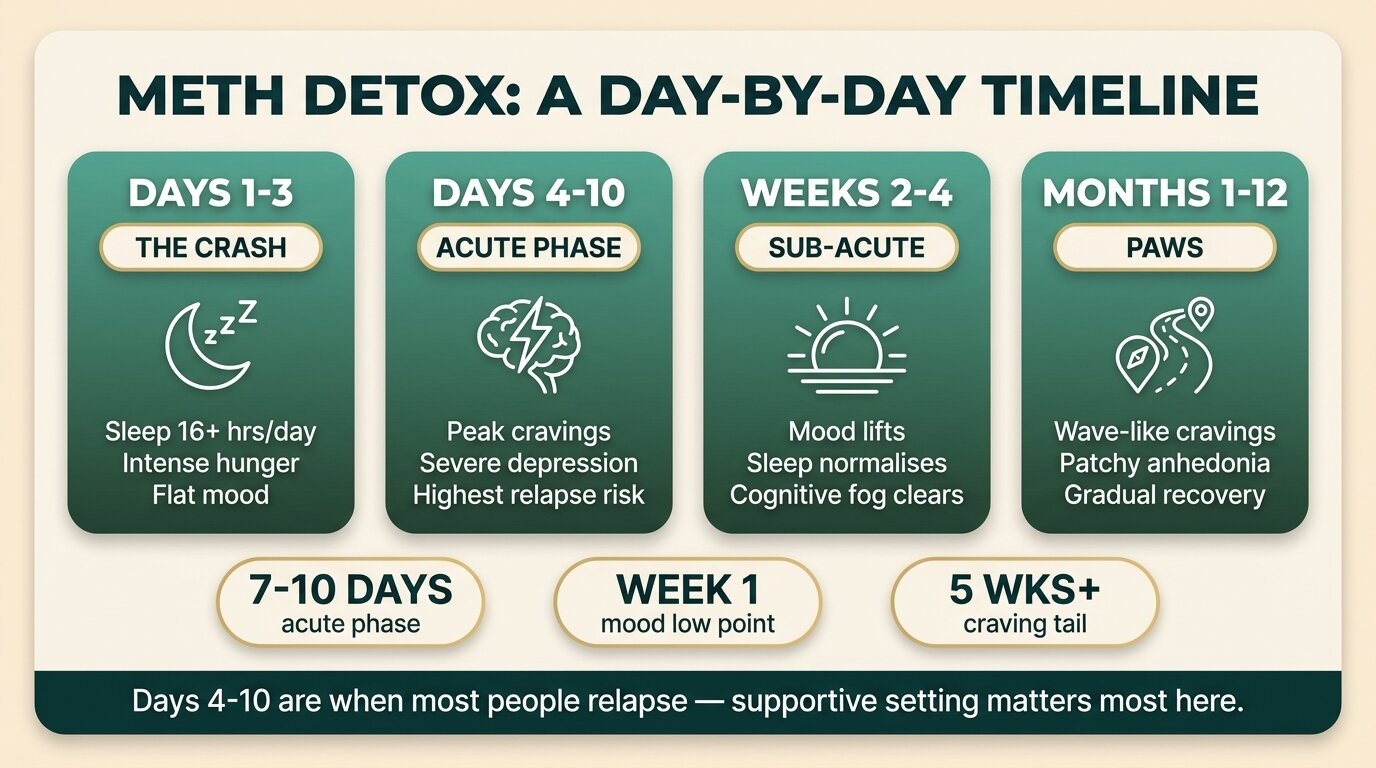
Meth detox takes about 7-10 days for the acute phase, with most physical symptoms resolving inside two weeks. The psychological part — depression, anhedonia, intermittent cravings — can persist for several months in heavy users (McGregor et al., Addiction, 2005). What follows is a day-by-day timeline of what actually happens in the body and mind, why days 4-10 are when most people relapse, and what supportive care during meth detox does (and doesn’t) include.
How Long Does Meth Detox Actually Take?
The acute phase of meth detox lasts 7-10 days. Symptom severity peaks within 24 hours of the last use and declines in a near-linear pattern over the first week, dropping to low background levels by day 7-10 (McGregor et al., Addiction, 2005). After that, a sub-acute phase of low mood, fatigue, and intermittent cravings can persist for weeks to months.
People searching for “how long does meth detox take” are usually asking one of two questions: how long until I stop feeling physically wrecked, and how long until I stop wanting to use. The answers are different. The body crash is mostly done by day 10. The cravings and mood disturbance can last considerably longer, depending on how long and how heavily the person used.
One large study followed methamphetamine-dependent patients through abstinence and found that depressive and psychotic symptoms largely resolved within one week, but craving did not decrease significantly until week two — and remained at a reduced level all the way to week five (Zorick et al., Addiction, 2010). That gap between “feeling physically better” and “stopping wanting to use” is exactly where unmedicated detox at home tends to fail.
What Happens in Days 1-3 (the Crash)?
Days 1-3 of meth detox are called “the crash.” The body and brain, which have been running on artificially elevated dopamine for days or weeks, collapse. Expect profound exhaustion, sleeping 16+ hours a day, intense hunger, depression, and a flat, joyless mood. There is usually very little anxiety yet — just total shutdown.
| Symptom | What the person feels |
|---|---|
| Hypersomnia | Sleeping 14-20 hours per day. Hard to wake. Disorientated when woken. |
| Hyperphagia | Ravenous hunger after days of barely eating on meth. Cravings for carbs and sugar. |
| Anhedonia | Nothing feels good. Food, conversation, music — flat. This is the dopamine system trying to reset. |
| Depression | Heavy, dull, weighted-down mood. Common but usually not yet the worst it will get. |
| Low cravings | During the crash itself, most people are too exhausted to crave. That changes around day 4. |
The Newton 2004 abstinence syndrome study tracked non-treatment-seeking meth-dependent volunteers through early withdrawal and found that the most prominent symptoms in the first several days were anhedonia, irritability, and poor concentration — not the dramatic physical symptoms people sometimes imagine (Newton et al., Am J Addict, 2004). The crash is mostly invisible from outside. The person looks like they are sleeping through a bad flu.

What Happens in Days 4-10 (Acute Withdrawal)?
Days 4-10 are when meth detox gets dangerous, not medically but psychologically. The acute physical crash has passed. Sleep starts to fragment. Depression deepens. Cravings, which were low during the crash, ramp up sharply. Suicidal thoughts are possible, especially in heavy users. This is when most people who try to quit at home relapse.
The pattern is almost predictable: the person makes it through three days of sleeping and eating, starts to feel slightly more functional, then around day four the dysphoria hits in full force. Cravings become specific and intrusive — drug-focused dreams, sensory memories of use, sudden waves of “just one more time.” This is the dopamine system protesting that it has been deprived of its usual flood.
| Symptom | Typical severity |
|---|---|
| Cravings | Peak. Often intense and specific. Drug-focused dreams common. |
| Depression | Severe. Suicidal ideation possible — assess and protect against this. |
| Anxiety | Moderate to severe. Restlessness, agitation, racing thoughts. |
| Dysphoria | Severe. Joyless, irritable, easily provoked. |
| Sleep | Disrupted. Vivid, often drug-focused dreams. Frequent waking. |
| Appetite | Starts to normalise. Sometimes overshoot into overeating. |
The 2005 McGregor study showed that overall symptom severity declines linearly across days 1-7, but the felt experience is not linear at all — the worst hours are often in the second half of the week, when the body has finished crashing but the mind has nothing to numb the discomfort. This is the window where a residential setting matters most.
Worried about getting through the days 4-10 window? Talk to our team — we’ll walk you through what supportive meth detox at One Step looks like, day by day.

What Happens in Weeks 2-4 (Sub-Acute Phase)?
Weeks 2-4 of meth detox are the sub-acute phase. The acute physical and emotional storm has eased. Mood gradually lifts, sleep starts to normalise, energy slowly returns, and cognitive fog begins to clear — but unevenly. Some days feel almost normal; others feel like a relapse of week one. This stop-start pattern is the brain’s reward system slowly rebooting.
Most people in residential treatment notice the shift around day 10-14. They start showing up for meals voluntarily, engaging in group, holding conversations without drifting. The depression hasn’t fully lifted, but it’s no longer the dominant signal. Cravings are still present but less constant — often triggered by specific cues (a memory, a person, a song) rather than running in the background all day.
Cognitive recovery in this window is real but slow. Methamphetamine use is associated with reduced executive function, attention, and memory during early abstinence, and these gradually improve with sustained sobriety (NIDA, 2024). The reader’s job during weeks 2-4 is mostly to wait — to stay in the structure, sleep, eat, move, and let the brain do its repair work.
What Are Post-Acute Withdrawal Symptoms (PAWS) After Meth?
Post-acute withdrawal syndrome (PAWS) after meth is the intermittent return of withdrawal-like symptoms in the weeks and months after acute detox ends. Common features are patchy anhedonia, low motivation, irritability, disrupted sleep, and cue-triggered cravings. In heavy long-term users, PAWS can persist for 6-12 months as the brain’s dopamine system slowly recalibrates.
PAWS is not a continuous experience. Most people describe it as waves: a few good days, then a flat low-energy stretch, then a sudden craving triggered by a smell or a memory, then back to baseline. The waves get shorter and less frequent over time, but they can be alarming when they hit during early sobriety because they feel like the original withdrawal returning.
This is one reason the recommended treatment length for meth dependence is not a single detox stay but several weeks of residential rehab followed by structured aftercare. The acute detox handles the crash. The rehab programme builds the relapse-prevention skills the person will need when PAWS hits at week six, week ten, week twenty.
The cliché that meth withdrawal is “just sleeping it off” is wrong. The sleep part is real — days one to three look mild from the outside. It’s days four to ten that send people back to using, and they don’t usually call that a relapse, they call it “I felt fine for a minute and thought I could handle it.” A residential setting matters because there is no version of meth detox where the person feels good enough to make sober decisions on their own at day five.
Dr. Worapakthorn KongpesalaphunConsultant Psychiatrist, One Step Rehab

Are There Medications That Help with Meth Withdrawal?
No medication is FDA-approved for meth withdrawal or meth use disorder. The foundation of treatment is supportive care: sleep, food, hydration, a controlled environment, and clinical staff who can monitor for depression and suicidal thoughts. Some clinicians use short-course sleep aids during the crash, low-dose antidepressants for sustained depression, and anti-craving or symptomatic medications case by case (NIDA, 2024).
This is honest because it is what the evidence shows. Unlike opioid withdrawal (buprenorphine, methadone) or alcohol withdrawal (benzodiazepines for seizure prevention), meth detox has no signature medication that shortens the timeline or eliminates the worst symptoms. The job during the crash is to keep the person fed, hydrated, rested, and safe.
| Element | Why it matters |
|---|---|
| Quiet, controlled environment | Reduces cue-triggered cravings and sensory overload during the crash. |
| Regular meals, hydration | The body is depleted after days of meth use suppressing appetite. |
| Sleep support | Lets the dopamine system reset. Short-course sleep aids sometimes used when natural sleep doesn’t return. |
| Depression/suicide monitoring | Days 4-10 carry the highest risk of suicidal thoughts. Staff need eyes on the person. |
| Antidepressants (selective use) | Used by some clinicians for depression that persists beyond the acute phase, not as a first-line detox aid. |
| No phone, no contact with use network | Removes the means to act on a craving in the peak relapse window. |
Behaviourally, the best-evidenced treatment for meth use disorder beyond detox is contingency management — a structured system of small rewards for verified abstinence — followed by cognitive-behavioural therapy and longer-term recovery support (SAMHSA TIP 33, 2021). These come after detox, not during it.
Why Does the Setting Matter Through Days 4-10?
The setting matters in days 4-10 because that is the peak relapse window. Cravings are highest, mood is lowest, and the person feels physically well enough to leave but psychologically nowhere near well enough to stay sober. A residential meth detox removes the means and opportunity to use during the exact week when the urge to use is strongest.
At home, meth detox at day six looks like this: the person has slept off the crash, can hold a conversation, looks “better,” and decides they have it under control. They go for a walk to clear their head, run into someone they used to use with, and the relapse is over before they consciously decided to use. The decision was made days earlier when the cravings started and there was no structural barrier between the urge and the supply.
In a residential setting, the barrier is permanent for the duration of the stay. No phone for the first week. No solo outings. Staff in the building. The cravings still happen — the setting doesn’t reduce them — but they pass without ending in use. After three or four of these passes, the person starts to notice that cravings end on their own. That observation is one of the first real building blocks of sobriety.

What Does Meth Detox at One Step Rehab Look Like?
One Step provides supportive on-site meth detox as the first phase of our structured residential programme. Most meth detoxes happen in our regular accommodation with full-time clinical staff, regular medical check-ins, and the same daily rhythm the wider programme follows. We do not need to refer meth detoxes to a hospital — meth withdrawal is psychologically demanding but does not require the intensive medical setup that severe alcohol or benzo withdrawal does.
What the first two weeks typically look like:
- Days 1-3: Mostly sleep, regular hydration and food brought to the room, light medical check-ins, no programme commitments. The job is to crash safely.
- Days 4-7: Light engagement begins — short walks, one-to-one check-ins with a counsellor, a few group sessions. Staff watching for low mood and suicidal thoughts. Phone access still restricted.
- Days 8-14: Full programme engagement starts — structured daily schedule, group therapy, individual sessions, exercise, meal times. The sub-acute phase is when the actual rehab work begins.
The fee for our 28-day residential programme is approximately ฿280,000 (around US $8,500), which covers the room, full-time staff, the therapeutic programme, meals, included activities, and standard intake checks with our visiting psychiatrist. Medication is billed separately — including any short-course sleep aids or antidepressants prescribed during detox, refills of existing prescriptions, and any nutraceutical supplements added to support recovery. Flights, visas, hospital visits, and personal items are not included.
For broader context on detox at One Step and how meth detox fits into the residential programme, see our detox and stabilisation overview and our meth rehab programme page. The plain-English guide to methamphetamine, amphetamines and crystal meth covers the substance itself; this post covers the detox timeline. The detox centres post covers what residential detox settings handle generally, and our guide on reducing relapse risk during withdrawal covers the structural decisions that make the difference in the days 4-10 window.
If you or someone you love is struggling with substance dependence, explore how a structured drug addiction treatment can provide the structure, clinical support, and environment needed for lasting recovery.
Frequently Asked Questions About Meth Detox
The questions people actually ask before walking into meth detox.
Meth withdrawal is not directly life-threatening the way alcohol or benzodiazepine withdrawal can be — it does not cause seizures or organ failure. But it carries a real risk of suicidal depression during days 4-10, especially in heavy long-term users. The danger is psychological, not cardiac or neurological, and it is managed by a controlled setting and people who can monitor mood.
Methamphetamine has a half-life of about 10-12 hours, so it is mostly cleared from the body within 2-4 days. Detection windows are longer: urine tests can pick it up for 3-5 days after the last use in occasional users, and longer in chronic heavy users. The substance leaving the system and the withdrawal symptoms resolving are different timelines — the symptoms outlast the drug by days.
Physically, yes — meth withdrawal does not require medical monitoring to be survived. Practically, most home meth detoxes fail at days 4-10, when cravings peak and the person has phone access and freedom of movement. The medical danger is low; the relapse risk is very high. The case for residential detox is structural rather than medical: it removes the option to use during the worst week.
Detox alone is rarely enough. Most clients stay 28-60 days in residential rehab after detox, so that the relapse-prevention work can land during the sub-acute and early PAWS windows when cravings can still hit hard. Shorter stays — discharging at day 14 because the acute symptoms have resolved — are associated with high early relapse. The body has detoxed; the recovery skills haven’t been built yet.
Heavy meth use floods the brain with dopamine. When it stops, the dopamine system is depleted and unresponsive — the person genuinely cannot feel pleasure for several days to weeks. Combined with sleep disruption and the awareness of damage done during use, this can produce severe depression and suicidal thoughts, especially in week one. The mood usually lifts as the dopamine system recovers, but it needs to be monitored and protected against in the meantime.
Sleep returns in stages. Days 1-3 are usually long oversleeping; days 4-10 are fragmented sleep with vivid dreams; weeks 2-4 see most people drift back toward a normal 7-9 hour pattern. Some PAWS-related insomnia can come and go for months in heavy users. Restoring sleep is one of the most important supports during the acute phase — short-course sleep aids are sometimes used when natural sleep doesn’t return by week two.
Yes. Meth detox happens on-site at One Step as the first phase of the residential programme, with full-time clinical staff and regular medical check-ins. Meth withdrawal does not require the intensive medical setup that severe alcohol or benzodiazepine withdrawal does, so there is no hospital referral step — the person arrives, settles into the room, and the supportive detox starts the same day.
Written by
Worapakthorn Kongpesalaphun, MD., Ph.D.
Dr. Worapakthorn Kongpesalaphun is a Thai Licensed Medical Doctor and Expert in Preventive Medicine (Community Mental Health) with extensive experience in addiction treatment and public health management. He holds multip...
Learn more about Worapakthorn