

Key Takeaways
- Amphetamine is the parent compound — the same chemical family as prescription Adderall, Dexedrine and Vyvanse. Used as directed under medical supervision, it has a defined safety profile.
- Methamphetamine is amphetamine with one extra methyl group attached to the nitrogen. That tiny change makes it more fat-soluble, so it crosses into the brain faster and hits harder — and it sticks around for 9-12 hours.
- Crystal meth, “ice” and “shabu” are all the same drug — pure crystalline methamphetamine, usually smoked or injected. It’s not a separate chemical; it’s the high-purity form of methamphetamine.
- Yaba — the small pink tablets that dominate the Thai market — is methamphetamine mixed with caffeine. Thailand seized roughly one billion yaba tablets in 2024 (UNODC, 2024).
- A Vyvanse prescription isn’t a meth problem. The pivot point is non-medical use of methamphetamine — especially smoked or injected — which is where dependence forms within weeks, sometimes days.
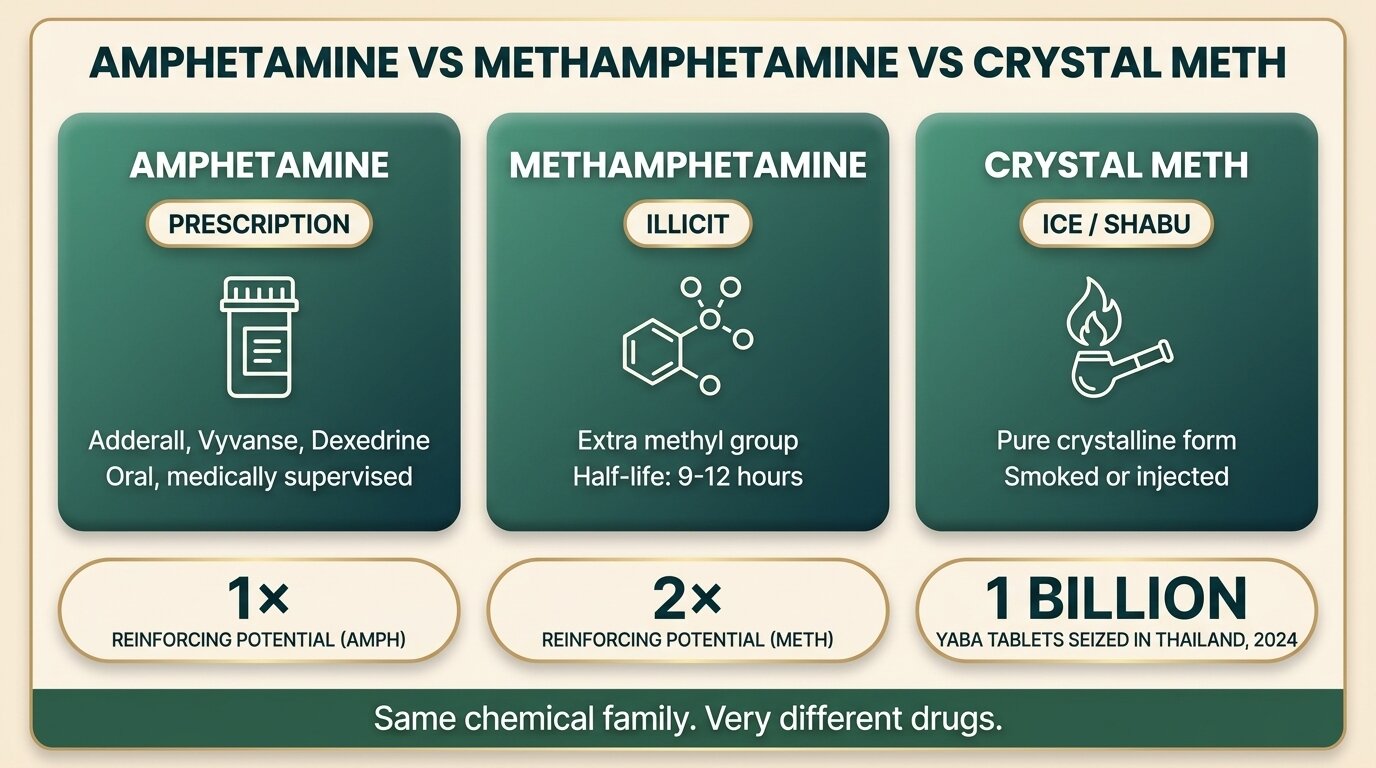
Amphetamine and methamphetamine are chemically related but functionally very different. Amphetamine is the parent compound behind prescription stimulants like Adderall and Vyvanse. Methamphetamine is the same molecule with one extra methyl group — a change small enough to fit on a chemistry quiz but big enough to make the drug cross into the brain faster, hit harder, and stay there longer. Crystal meth, “ice” and “shabu” aren’t different drugs — they’re the pure crystalline form of methamphetamine, usually smoked or injected (NIDA, 2024).
What Is Amphetamine?
Amphetamine is a synthetic stimulant first made in the 1880s and used medically since the 1930s. Today it’s the active ingredient in prescription medications like Adderall, Dexedrine and Vyvanse, all classified by the DEA as Schedule II controlled substances. At therapeutic doses, it increases attention, focus and wakefulness — which is why it’s prescribed for ADHD and narcolepsy.
Millions of people take Adderall or Vyvanse safely every day under medical supervision. The drug isn’t safe because the molecule is harmless — it’s safe because the dose is controlled, the route is oral (slow onset), the patient is screened, and a doctor is monitoring the response. Strip out any of those guardrails and the risk profile changes fast.
The reinforcing potential of amphetamine is roughly half that of methamphetamine at equivalent doses, which is one of the reasons it’s the molecule that ends up in prescription pads rather than its more dangerous cousin (Moszczynska, Psychiatr Times, 2016).
What Is Methamphetamine?
Methamphetamine is amphetamine with one extra methyl group bolted onto the nitrogen atom. That single chemical addition makes the molecule less polar and more fat-soluble. More fat-soluble means it slips through the blood-brain barrier faster than amphetamine, reaches higher concentrations inside the brain, and resists breakdown by the body’s enzymes for longer. The half-life sits between 9 and 12 hours, compared to a faster fall-off for plain amphetamine.
That’s the pharmacology in plain English: same family, more brain-active, longer-lasting. Methamphetamine still exists as a prescription drug in the US under the brand name Desoxyn, but it’s prescribed very rarely. The version that fuels addiction worldwide is illicitly manufactured, and the dose, purity and route bear no resemblance to anything a doctor would write.
The reason this matters clinically: at the same milligram dose, more methamphetamine reaches the brain than amphetamine, and it stays there longer. That’s what underwrites the higher dependence risk, the worse comedown, and the more pronounced damage to dopamine-producing neurons over time.
Is Crystal Meth a Different Drug from Methamphetamine?
No. Crystal meth, “ice,” and “shabu” are all street names for the same drug — methamphetamine in its high-purity crystalline form. The crystals look like shards of glass or rock salt and are usually smoked in a glass pipe or dissolved and injected. Both of those routes deliver the drug to the brain within seconds, which is what makes crystal meth so much more addictive than swallowing a tablet.
The form changes the experience; it doesn’t change the chemistry. Crystal meth tested in a lab and yaba tablets tested in a lab both come back as methamphetamine. What differs is purity, dose per use, and how quickly the drug gets to the brain. Smoking a hit of ice and swallowing a yaba tablet are the same molecule on the same receptors — just at very different speeds.
| Route | Onset to peak | Typical form |
|---|---|---|
| Oral (swallowed) | Up to 3 hours | Yaba tablets, prescription pills |
| Snorted | Under 15 minutes | Crushed crystals or powder |
| Smoked | Under 18 minutes (peak); seconds to first effect | Crystal meth / ice / shabu |
| Injected | Under 15 minutes (peak); seconds to first effect | Crystal meth dissolved in water |
This is why dependence forms fastest with smoked and injected meth: the brain learns the connection between using and getting high in seconds, not hours. Oral routes give the brain time to register the dose more gradually — still addictive, but not at the same speed.
Why Is Methamphetamine More Harmful Than Prescription Amphetamines?
Methamphetamine causes more harm than prescription amphetamines for three reasons stacked on top of each other: it gets into the brain faster, it reaches higher concentrations once it’s there, and it stays longer. Add unregulated dosing and non-oral routes — smoking and injecting — and you get a drug that damages dopamine-producing neurons in ways that prescription amphetamine, taken as directed, simply doesn’t.
The damage isn’t theoretical. Imaging studies of long-term methamphetamine users show persistent decreases in dopamine transporters and serotonin markers in the caudate and putamen — parts of the brain involved in movement, reward and motivation. Methamphetamine users have roughly a 75% higher risk of developing Parkinsonism (movement disorder) than non-users (Jayanthi et al., Exp Neurol, 2021).
The good news from the same body of research: with extended abstinence, much of the brain abnormality and associated neurological problems partially recover. People who stop using meth and stay stopped see their brains heal — not all the way, not for everyone, but meaningfully (Moszczynska, Psychiatr Times, 2016). That’s the whole point of getting into treatment early.
None of this applies to someone taking a 30mg Vyvanse capsule every morning with their breakfast under a psychiatrist’s care. The drug, the dose, the route and the oversight are different enough that comparing the two is a category error. A prescription for Vyvanse is a treatment decision; smoking crystal meth is a different thing entirely.
“The single methyl group is the part that makes methamphetamine more dangerous than prescription amphetamine, but it’s not the only part. Route and dose matter just as much. Someone smoking crystal meth twice a day is delivering enormous doses, very fast, with no medical oversight — that’s a different drug experience than a steady oral dose of Vyvanse, even though the underlying molecule shares the same family.”
Dr. Worapakthorn KongpesalaphunConsultant Psychiatrist, One Step Rehab

What Are Yaba and Shabu? (The Forms You See in Thailand)
In Thailand and across Southeast Asia, methamphetamine takes two dominant forms. “Yaba” — meaning “crazy medicine” in Thai — is a small pressed tablet, usually pink or orange, made from methamphetamine cut with caffeine. “Shabu” is the regional name for crystal meth: the high-purity crystalline form, smoked or injected. Both are methamphetamine; the difference is purity and how people use them.
The scale is enormous. In 2024, Thailand recorded the largest methamphetamine seizures in East and Southeast Asia, including roughly one billion yaba tablets. The vast majority of regional supply originates in super-labs in Myanmar’s Shan State, in the Golden Triangle, where ongoing armed conflict has enabled industrial-scale production. Oversupply has driven yaba prices down to as little as 10 baht per tablet — cheaper than a bottle of water (UNODC, 2024).
This regional context matters for anyone considering treatment in Thailand. The clients we see at One Step who have a meth problem are usually dealing with yaba or shabu — not American crystal meth, not European amphetamine. The drug is the same molecule, but the local supply chain, social context and pricing make it a different problem to treat than meth use in the West.
Confused about whether what you’re using counts as a “meth problem”? Talk to our team — we’ll give you a straight answer, whether it’s yaba, ice, prescription stimulants you’ve started misusing, or something else.
When Does a Prescription Stimulant Become an Addiction Problem?
A Vyvanse or Adderall script taken as prescribed isn’t a meth problem and shouldn’t be treated like one. The shift from medical use to misuse happens when the user starts taking more than prescribed, takes someone else’s prescription, crushes and snorts pills to speed up the onset, or combines prescription stimulants with non-prescription meth. Those are the patterns that bring people into treatment.
Some signals we see in clients who came in through the prescription stimulant route:
- Running out of a 30-day prescription in 7-10 days
- Buying extra pills from friends, classmates, online sellers
- Snorting crushed tablets for a faster, more intense hit
- Combining stimulant use with binge drinking or benzodiazepines to manage the comedown
- Continuing to use after stopping ADHD treatment officially
- Crossing over from prescription pills to street methamphetamine because it’s cheaper or stronger
None of this is judgement on people legitimately treated for ADHD. We treat the misuse pattern, not the original prescription. If you’re not sure whether you’ve crossed the line, the honest test is whether your use looks like what your doctor wrote — same drug, same dose, same route, same frequency. If any of those have drifted, it’s worth getting checked out.

How We Treat Methamphetamine Addiction at One Step
Methamphetamine withdrawal isn’t medically dangerous the way alcohol or benzodiazepine withdrawal can be — it’s psychologically brutal but rarely life-threatening. We handle meth detox on-site at One Step. Most clients spend the first 7-10 days sleeping a lot, eating heavily, feeling flat and irritable, and gradually coming back to themselves. The acute phase is short. The harder work starts after.
Our programme runs in structured 28-day blocks with a fixed daily schedule, group therapy from 9-11am, individual sessions, physical activity, and no phones for the first week. The cost is roughly ฿280,000/month (about $8,500 USD). Medication prescribed during your stay is billed separately — what the doctor writes, you pay for. Flights, visas and personal items aren’t included. The pricing page has the full list.
Stimulant recovery is heavily about rebuilding dopamine reward — which is why we lean hard on physical activity, structured sleep, real food, and CBT and DBT-based work on triggers and craving management. Most clients see the worst of the meth cognitive fog lift in the first 4-6 weeks. For more on the substance-specific clinical track, see our meth rehab programme page.
If you or someone you love is struggling with substance dependence, explore how a drug addiction treatment programme can provide the structure, clinical support, and environment needed for lasting recovery.
Frequently Asked Questions
Quick answers to the questions people most often have about how amphetamine, methamphetamine and crystal meth differ.
No. Adderall is a mix of amphetamine salts, prescribed under medical supervision and taken orally. Methamphetamine is a closely related molecule with one extra methyl group that makes it cross into the brain faster and last longer. Same chemical family, different drugs.
No. Crystal meth is just methamphetamine in its high-purity crystalline form, usually smoked or injected. “Ice” and “shabu” are other street names for the same thing. The chemistry is identical to other forms of methamphetamine — only the purity and route of use are different.
Yaba is methamphetamine mixed with caffeine, pressed into small pink or orange tablets and usually swallowed or smoked off foil. It’s the dominant street form of meth across Thailand and much of Southeast Asia. Thailand alone seized around one billion yaba tablets in 2024 (UNODC, 2024).
Methamphetamine is more fat-soluble, so it crosses into the brain faster and reaches higher concentrations than amphetamine at the same dose. It also lasts longer — a 9-12 hour half-life. The reinforcing potential is roughly double that of amphetamine, which is why it has a much higher dependence risk.
Heavy methamphetamine use damages dopamine-producing neurons and is associated with a roughly 75% higher risk of Parkinsonism (Jayanthi et al., 2021). Some of this damage is partially reversible — with extended abstinence, brain abnormalities and neurological problems often improve, though not always fully.
Not on its own. Vyvanse is a prescription amphetamine taken orally under medical supervision — that’s a treatment, not an addiction. It becomes a problem if the dose creeps up, the route changes (crushing and snorting), or use continues outside the prescribed pattern. The misuse is what we treat, not the original script.
The half-life of methamphetamine in the bloodstream is 9-12 hours, though it can range from 5-30 hours depending on the person and route. A standard urine test usually picks up meth for 1-4 days after the last use; heavier or chronic use can extend that window.
Written by
Worapakthorn Kongpesalaphun, MD., Ph.D.
Dr. Worapakthorn Kongpesalaphun is a Thai Licensed Medical Doctor and Expert in Preventive Medicine (Community Mental Health) with extensive experience in addiction treatment and public health management. He holds multip...
Learn more about Worapakthorn