

Key Takeaways
- Cannabis-induced anxiety, panic attacks and psychosis sit on a spectrum — anxiety and racing-heart paranoia are common, panic attacks are common enough to fill ERs, and full psychotic episodes are rarer but serious.
- High-THC strains (above 10% THC), dabs, and edibles cause the worst acute reactions. Daily users of high-potency cannabis have nearly 5x higher odds of a first psychotic episode than non-users (Di Forti et al., Lancet Psychiatry, 2019).
- Roughly 47% of people who experience a cannabis-induced psychotic episode go on to develop schizophrenia or bipolar disorder within years (Starzer et al., Am J Psychiatry, 2018). Genetic loading and adolescent heavy use are the biggest predictors.
- Most cannabis panic attacks pass within 30-90 minutes. During one: slow breathing, cool air, water, reassurance. They feel like a heart attack but are not.
- Anxiety and panic usually resolve with abstinence plus CBT. Psychosis needs medical evaluation, often antipsychotic medication, and residential treatment if heavy use continues.
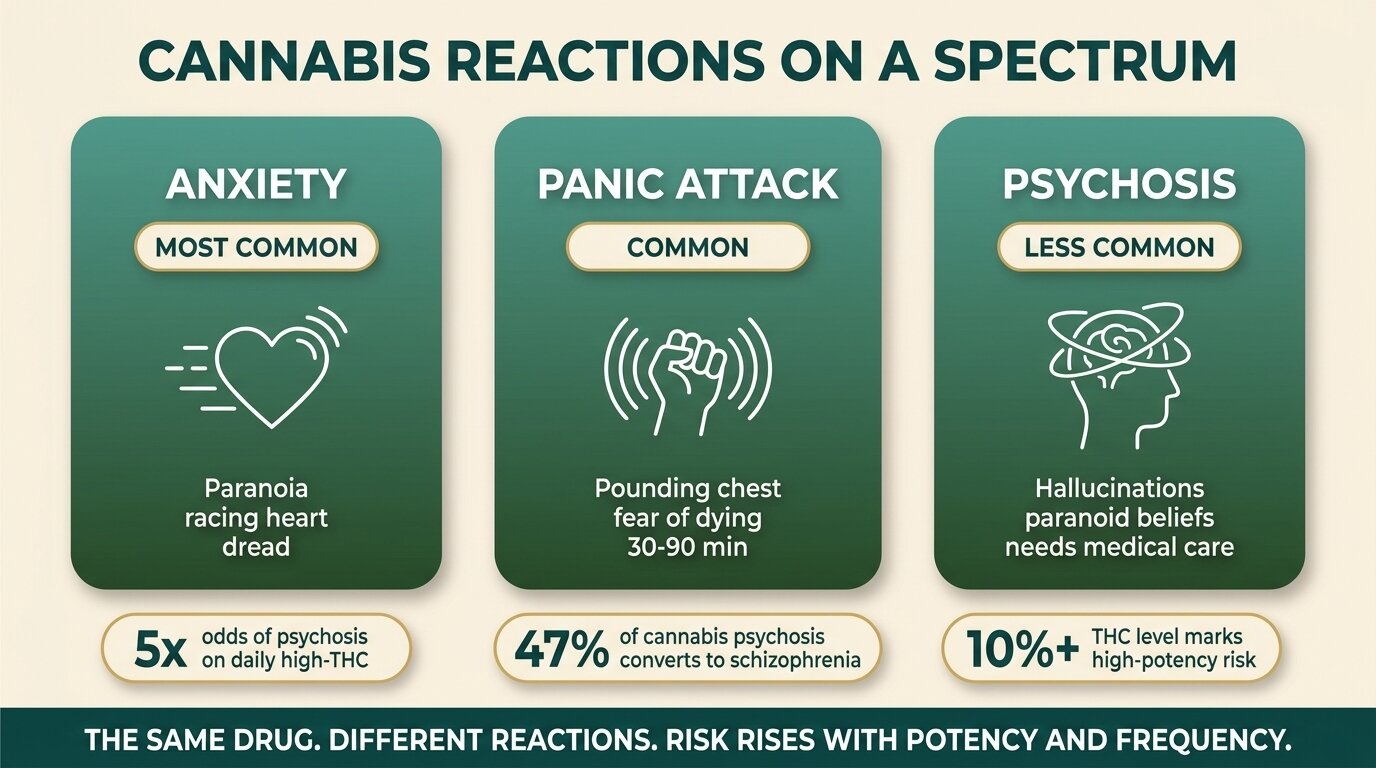
Yes — cannabis can trigger anxiety, panic attacks, and in some users, psychosis. The reactions sit on a spectrum. Anxiety and paranoia happen to a large minority of users, especially with high-THC strains. Panic attacks are common enough that cannabis intoxication is one of the most frequent reasons young adults end up in emergency rooms after drug use. Psychotic episodes are rarer but well-documented, with daily high-potency cannabis users showing nearly five times the odds of first-episode psychosis compared with non-users (Di Forti et al., Lancet Psychiatry, 2019).
This guide is for two readers: the person who had a terrible experience and is now scared to leave the house, and the parent who searched “is weed psychosis real” at 2am. We cover all three reactions — what they feel like, why they happen, who is at higher risk, what to do during one, and when professional treatment is needed.
Why Does Cannabis Cause Anxiety in So Many People?
Cannabis causes anxiety because high THC doses overstimulate the brain’s CB1 receptors in regions that govern fear and threat detection — the amygdala and prefrontal cortex. The result is a racing heart, hyperawareness, paranoia, and a sense that something is wrong. Modern high-THC strains (often above 20% THC) cause this far more reliably than the cannabis of 20 years ago.
This is the most common bad reaction. Many users describe a sudden shift mid-high: the music gets too loud, they become certain their friends are judging them, time slows down, their heart pounds. For some it passes in an hour. For others it triggers a longer pattern — anxiety between uses, dread before getting high, a chronic baseline of unease that builds over months of regular use.
The DSM-5-TR recognises this as cannabis-induced anxiety disorder when panic or anxiety predominates during or soon after intoxication and the symptoms cannot be better explained by a pre-existing anxiety disorder. Symptoms typically resolve within about a month of stopping use; if they persist longer, an underlying anxiety disorder is likely.
Risk factors that make a bad anxiety reaction more likely:
- High-THC products — dabs, wax, shatter, vape concentrates (60-90% THC), strong edibles
- Edibles in particular — onset is delayed 30-90 minutes, users often re-dose thinking nothing is happening, then get hit by a much larger dose
- Inexperience or long breaks from use — tolerance drops fast
- Pre-existing anxiety or depression — cannabis amplifies what’s already there
- Stressful setting — unfamiliar places, crowds, conflict
- Low CBD strains — CBD blunts some of THC’s anxiety-inducing effects; modern high-THC, low-CBD strains lose that buffer
What Does a Cannabis-Induced Panic Attack Feel Like?
A cannabis panic attack feels like a heart attack and a near-death experience at the same time. The hallmark symptoms are a racing or pounding heart, chest tightness, shortness of breath, tingling in the hands, depersonalisation (a sense of being outside your body), an overwhelming conviction that something is terribly wrong, and a fear of dying or going insane. It usually peaks within 10-30 minutes.
These episodes are common enough that cannabis is among the top drug-related reasons young adults turn up at emergency rooms. The episodes are unpleasant but not dangerous — no one has died from a cannabis panic attack itself. The danger is misreading it as a heart attack and panicking further, or driving while in this state.
| Symptom | Cannabis panic attack | Cardiac event |
|---|---|---|
| Chest sensation | Tightness, sharp, comes in waves | Crushing pressure, often radiating to left arm or jaw |
| Onset | During or shortly after using cannabis | Often during exertion, no drug link |
| Hands and fingers | Tingling, numb, sometimes cramping | Usually no tingling |
| Depersonalisation | Common — feeling outside body, dreamlike | Not typical |
| Duration | 10-30 minutes peak, settles within 90 minutes | Builds and persists; needs ER |
| Response to slow breathing | Reduces symptoms within minutes | No effect |
If you are unsure, go to an emergency room. A cardiac event in a young person is rare but real — chest pain that does not ease with rest and slow breathing, especially with radiating arm or jaw pain, needs medical evaluation. Cannabis use does temporarily raise heart rate and blood pressure, and there are documented (rare) cardiac complications in heavy users.

What Should You Do During a Cannabis Panic Attack?
The single most important thing is to remember that it will pass. Cannabis panic attacks peak within 10-30 minutes and fully resolve within 60-90 minutes for most people. The reaction is the body responding to acute THC overload, not a heart attack and not the beginning of permanent damage. Reassurance, slow breathing, and waiting it out are the entire treatment.
Practical steps during an episode:
- Move to a cool, quiet place. Crowds, loud music, and bright lights make it worse. A bathroom, bedroom, or outdoor space works.
- Slow your breathing. Box breathing — inhale 4 seconds, hold 4, exhale 6, hold 2 — calms the nervous system within minutes. The slower exhale is the active ingredient.
- Drink cold water. Hydration helps. Cold water on the face triggers the dive reflex, which lowers heart rate.
- Eat something light. A few crackers, a piece of fruit, anything with a small amount of sugar. Low blood sugar amplifies the reaction.
- Black pepper. Anecdotal but widely reported — sniffing or chewing a few black peppercorns appears to ease THC-induced anxiety. The terpenes in black pepper share chemical pathways with cannabis.
- Tell yourself, out loud, “this will pass.” Naming the reaction as a panic attack — not a heart attack — short-circuits the spiral.
- Do not drive. Have someone stay with you. If alone, call a trusted person and stay on the line.
If symptoms worsen after 60 minutes, if there is severe chest pain that does not ease, or if hallucinations or paranoid thoughts escalate, go to an emergency room. ER staff see cannabis intoxication frequently and will not call the police for personal use in most countries.
Can Cannabis Really Cause Psychosis?
Yes — and the evidence is now strong enough that the question is not whether cannabis can trigger psychosis but how much, in whom, and how often. Acute cannabis-induced psychotic episodes happen during heavy use of high-THC products. In a meta-analysis of 15 controlled studies, a single dose of THC produced large increases in positive psychotic symptoms (paranoid thinking, hallucinations) in healthy adults (Hindley et al., Lancet Psychiatry, 2020).
What this looks like in real life:
- Acute psychotic symptoms during use — fixed paranoid beliefs (“they’re tracking me”), auditory hallucinations, disorganised thinking, conviction that strangers are communicating in code. These usually pass within hours to days of stopping.
- Cannabis-induced psychotic disorder — symptoms persist for days or weeks after use stops. Treatment usually requires antipsychotic medication and clinical supervision.
- Transition to schizophrenia or bipolar disorder — in vulnerable individuals, a cannabis-induced psychotic episode is sometimes the first sign of a chronic psychotic illness. A Danish registry study of 6,788 people who had a substance-induced psychosis found that 47% of those whose psychosis was cannabis-induced went on to develop schizophrenia or bipolar disorder over follow-up (Starzer et al., Am J Psychiatry, 2018). Cannabis carried the highest conversion risk of any substance studied.
The dose-response link is clear. The EU-GEI study — the largest case-control study of cannabis and first-episode psychosis to date — found that daily users of high-potency cannabis (above 10% THC) had nearly five times the odds of a first psychotic episode compared with people who had never used cannabis (Di Forti et al., Lancet Psychiatry, 2019). The risk rose with potency and frequency. Most users will never experience psychosis. The risk is concentrated in a smaller, identifiable group.

Who Is at Higher Risk of Cannabis-Induced Psychosis?
The risk of cannabis-induced psychosis is concentrated in a smaller subset of users: people with a family history of schizophrenia or bipolar disorder, adolescents whose brains are still developing, daily users of high-THC strains, and people with prior psychotic-like experiences. Most cannabis users never experience psychosis. But for a person carrying genetic vulnerability, daily heavy use is genuinely dangerous.
The strongest known risk factors:
| Risk factor | Why it matters |
|---|---|
| Family history of schizophrenia or bipolar | Genetic loading is the single strongest predictor. Cannabis appears to bring forward the onset of schizophrenia in vulnerable people by years. |
| Adolescent use (under 18) | The brain’s CB1 system is still developing into the mid-20s. Heavy use in this window has the strongest links to long-term psychotic illness. |
| Daily or near-daily use | Frequency drives risk more than total years. Daily users have around 3x the odds of psychosis (Di Forti et al., 2019). |
| High-THC products (>10%) | Daily users of high-potency cannabis show nearly 5x the odds. Dabs, vape concentrates, and high-THC flower are the highest risk. |
| Prior psychotic-like experiences | A history of brief paranoid episodes, derealisation, or magical thinking under any drug suggests vulnerability. |
| Personal history of mental illness | Depression, anxiety, ADHD, and PTSD all increase vulnerability to cannabis-related psychiatric problems generally. |
If two or more of these apply, the math changes. Continued daily use of high-THC cannabis is not a casual decision — it is a meaningful risk for a serious psychiatric outcome.
When we see a young patient with a cannabis-induced psychotic episode, the conversation we have with the family is honest: this might be a one-off that resolves with abstinence, or it might be the first signal of a longer-term illness. Either way, continuing to smoke is the worst possible decision. We can’t predict who will convert, but we can stop adding fuel to the fire.
Dr. Worapakthorn KongpesalaphunConsultant Psychiatrist, One Step Rehab
Worried about someone who’s had a bad cannabis episode? Talk to our team — we’ll give you an honest read on whether this needs treatment or not.
How Is Cannabis-Induced Anxiety, Panic, or Psychosis Treated?
Treatment depends on which point on the spectrum the person is at. Anxiety and panic attacks usually resolve with cannabis abstinence plus a short course of CBT for the residual fear of recurrence. Psychotic episodes need medical evaluation, often antipsychotic medication, and residential treatment if cannabis use has been heavy. Continued cannabis use blocks recovery in every category.
How each presentation is usually managed:
| Presentation | First-line treatment | Setting |
|---|---|---|
| One-off bad anxiety reaction | Stop using. Reassurance. No treatment needed unless residual anxiety persists. | Self-managed |
| Chronic cannabis-induced anxiety | Abstinence plus CBT. Symptoms typically resolve within 4 weeks of stopping. | Outpatient or residential rehab |
| Recurrent panic attacks linked to use | Abstinence plus CBT for panic. SSRIs sometimes used short-term. | Outpatient or residential rehab |
| Acute cannabis-induced psychosis | Medical evaluation, antipsychotic medication, close clinical supervision. | Hospital first, then residential rehab |
| Persistent psychotic symptoms | Antipsychotic medication, full psychiatric assessment to rule out schizophrenia spectrum disorder, dual diagnosis programme. | Hospital first, then specialised dual diagnosis treatment |
For people whose cannabis use has triggered repeated panic attacks or any episode of psychosis, attempting to “manage it on your own” usually fails. The cannabis cycle resumes, the symptoms return worse, and the window to act early closes. NIDA notes that high cannabis doses can trigger acute psychosis and panic attacks, and that adolescents who use cannabis regularly face higher risks of depression, anxiety, and social withdrawal (NIDA, 2024). For an adolescent or young adult with any of the risk factors above, residential treatment is often the right intervention.

How One Step Rehab Treats Cannabis-Related Anxiety and Psychosis
One Step Rehab is a residential addiction treatment programme in Chiang Mai, Thailand, that treats cannabis use disorder and the psychiatric problems that come with it — including cannabis-induced anxiety, panic disorder, and the early stages of cannabis-related psychosis. Our standard programme runs 28 to 90 days at approximately ฿280,000 per month (~$8,500 USD). For active psychosis or acute psychiatric crisis, hospital evaluation comes first, then a transfer to us once the person is medically stable.
What treatment looks like at One Step for cannabis-related problems:
- Cannabis cessation in a structured residential setting. Removing the substance entirely is the foundation. Symptoms cannot improve while cannabis use continues.
- CBT, DBT and one-to-one counselling to address the anxiety patterns and the cannabis use disorder driving them. See how CBT and DBT differ in addiction treatment.
- Psychiatric assessment by our visiting consultant psychiatrist for anyone with psychotic symptoms, severe anxiety, or a dual diagnosis. Medication is prescribed where indicated.
- Dual diagnosis treatment for clients whose cannabis use sits alongside schizophrenia spectrum illness, bipolar disorder, severe anxiety or depression. Our dual diagnosis programme addresses both at the same time rather than referring out.
- Structured daily routine — group therapy, exercise, outdoor activity, set sleep and meal times. The treatment schedule is designed to rebuild the nervous-system regulation that heavy cannabis use erodes.
- Aftercare planning to prevent relapse once the residential phase ends. See our aftercare programme.
Honest scope: we are not a locked psychiatric hospital. For someone in active psychosis — disorganised, agitated, hallucinating, or at risk of harm to themselves or others — the first stop is a psychiatric hospital for stabilisation. Once they are medically stable and able to participate in rehabilitation, residential treatment with us is appropriate.
Related reading for context: our cannabis rehab page covers the full programme. For the legal and cultural backdrop in Thailand, see our post on marijuana addiction in Thailand after legalisation, and for the withdrawal timeline see our post on cannabis withdrawal symptoms and timeline. For the role of dual diagnosis treatment more broadly, see our piece on personalised dual diagnosis therapy options.
Frequently Asked Questions
The questions families ask us most often about cannabis-induced anxiety, panic, and psychosis.
It can. Some people develop a fear of going outside, of social situations, or of their own heart rate after one severe panic attack on cannabis. This is treatable with CBT focused on the fear of the panic recurring, and it usually resolves within a few weeks of stopping cannabis. If symptoms persist beyond about a month, an underlying anxiety disorder is likely.
Acute symptoms during intoxication usually pass within hours to a few days of stopping cannabis. A more persistent cannabis-induced psychotic disorder can last days to weeks and typically needs antipsychotic medication. If symptoms persist beyond a month without ongoing cannabis use, the diagnosis usually shifts to schizophrenia spectrum disorder or another primary psychotic illness.
Not always, but the risk is substantial. The largest registry study found that about 47% of people who had a cannabis-induced psychotic episode went on to be diagnosed with schizophrenia or bipolar disorder over years of follow-up. This was the highest conversion rate of any substance studied. Family history of psychotic illness raises the risk further. Stopping cannabis use after the first episode lowers but does not eliminate the risk of conversion.
Yes, especially for inexperienced users. Edibles take 30 to 90 minutes to take effect, so users often re-dose thinking the first dose did nothing, then get hit by a much larger total dose. The effects last six hours or more. Most cannabis emergency room visits in legalised markets involve edibles, not flower.
A single episode after light experimentation in a teenager with no family history may resolve with cessation and outpatient follow-up. A psychotic episode in an adolescent with heavy daily use, a family history of schizophrenia or bipolar disorder, or any difficulty stopping on their own is a strong indication for residential treatment. The window to act early matters more than parents usually realise.
Pure CBD does not produce psychotic symptoms and may modestly blunt some of THC’s negative effects. The reactions described in this article are driven by THC. Many real-world cannabis products labelled as “CBD” contain meaningful amounts of THC, especially in unregulated markets, so a bad reaction to a CBD product almost always means THC is present.
The DSM-5-TR treats cannabis-induced anxiety disorder as a distinct diagnosis. It is given when anxiety or panic dominates during or shortly after cannabis intoxication and the symptoms cannot be better explained by a pre-existing anxiety disorder. Symptoms usually resolve within about a month of stopping. If they persist longer, a primary anxiety disorder is the more likely diagnosis and benefits from separate treatment.
Written by
Worapakthorn Kongpesalaphun, MD., Ph.D.
Dr. Worapakthorn Kongpesalaphun is a Thai Licensed Medical Doctor and Expert in Preventive Medicine (Community Mental Health) with extensive experience in addiction treatment and public health management. He holds multip...
Learn more about Worapakthorn