
Key Takeaways
- Cannabis use disorder is a real DSM-5 diagnosis. About 22–30% of regular users meet the criteria, and people who start before 18 are 4–7 times more likely to develop it than adults who start later.
- Modern cannabis is not the weed you remember. Average THC potency in the US has risen from roughly 4% in 1995 to over 13% by 2019, and many dispensary flower and concentrates run 20–80%+ THC.
- The first conversation is not where you fix the problem. The goal is to be the person they come back to when they are ready — not the person who slammed the door.
- CRAFT (Community Reinforcement and Family Training) helps families engage treatment-resistant users at roughly 64–67% — more than double the rate of Al-Anon/Nar-Anon style detachment.
- You can love them and still need your own support. Mar-Anon, Al-Anon, and a counsellor for you are legitimate, even if they never go to treatment.
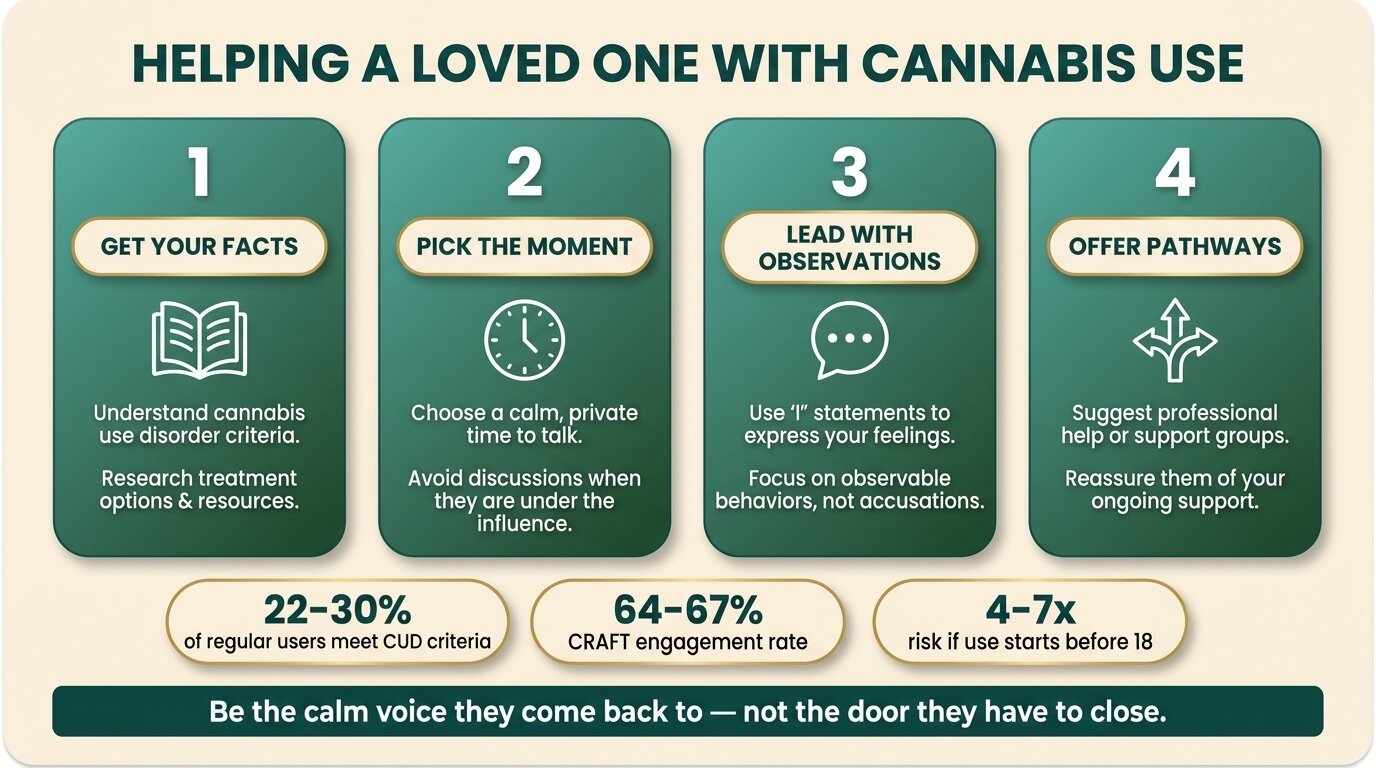
Help someone overcome marijuana addiction by getting your facts straight, picking a calm sober moment, leading with what you have observed rather than labels, expecting deflection, and offering specific pathways instead of ultimatums. The newer the cannabis, the higher the THC — and daily heavy use of high-potency products is associated with cannabis use disorder in roughly one in four regular users (Nimmana et al., StatPearls / NIH, 2026). You are not overreacting. You are also not going to argue them sober. Here is the framework families actually use.
Is Cannabis Really Addictive, or Am I Overreacting?
Yes, cannabis is addictive for a meaningful minority of users. The DSM-5 recognises cannabis use disorder, and roughly 22–30% of people who use cannabis develop it — higher among daily users and people who started before 18 (NIDA, 2024). Daily use of today’s high-THC products carries real tolerance, withdrawal, and dependence — not the urban legend version your loved one will quote at you.
If you have spent decades being told cannabis “isn’t really addictive,” that wasn’t a lie exactly — it was true-ish about 1990s weed, which averaged around 4% THC. The product on the table in 2026 is a different molecule by volume. The University of Mississippi Potency Monitoring Program found average illicit cannabis rose to roughly 14% THC by 2019, and dispensary flower and concentrates regularly test at 20–80%+ (ElSohly et al., Frontiers in Public Health, 2024).
What this means for the person you are worried about: the daily user in front of you is consuming a dose that did not exist when most parents and partners first formed their opinions about weed. If their life is shrinking around it, you are not seeing things.
| Domain | What you might notice |
|---|---|
| Impaired control | Failed attempts to cut back, using more than they intended, mornings now included |
| Social and occupational | Friends and hobbies dropped, missed shifts, study slipping, conflict at home |
| Risky use | Driving high, using around children, hiding it from a doctor managing other conditions |
| Tolerance and withdrawal | Needs more to get the same effect; irritable, anxious, sleepless, or low appetite when they stop for a day or two |
How Do You Get Your Own Facts Straight First?
Before any conversation, spend a weekend learning what current daily heavy cannabis use actually does — to motivation, anxiety, sleep, and (rarely but seriously) psychosis. Going in armed with two or three specific facts about modern THC, withdrawal, and risk lets you stay calm when they say “it’s just weed.” Your job in step one is to stop arguing inside your own head about whether this is real.
The reading that will actually change how you think:
- Our overview of cannabis addiction and what daily use does over time, including who is most at risk.
- The cannabis withdrawal symptoms timeline — so you know what to expect physically when they stop, and why the first 1–2 weeks are the hardest.
- Our piece on cannabis, anxiety, panic attacks and psychosis — especially relevant if you’ve noticed paranoia, panic, or strange thinking.
You don’t need to become a clinician. You need to be able to say, calmly: “Daily use of 20%+ THC products is associated with cannabis use disorder in roughly one in four regular users. I’m worried because I’m seeing X, Y, and Z.” That’s the difference between a worried parent and a panicking one — and worried lands.
When and Where Should You Have the Conversation?
Pick a sober, private, daytime moment when nothing else is on fire. Never during use, never in the middle of an argument, never with siblings or grandparents as an audience, never the night before something important. The conversation works when they feel cornered into thinking, not cornered into defending. Saturday morning, walking the dog, no phones — that kind of moment.
The wrong moments produce predictable failures. The argument that flares at 9pm when you smell weed in the house turns into a fight about respect, not about use. The “we need to talk” sit-down with both parents and the partner present feels like an ambush. The lecture delivered while they are high lands on a brain that cannot process consequence in the moment.
Practical setup:
- Time of day: morning or early afternoon, before they have used.
- Audience: one person. Two if a couple absolutely has to do it together, never more.
- Setting: private, neutral, low pressure — a walk, a coffee, the car on a long drive. Not their bedroom. Not the dinner table.
- Duration: twenty minutes is enough. Don’t try to fix everything in one go.

How Should You Open Without Putting Them on the Defensive?
Lead with concrete things you have observed, not labels. “I’ve noticed you don’t see Jake or Sam much anymore, and you missed your shift twice this month” lands. “You’re a stoner and you’re throwing your life away” closes the door. Observations are hard to argue with. Labels invite a defence of identity, which they will win — at least in their own head.
Three opening lines that have worked for families we have seen:
“I love you. I’m not here to fight. I’ve noticed [specific things], and I’m scared.”
“I’m not asking you to stop today. I want to understand what’s going on for you.”
“You don’t have to agree with me. I just need you to hear what I’m seeing.”
This is straight motivational interviewing applied at the kitchen table — meet ambivalence with curiosity, not pressure (Tang et al., PubMed, 2022). Long-lasting change is much more likely when the person discovers their own reasons to change than when someone tells them to.
What Are the Common Deflections, and What Do You Say Back?
Expect three scripts: “weed isn’t addictive,” “I just like it,” and “it helps my anxiety.” Don’t argue the drug — argue the impact you’ve seen. A one-line pivot back to your observations beats fifteen minutes debating peer-reviewed papers. The drug debate is a trap they have rehearsed; the observed-impact debate is one only you can have, because only you live with them.
| What they say | What you say back |
|---|---|
| “Weed isn’t addictive.” | “Maybe — but I’m not worried about the drug. I’m worried that you couldn’t get through a Tuesday without it.” |
| “I just like it.” | “I know. And I’ve noticed that what you liked alongside it — friends, music, going out — has dropped away. That’s what’s worrying me.” |
| “It helps my anxiety.” | “I hear that it takes the edge off in the moment. I’ve also noticed you’re more anxious between sessions than you used to be. Have you noticed that too?” |
| “You don’t know what you’re talking about.” | “You’re right that I haven’t lived this. I’m not trying to win the science. I’m telling you what I’m seeing as someone who loves you.” |
| “Everyone smokes.” | “A lot of people do. I’m not talking about everyone. I’m talking about you, and what’s changed.” |
| “It’s legal now.” | “Alcohol’s legal too. Legality isn’t what I’m asking about — I’m asking about the daily pattern.” |
Notice the rhythm: validate one tiny thing, then return to what you’ve observed. You are not winning a debate. You are refusing to be pulled into one.
The families who get traction with cannabis are the ones who give up on the pharmacology argument early. The person doesn’t need you to prove weed is addictive. They need you to be the one calm voice that keeps describing what they are losing — without telling them what to do about it.
Alastair MordeyProgramme Director, One Step Rehab
Worried but unsure if it’s really “rehab level”? Talk to our team — we’ll give you a straight assessment of whether residential treatment is appropriate, or whether outpatient counselling is the right starting point.
Why Shouldn’t You Issue an Ultimatum on Day One?
Because the goal of the first conversation isn’t to make them quit — it’s to make sure you’re still the person they trust when they’re ready. An ultimatum on day one (“stop or move out”) forces them to choose between cannabis and you, and at the height of dependence, the cannabis often wins. You then lose the conversation and the access.
Boundaries are not the same as ultimatums. A boundary is something you do; an ultimatum is something you demand they do. “I won’t lend you money for rent while you’re spending on cannabis daily” is a boundary you can keep regardless of their choice. “Quit by Sunday or we’re done” is an ultimatum that either gets ignored or detonates the relationship.
Save the harder lines for after you have built a few honest conversations — when they know you’re not going to weaponise their honesty against them.
What Practical Pathways Can You Offer Instead?
Offer a tiered set of options, smallest first: a self-directed two-week trial of abstinence to test withdrawal, an outpatient counsellor or addiction specialist, peer support like Marijuana Anonymous, and — if the pattern is severe and life is fragmenting — residential treatment. People accept the option that feels proportionate to where they think they are. Leading with the biggest one rarely lands.
| Level | What it looks like | When it fits |
|---|---|---|
| Self-directed trial | 2-week abstinence trial, journal mood/sleep/anxiety daily | They still believe they “could stop anytime” |
| Peer support | Marijuana Anonymous, online or in person; Mar-Anon for the family | Mild-to-moderate use, willing to admit it’s a problem |
| Outpatient counselling | Weekly sessions with an addiction-trained counsellor; CBT or motivational interviewing | Moderate cannabis use disorder, structure at home still intact |
| Intensive outpatient (IOP) | Group + individual sessions 9–15 hours/week | Multiple failed attempts at outpatient, anxiety/psychosis components |
| Residential treatment | 28–60 day inpatient programme with daily group, individual, family work | Severe cannabis use disorder, life unravelling, co-occurring anxiety or psychosis, repeated outpatient failure |
The CRAFT model — Community Reinforcement and Family Training — gives families a structured way to keep engaging without enabling. In randomised trials, family members trained in CRAFT got treatment-refusing loved ones into treatment at around 64–67%, compared with roughly 29% for Al-Anon/Nar-Anon style detachment (Meyers et al., Journal of Consulting and Clinical Psychology, 2002). If you find a CRAFT-trained therapist for yourself, you will get more traction than any speech you give them.
What If the Conversation Backfires?
If they shut down, leave, or escalate, do not chase. Send one short text the next day (“I love you. I meant what I said. I’m here when you want to talk”) and then hold the line. Most first conversations backfire to some degree — that does not mean you failed. It means the seed went in. Returns to the conversation tend to come a week to three months later, often after a consequence they can no longer explain away.
What not to do after a backfire:
- Don’t apologise for raising it. You can apologise for tone, never for the concern. Walking it back teaches them the concern wasn’t serious.
- Don’t repeat the conversation immediately. Hammering twice in a week tells them this is your hobby horse, not a real worry.
- Don’t share usage with them anymore. If you smoke at the party while telling them they smoke too much, you have given them their out.
- Don’t go silent for months. Stay warm in normal life. The point is that the relationship is still safe.
How Do You Take Care of Yourself Through This?
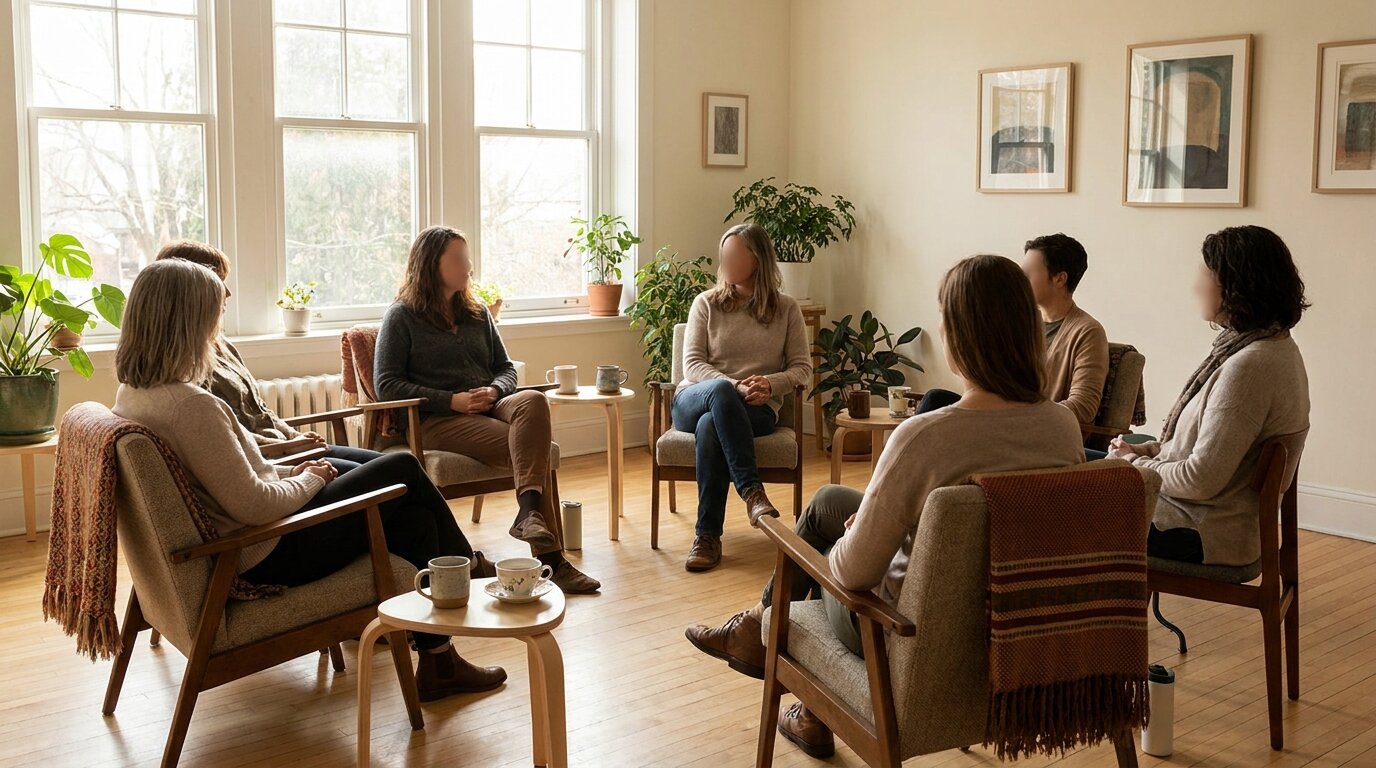
You need your own support, separately from theirs. Codependency, anxiety, and exhaustion in the family member is a separate problem from the addiction itself — and treating it does not require your loved one to do anything. Mar-Anon, Al-Anon, a CRAFT-trained therapist, or a counsellor of your own gives you somewhere to put the weight that isn’t them.
Concrete options for the family:
- Mar-Anon Family Groups — Al-Anon-modelled meetings specifically for families affected by another person’s cannabis use.
- Al-Anon — broader scope; about a third of members are there for a drug, not alcohol. Works fine for cannabis families.
- A CRAFT-trained therapist for you — many CRAFT sessions are 1:1 with the family member only; the user never needs to attend.
- An individual counsellor — to work on your own anxiety, sleep, and the boundary-setting muscles you will need.
The reframe that helps the most families we work with: your loved one’s recovery is not in your hands. Your wellbeing is. You can stop trying to control their use and still be a powerful, calm, recovery-friendly presence in their life.
When Does Residential Treatment Make Sense for Cannabis?
Residential treatment makes sense when the pattern is severe, outpatient options have failed once or twice, mental health complications are present (anxiety, psychosis, depression), or when home is the trigger. People rarely “need” inpatient for cannabis alone the way they do for severe alcohol or benzodiazepine dependence — but they often need the distance from supply, peer group, and routine that home cannot give them.
What residential treatment for cannabis looks like in practice at One Step:
- Length: most cannabis clients stay 28–60 days. Less than 28 rarely sticks. Sixty gives time for sleep, mood, motivation, and exercise tolerance to recover — all of which take 4–8 weeks off daily heavy use.
- Detox: cannabis withdrawal is uncomfortable, not medically dangerous. We handle it on-site — no hospital transfer needed. Expect irritability, sleep disruption, vivid dreams, and appetite drop for the first 1–2 weeks. Our on-site detox covers it.
- Programme: CBT and group therapy through the day, with structured fitness, nutrition, and meditation. See the full daily treatment schedule.
- Cluster-specific work: if anxiety has been driving the use, that’s where the clinical work focuses. Our cannabis rehab programme details how we approach this.
- Cost: ฿280,000/month (~$8,500 USD). Full breakdown on the pricing page. Medication, flights, visas, and personal items are not included.
- Family work: we run weekly family video calls during treatment and offer aftercare planning that includes the family — see aftercare.
If you are thinking about residential as the first move because the home situation has become untenable, that is a legitimate reason — but be honest with your loved one about why. “I need a break and you need a circuit-breaker” is a more truthful frame than “you are sick and need this.”
For a family playbook for a different drug that uses the same structure, our guide to talking to a loved one about ketamine addiction is worth a read — many of the conversation moves transfer directly.
Frequently Asked Questions
Common questions families ask when they suspect cannabis use has tipped into a problem.
Look at functioning, not frequency alone. If they’re meeting commitments, maintaining relationships, and can stop for two weeks without distress, it’s use you may not like but that doesn’t meet a clinical threshold. If two or more of the DSM-5 cannabis use disorder criteria — failed attempts to cut down, life narrowing around use, withdrawal, tolerance, continued use despite consequences — apply, it’s a disorder.
Generally no, unless they are under 16 and in your home. With adult children or partners, searches and confiscations almost always backfire — they treat it as proof you can’t be trusted and respond by hiding use more carefully. Your influence is the relationship; surveillance and seizure burn that influence for very little operational gain.
Take it seriously without buying it whole. Daily heavy cannabis use is associated with worsening anxiety over time, not better — the in-the-moment relief masks a rebound that drives further use. Suggest a proper anxiety assessment with a GP or therapist, and frame quitting as a way to find out what their baseline anxiety actually is, rather than a punishment.
Yes, if you’ve raised concerns. Sharing a joint at a party while telling them they use too much undermines your credibility entirely — they will (correctly) read it as you don’t really think it’s a problem. You don’t have to lecture; just don’t be part of the supply chain. If they ask, “because I asked you to take this seriously, and I’m taking it seriously too” is enough.
Generally not as a first move. Surprise interventions work better on TV than in life — they often produce a defensive person who agrees to treatment to escape the room, then leaves treatment within days. CRAFT (Community Reinforcement and Family Training) outperforms confrontational interventions in randomised trials and is the more reliable family approach for cannabis.
The acute phase — irritability, sleep disruption, vivid dreams, anxiety, low appetite — typically peaks in the first week and tapers over 2–3 weeks. Sleep can stay disrupted for 4–8 weeks. People often describe weeks 2–4 as the real test, when the novelty of stopping has worn off but baseline mood and energy haven’t fully returned. Our cannabis withdrawal timeline covers each phase.
That’s the most common starting point, not a dead end. Get yourself into a CRAFT-style support setup, work on the boundaries you can actually keep, and stop trying to push them through a door they’re sitting against. People usually move when a consequence they can’t reframe arrives — a job loss, a relationship ending, a health scare. Your job is to be the same calm person on the other side of that moment.
Written by
Alastair Mordey
Alastair Mordey is one of the pioneers of drug and alcohol treatment globally and specifically in Asia. He has been an addiction’s professional for twenty years. He started his career as an expert in substance abuse w...
Learn more about Alastair
Medically reviewed by
Dr. Worapakthorn Kongpesalaphun
Consultant Psychiatrist · Thai Licensed Medical Doctor · Residency in Psychiatry, Somdet Chaopraya Institute · Doctor of Medicine, Rangsit University
Dr. Worapakthorn Kongpesalaphun is a Thai Licensed Medical Doctor and Expert in Preventive Medicine (Community Mental Health) with extensive experience in addiction treatment and public health management. He holds multip...
Learn more about Dr. Worapakthorn