

Key Takeaways
- Alcohol detox is a short medical phase (typically 5–10 days) that handles acute withdrawal. Rehab is the longer therapeutic phase that follows — usually 28 to 90 days of structured psychotherapy.
- Detox alone has poor long-term outcomes. NIDA states explicitly that medically assisted detox "is rarely sufficient" on its own; without follow-up rehab, most people return to drinking within months.
- The two phases do different work. Detox keeps you medically safe through tremors, anxiety, and seizure risk. Rehab gives you the therapy, structure, and skills that make sobriety stick after the alcohol clears.
- Anyone with moderate or severe alcohol use disorder needs both. Detox-only makes sense for almost no one — it solves the easier problem and leaves the harder one untouched.
- At One Step in Chiang Mai, both phases happen on the same residential programme. Standard detox runs on-site; severe withdrawal cases detox first at our partner hospital before transferring back for the rehab phase.
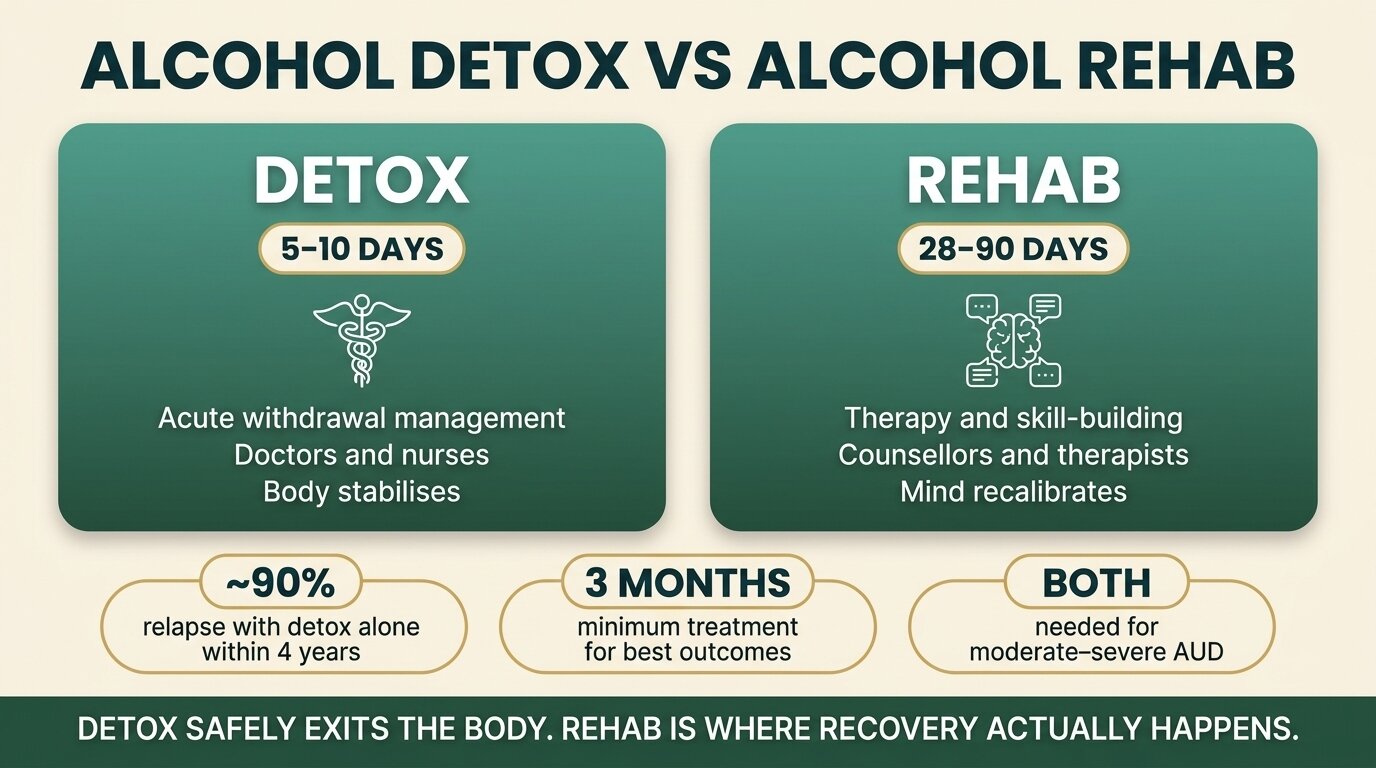
Detox is the short medical phase that gets alcohol out of your system safely. Rehab is the longer therapeutic phase that teaches you how to live without it. The two are often discussed as if they were interchangeable — they are not. Medically assisted detox "is rarely sufficient" on its own and does not produce the behavioural change recovery requires (NIDA, Principles of Effective Treatment, 2018). Stopping there is the single most common reason people relapse within weeks of leaving a hospital detox ward.
What Is Alcohol Detox?
Alcohol detox is the medically supervised process of getting through acute withdrawal — the 3 to 10 days when your body is recalibrating without alcohol. The goal is narrow and clinical: keep you safe through tremors, sweating, anxiety, insomnia, and the risk of seizures or delirium tremens. Detox stabilises the body. It does not treat the addiction.
In practice, alcohol detox involves a daily clinical assessment (often using the CIWA-Ar scale to score withdrawal severity), tapering doses of a long-acting benzodiazepine such as diazepam or chlordiazepoxide, IV or oral fluids, thiamine and B-vitamin supplementation to prevent Wernicke’s encephalopathy, and close observation of vital signs. The Cochrane review of 64 randomised trials confirms benzodiazepines are the most effective medication for preventing withdrawal seizures versus placebo (Amato et al., Cochrane Database of Systematic Reviews, 2022).
What detox does not do: it does not address why you drink, teach you how to refuse a drink at a wedding, repair the relationships that drinking damaged, or treat the depression or trauma sitting underneath. That is rehab’s job, and the two cannot do each other’s work.

What Is Alcohol Rehab?
Alcohol rehab is the therapeutic phase that begins once acute withdrawal has settled. It typically runs 28 to 90 days in a residential setting and combines individual counselling, group therapy, evidence-based modalities like cognitive behavioural therapy (CBT) and dialectical behaviour therapy (DBT), relapse-prevention planning, and structured daily routine. Rehab is where the actual recovery work happens.
A well-run residential programme will include several hours of clinical contact a day, peer group work, a fixed schedule that rebuilds sleep, exercise, and meals, and time to address co-occurring problems — anxiety, depression, trauma, family conflict, the loss of identity people often feel when alcohol is no longer organising their day. SAMHSA’s TIP 45 is explicit on the distinction: detoxification "does not constitute substance abuse treatment but is one part of a continuum of care" (SAMHSA TIP 45, 2006).
NIDA’s research synthesis is direct about duration: most people need at least 3 months of treatment to significantly reduce or stop their drinking, and the best outcomes come with longer stays (NIDA, 2018). A 7-day hospital detox is a small fraction of that.
How Are Detox and Rehab Actually Different?
Detox and rehab differ in length, setting, what they treat, who delivers them, and what the patient does each day. Detox is days; rehab is weeks. Detox is medical; rehab is therapeutic. Detox runs on doctors and nurses; rehab runs on counsellors and therapists. The patient is mostly passive in detox and almost entirely active in rehab.
| Dimension | Detox | Rehab |
|---|---|---|
| Length | 5–10 days (most cases) | 28–90 days |
| Primary goal | Manage acute withdrawal safely | Treat the underlying addiction |
| Setting | Hospital, residential rehab, or sometimes outpatient | Residential or outpatient programme |
| Lead staff | Doctors, nurses | Therapists, counsellors, psychiatrists |
| Main interventions | Benzodiazepine taper, fluids, thiamine, vital-signs monitoring | CBT, DBT, group therapy, relapse prevention, family work |
| Patient role | Largely passive — rest, hydration, sleep | Active — daily therapy work, group participation, homework |
| What it fixes | The body’s physical dependence | The drinking behaviour and its triggers |
| If you skip it | Risk of seizures, DTs, hospitalisation, death in severe cases | Very high relapse rates within weeks of stopping |

Why Does Detox Alone Have Such High Relapse Rates?
Detox alone fails because it solves only the body’s problem and leaves the mind’s problem untouched. After 7 days in a hospital ward, the alcohol is gone but the cravings, the social environment, the coping habits, the unaddressed anxiety or depression, and the cue-driven urges are all still in place. The person leaves physically clear and psychologically defenceless, and most return to drinking within months.
Long-term outcome research makes this concrete. Moos and Moos followed people with alcohol use disorder for 16 years and found that those who achieved short-term remission without professional treatment relapsed at substantially higher rates than those who received treatment — what the authors call a "double disadvantage" for the no-help group (Moos & Moos, Addiction, 2006). Detox without rehab is closer to the no-help group than people realise: the chemical exit is medical, but the recovery isn’t.
A meta-analysis of 33 controlled trials of continuing care after initial treatment found that staying engaged with structured therapy beyond the first phase produces a small but significant improvement in long-term outcomes (Blodgett et al., Journal of Substance Abuse Treatment, 2013). The pattern is consistent across the literature — engagement length predicts outcome, and a 7-day detox is not engagement length.
The mechanism is simple. Alcohol use disorder has rewired reward, stress, and decision-making in ways that take months of consistent therapeutic work to recalibrate. A week of benzodiazepines can’t do that work. It was never supposed to.
Wondering if you need both detox and rehab — or just one? Talk to our team — we’ll give you a straight answer based on your drinking pattern, not a sales pitch.
Who Needs Both Detox and Rehab?
Almost anyone with moderate or severe alcohol use disorder needs both phases. If you drink heavily every day, drink to manage withdrawal symptoms in the morning, or have a history of seizures, blackouts, or previous failed quit attempts, detox-only is not a treatment plan — it’s a medical procedure with no follow-through. Rehab is what turns the detox into a recovery.
A useful test: if removing alcohol makes you physically ill, you almost certainly also need help with the reasons you keep returning to it.
Detox by itself is the easier half of the work — clinically, we can usually stabilise someone in a week. What we see again and again is people who finished a hospital detox, felt fine, went home, and were drinking again within a fortnight because nothing about their environment or their coping skills had changed. The rehab phase is where that actually gets addressed.
Dr. Worapakthorn KongpesalaphunConsultant Psychiatrist, One Step Rehab
There is a small group of people for whom detox-only is reasonable: someone with very mild dependence, strong social support, no co-occurring mental health issues, no history of relapse, and a community-based aftercare plan already in place (mutual-help group, outpatient counsellor, supportive family). For everyone else — particularly anyone reading a post like this because they’re worried — detox-only is a setup for the next cycle.

How Do Detox and Rehab Connect at One Step?
At One Step, detox and rehab are one continuous residential programme rather than two separate stops. Standard alcohol detox happens on-site over the first 5–10 days, supervised by our medical team, and the rehab phase begins immediately after — same building, same staff, same room. The transition is seamless because there isn’t one in the logistical sense; only the clinical focus shifts.
For most clients with moderate alcohol dependence, this works directly. Our visiting doctor assesses you on intake, prescribes the benzodiazepine taper, and our nurses and support staff handle the daily checks while you rest, sleep, hydrate, and start to eat again. Once acute withdrawal has settled, you join the standard treatment programme — group therapy, individual counselling, CBT and DBT sessions, and the structured daily schedule.
For severe withdrawal cases — heavy long-term daily drinking, history of DTs, history of withdrawal seizures, significant medical comorbidity — we may detox you first at our partner hospital, which has intensive and intermediary intensive care units, and then you transfer to One Step for the rehab phase. That is the safer route when ICU-level monitoring is warranted; we are honest about which cases need it.
The programme fee is approximately ฿280,000/month (~$8,500 USD) and covers the residential treatment itself. Medication prescribed during detox or rehab is billed separately — you pay for what the doctor actually prescribes. Full pricing details are on the pricing page, including what’s not included (flights, visas, hospital visits, additional counselling, supplements).
Other relevant context: we keep alcohol treatment as the largest single segment of our caseload, so this is the situation we see most often. Detox planning starts at intake — not at admission day — so the medication, monitoring approach, and staffing are set before you arrive.

How Long Is the Full Detox-Plus-Rehab Stay?
A full stay covering both alcohol detox and the rehab phase typically runs 4 to 12 weeks. The detox portion is 5–10 days; the rehab portion is everything after that. NIDA’s research consistently identifies 90 days as the inflection point where outcomes meaningfully improve, which is why the longer end of that range is what we recommend whenever circumstances allow.
Shorter stays exist — some clients can only commit to 28 days because of work or family — and we’ll work with that, but we are upfront that 28 days is the floor, not the ideal. The literature is unambiguous: engagement length predicts outcome (NIDA, 2018). After residential treatment, aftercare — online groups, alumni contact, an outpatient counsellor at home — is what holds the gains in place.
Two related posts worth reading if you’re researching this: Alcohol Detox & Withdrawal: What to Expect for the medical detail of the detox phase, and our Complete Guide to Inpatient Alcohol Rehab for what the rehab phase looks like day to day.
Frequently Asked Questions
Common questions about how alcohol detox and rehab differ and connect.
It is technically possible but rarely advisable for anyone with moderate or severe alcohol use disorder. Detox alone has very high relapse rates because it does not address the psychological, behavioural, or social drivers of drinking. NIDA states explicitly that medically assisted detoxification is rarely sufficient on its own.
Alcohol detox typically takes 5–10 days. Alcohol rehab usually runs 28–90 days depending on severity, history of previous attempts, and how much time the person can commit. Detox is roughly 5–10% of the total stay; rehab is the long phase where the actual therapeutic work happens.
No. SAMHSA’s TIP 45 makes the distinction explicit: detoxification is one part of a continuum of care, but it is not the same as treatment or rehabilitation. Detox manages the body’s withdrawal; rehab treats the addiction itself through psychotherapy, group work, and skill-building over weeks or months.
Most people detox on-site at One Step under medical supervision. For severe withdrawal cases — heavy long-term daily drinking, history of delirium tremens or seizures, significant medical complications — we may detox you first at our partner hospital, which has intensive and intermediary intensive care units, before you transfer back to One Step for the rehab phase.
The standard approach is a tapering dose of a long-acting benzodiazepine — diazepam or chlordiazepoxide are the most common — alongside thiamine, B-vitamins, and fluids. The Cochrane review of 64 trials confirms benzodiazepines are the most effective medication for preventing alcohol-withdrawal seizures compared to placebo. Medication is billed separately from the programme fee.
The residential cost of the detox phase at One Step is part of the standard programme fee (~฿280,000/month). Medication prescribed by the doctor during detox is billed separately. If severe withdrawal requires a stay at our partner hospital first, the hospital fees are billed by the hospital and are not included in the One Step programme fee.
Detox is the first step, not the last. After the rehab phase ends, aftercare continues for months — online alumni groups, outpatient counselling at home, mutual-help meetings. Meta-analytic evidence shows continuing care produces small but significant improvements in long-term outcomes, so we treat aftercare as part of the same recovery, not a separate one.
Written by
Worapakthorn Kongpesalaphun, MD., Ph.D.
Dr. Worapakthorn Kongpesalaphun is a Thai Licensed Medical Doctor and Expert in Preventive Medicine (Community Mental Health) with extensive experience in addiction treatment and public health management. He holds multip...
Learn more about Worapakthorn