
Key Takeaways
- Holistic is not an alternative to clinical treatment for meth. It’s the wraparound — sleep, nutrition, exercise, meditation, group — that supports the clinical spine of CBT, motivational interviewing, contingency management, and dual diagnosis care.
- The clinical spine matters most. Behavioural therapies (CBT and contingency management especially) are what NIDA and SAMHSA cite as the evidence base for meth treatment. There is currently no approved medication for meth use disorder.
- Sleep restoration, nutrition repair, and structured exercise have real research behind them. Meth devastates all three, and rebuilding them shortens the joyless months and lowers relapse risk.
- Mindfulness-based relapse prevention has the strongest evidence among “holistic” modalities — a JAMA Psychiatry trial showed it outperforms treatment-as-usual for substance use disorders at 12 months.
- “Holistic-only” meth programmes are dangerous. Ayahuasca, ibogaine, supplement cures, and “detox cleanses” have no evidence base for meth, and some carry serious medical risk.
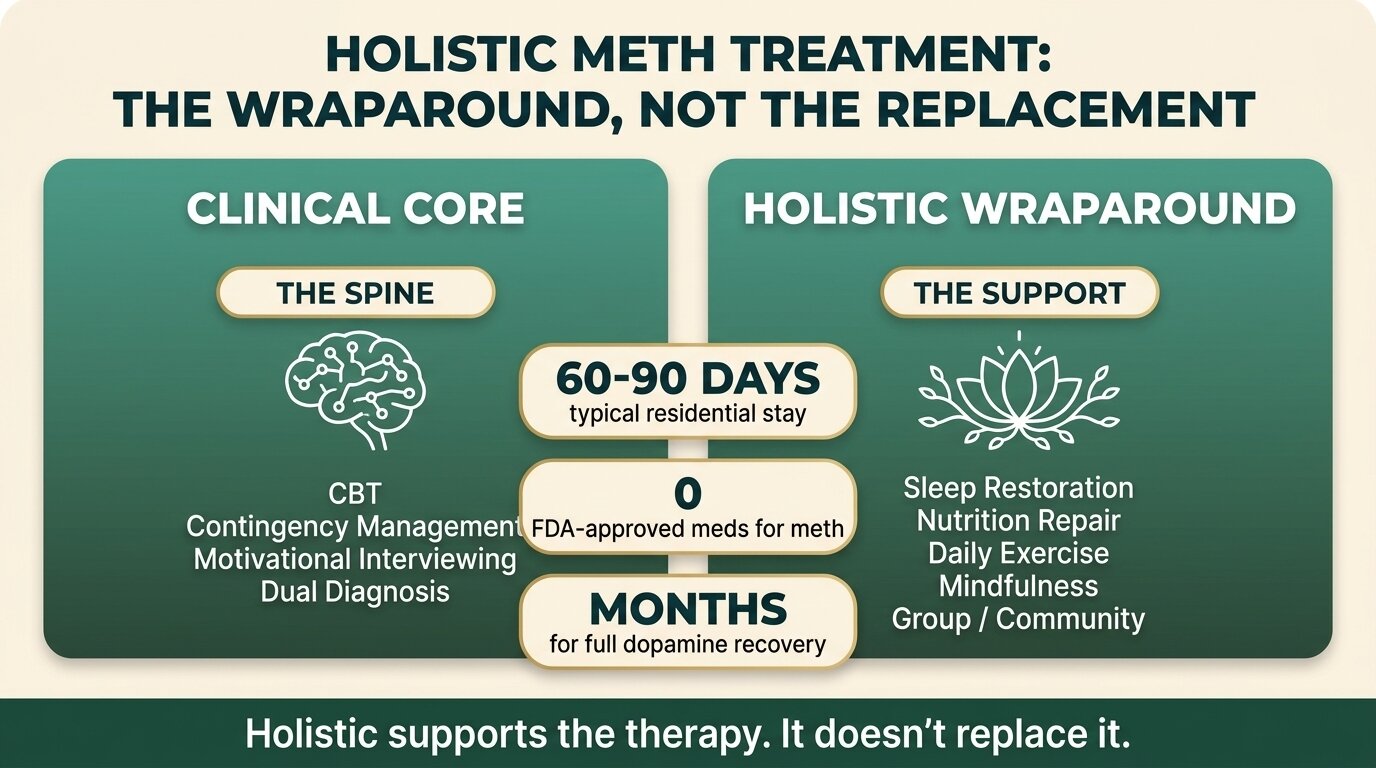
Holistic meth addiction treatment works when it sits on top of evidence-based clinical care — not in place of it. The honest version of “holistic” is the wraparound that supports the therapy: sleep restoration, nutrition repair, daily structured exercise, mindfulness training, group, and meaning. Meth recovery is long and joyless for months because the brain’s reward system takes that long to recover (Morais et al., CNS Neuroscience & Therapeutics, 2017). A programme that pays attention to the body, sleep, nervous system, and community survives that stretch. A programme that’s only clinical usually doesn’t. A programme that’s only holistic — meditation retreat, juice cleanse, no therapy — is dangerous.
This post covers what “holistic” actually means in serious meth treatment, which modalities have evidence, which ones don’t, and how One Step’s meth rehab programme in Chiang Mai puts the wraparound around the clinical core.
What Does “Holistic” Actually Mean for Meth Treatment?
Holistic treatment for meth addiction means addressing the whole person — body, sleep, nutrition, nervous system, relationships, and meaning — as a supporting structure around the clinical core of therapy. It is not an alternative to evidence-based care. SAMHSA’s TIP 33 names cognitive behavioural therapy, contingency management, motivational interviewing, and dual diagnosis treatment as the proven approaches for stimulant use disorders (SAMHSA TIP 33, 2021). Holistic wraps these.
Here’s the framing we use: the therapy is the spine. The body, sleep, exercise, nutrition, group, and meaning layers are the muscles around it. Strip out the spine and you have a wellness retreat. Strip out the muscles and the spine is exposed — most meth clients won’t stay long enough to do the work, because withdrawal anhedonia (the joyless months) breaks them before the therapy can land.
“Holistic” gets misused in two directions. Some facilities use it as marketing for spa days. Other facilities reject the word entirely because it’s been so abused. Both miss the point. Serious holistic treatment in Chiang Mai is a clinical programme that takes the body seriously — because in meth recovery, the body is what fails first.
What Is the Clinical Core of Meth Treatment?
The clinical core of meth treatment is behavioural therapy. NIDA identifies cognitive behavioural therapy and contingency management as the two best-evidenced approaches, with motivational interviewing, group support, and dual diagnosis treatment alongside (NIDA, 2024). There is currently no FDA-approved medication for meth use disorder, which makes the behavioural work the heart of treatment.
Why these specifically:
| Modality | What it does | Why it matters for meth |
|---|---|---|
| Cognitive Behavioural Therapy (CBT) | Identifies cravings, triggers, thought patterns; builds coping responses | Meth use is heavily cue-driven (paraphernalia, people, places). CBT teaches the response. |
| Contingency Management (CM) | Tangible rewards for verified abstinence | The single most-evidenced behavioural intervention for stimulants. Compensates for the broken reward system. |
| Motivational Interviewing (MI) | Resolves ambivalence about quitting; works with — not against — resistance | Most meth clients arrive ambivalent. MI is how the door opens. |
| Dual diagnosis treatment | Treats co-occurring conditions (depression, anxiety, ADHD, PTSD, psychosis history) | Heavy meth use commonly leaves residual psychiatric symptoms. Untreated, they drive relapse. |
| Group / therapeutic community | Peer accountability, normalisation, shared experience | Meth recovery is isolating. Group is how the joyless months become survivable. |
Everything we describe in the rest of this post — sleep, exercise, nutrition, mindfulness, meditation, acupuncture, bodywork — wraps around that spine. Read more on how CBT and DBT work for addiction if you want the therapy detail.

Why Is Sleep Restoration Such a Big Part of Meth Recovery?
Meth devastates sleep, and sleep disturbance is a universal risk factor for relapse across all psychoactive substances (Brower & Perron, Med Hypotheses, 2009). Chronic meth users routinely go days without sleep, then crash for 24 to 48 hours. By the time someone arrives in treatment, their circadian rhythm is in pieces. Rebuilding it is not optional — it’s a clinical priority.
What actually helps:
- Fixed wake time. Same time every day, regardless of how well you slept. The body recalibrates around the wake time, not the bedtime.
- Low-stimulation evenings. No screens in bed, no caffeine after midday, dim lights from 8pm onward.
- Blackout bedrooms. Sounds simple. Most people skip it. Light exposure at night blocks the melatonin curve.
- Morning daylight. 10–15 minutes of outdoor light within an hour of waking — the strongest single signal for resetting the body clock.
- Melatonin where clinically appropriate. Short-term, low-dose, doctor-supervised. Not as a long-term sleeping pill.
- Movement during the day. Exhaustion through use, not sedation through medication.
This stretch — the first six to eight weeks where sleep is broken and the body is recalibrating — is when many people relapse. They feel awful, can’t sleep, and meth is the only thing that ever made the awful go away. Treating sleep seriously is part of treating relapse risk.

How Does Nutrition Repair Work in Meth Recovery?
Chronic meth use leaves people severely undernourished. The drug suppresses appetite for days, depletes water and electrolytes, and undermines absorption. By the time someone enters treatment, common deficiencies include B-vitamins, magnesium, zinc, and protein — the exact nutrients the nervous system needs to repair itself. Real food is part of the treatment, not a side amenity.
A serious nutrition approach in meth recovery looks like:
- Three structured meals a day at consistent times — eating cues the body to expect food again, which restores appetite signalling
- Protein with each meal — amino acids are precursors for the neurotransmitters meth depleted
- B-complex, magnesium, and zinc where deficient — addressed clinically, not via shelf supplements
- Hydration deliberately rebuilt — chronic meth users are often profoundly dehydrated
- No sugar binges as substitute reward — common pitfall; spikes and crashes worsen mood and cravings
For deeper detail on the food side of recovery, see our companion post on nutrition and the dopamine diet in addiction recovery. The principles apply broadly, but meth recovery is where they matter most because the depletion is so severe.

How Does Exercise Help Meth Recovery?
Structured daily exercise is one of the most evidence-supported wraparound modalities in meth recovery. Aerobic exercise reduces cravings, improves mood, restores cognitive control, and appears to support recovery of the dopamine system that meth damaged (Huang et al., Frontiers in Psychiatry, 2020). It is not optional in our programme — it is daily.
What works in practice:
- 30 to 60 minutes of moderate aerobic exercise, most days. Walking briskly, swimming, cycling, structured gym sessions. Intensity matters less than consistency.
- Strength training two to three times a week. Rebuilds muscle mass meth catabolised; supports mood through testosterone and growth hormone restoration.
- Outdoor movement. Combines exercise with daylight (sleep benefit) and nature exposure (stress reduction).
- Not extreme. Some clients arrive obsessed with replacing meth’s intensity with exercise intensity. We slow that down — overtraining sabotages sleep and amplifies anxiety.
A 2024 Frontiers in Psychiatry review of 17 studies confirmed that exercise interventions consistently reduce negative emotions and drug cravings in meth users (Xu et al., Frontiers in Psychiatry, 2024). The mechanism appears to involve upregulation of dopamine D2/D3 receptors — exercise is one of the few non-drug ways to repair the reward system meth burned out.
Not sure if a holistic-plus-clinical programme is right for your situation? Talk to our team — we’ll give you a straight answer, including if we think somewhere else fits you better.
Does Mindfulness Meditation Actually Work for Meth?
Yes — within limits. Mindfulness-based relapse prevention (MBRP) has the strongest evidence base of any “holistic” modality used in addiction treatment. A JAMA Psychiatry randomised trial found MBRP outperformed standard relapse prevention and treatment-as-usual for substance use disorders at 12 months (Bowen et al., JAMA Psychiatry, 2014). For meth specifically, mindfulness is useful for craving surfing, cue exposure, and tolerating anhedonia.
The clinical mechanism: mindfulness teaches people to observe a craving as a wave that crests and falls, rather than as a command. Trials show MBRP significantly reduces craving and the avoidance behaviours that drive relapse (Witkiewitz et al., Addictive Behaviors, 2012). For meth users facing the long anhedonia stretch, this is one of the few skills that translates immediately.
What mindfulness does not do: it doesn’t replace therapy, it doesn’t shortcut withdrawal, and a ten-day silent retreat is not a meth treatment programme. It is a skill — taught, practised, and integrated alongside CBT and group.
Does Buddhist Meditation in Chiang Mai Help?
Chiang Mai’s Buddhist meditation tradition genuinely supports recovery for clients open to it — but only as an adjunct, not a treatment in itself. The city has a centuries-old monastic tradition, accessible temples, and meditation teachers who work with foreigners. For clients who want it, structured temple visits and meditation instruction become a meaningful part of the wraparound. It is not a marketing prop. It is locally available, and it works.
The honest version: not every client wants this, and we don’t push it. Some clients arrive sceptical of anything religious or spiritual, and the clinical programme stands on its own. For clients who do engage with it — including non-Buddhist clients — the structure of mindfulness practice, the calm of temple environments, and the cultural distance from the chaos of active use are restorative. Read more about how this fits the case for rehab in Thailand.
What About Acupuncture, Massage, and Bodywork?
These are adjuncts — useful for nervous system regulation and sleep, not curative. Auricular acupuncture using the NADA protocol has modest evidence for reducing anxiety and improving sleep in early substance recovery (Ahlberg et al., Substance Abuse Treatment, Prevention, and Policy, 2016). Massage and bodywork help downregulate the chronic sympathetic activation that lingers after stimulant use. Neither replaces therapy.
Where these fit:
- Acupuncture (NADA protocol) — small, frequent sessions during the first weeks; helps anxiety and sleep onset
- Therapeutic massage — weekly; releases held tension, supports parasympathetic recovery
- Breathwork — daily; the cheapest, most portable nervous system regulation tool
- Yoga and stretching — daily; pairs movement with breath and attention
These are the kinds of things that make a meth client’s body feel less awful while the therapy does its work. They are not therapy. A facility that markets “holistic meth treatment” as primarily massage and acupuncture is selling you a spa.
Which “Holistic” Treatments Don’t Work (or Carry Risk) for Meth?
Several “holistic” interventions marketed to meth users have no evidence base and some carry real medical risk. Ibogaine has some weak evidence for opioid withdrawal but not for meth, and it carries cardiac arrhythmia risk that has caused deaths. Ayahuasca and psychedelic “cures” for meth are not supported by clinical evidence. “Detox cleanses” and supplement protocols sold as standalone meth treatments are marketing, not medicine.
| Approach | Why we don’t recommend it for meth |
|---|---|
| Ibogaine | Some opioid evidence; thin for meth; serious cardiac arrhythmia risk including reported deaths |
| Ayahuasca / psychedelic ceremonies as “cure” | No controlled evidence for meth; ceremonies are not clinical treatment; risk of psychosis in vulnerable clients |
| “Detox cleanses” and juice fasts | No mechanism to remove meth (it clears in days); risk of dehydration and electrolyte imbalance |
| Supplement “cures” (amino acid protocols, IV vitamins as standalone) | Useful as nutrition support; not curative; no replacement for therapy |
| Pure naturopathy without therapy | Misses the behavioural core of meth recovery; meth use disorder is not a deficiency state |
| Equine / animal-assisted therapy as a primary modality | Emerging evidence as an adjunct; not enough yet to recommend as primary; we don’t currently offer it on site |
The pattern: anything sold as a meth cure is overselling. The evidence-based modalities are unglamorous — therapy, group, exercise, sleep, food, time.
An Honest Read on Holistic Meth Treatment
The reason we layer sleep, food, exercise, group, and meditation around the therapy isn’t to make a brochure look good. It’s because meth recovery takes months, the body has to repair, and people don’t stay long enough to do the work if you ignore everything else. The therapy is the core. The wraparound is what keeps clients in the chair long enough for the therapy to land.
Alastair MordeyProgramme Director, One Step Rehab
How Does One Step Combine Clinical and Holistic for Meth?
One Step’s meth programme runs a clinical spine of CBT, motivational interviewing, group therapy, and dual diagnosis treatment, wrapped in a structured daily routine of sleep, nutrition, exercise, mindfulness, and Chiang Mai’s natural environment. The programme runs ~฿280,000/month (~$8,500 USD) for 28-day minimum stays, with most clients staying 60–90 days because meth recovery genuinely takes that long.
What that looks like operationally:
- Clinical core: Individual CBT sessions, group therapy daily, motivational interviewing, dual diagnosis treatment with our visiting psychiatrist
- Sleep: Fixed wake times, dark rooms, structured evenings, no screens in bed for the first weeks
- Nutrition: Three planned meals a day — not a buffet — with protein at each, hydration, B-complex and other supplementation where indicated. Read about our nutraceutical approach.
- Exercise: On-site gym and pool, daily movement, hiking in the surrounding mountains as part of our outdoor therapy programme
- Mindfulness: Daily mindfulness practice built into the schedule; optional partner-temple meditation for clients who want it
- Bodywork: Weekly massage included; additional sessions billed separately
- Group / community: Therapeutic community model — clients live alongside each other, accountability is built into the daily structure
The full treatment schedule and treatment programme pages have the daily breakdown. Pricing covers what’s included and what isn’t — medication is billed separately, as are flights, visa extensions, and additional bodywork beyond the weekly session.
The location matters. Chiang Mai sits in the forested mountain north of Thailand. Cool mornings, hot afternoons, big skies, low cost of living, slow pace. It’s a setting that supports the body recovering — not because the air is magic, but because the daily rhythm is sane.
If you or someone you love is struggling with substance dependence, explore how a drug addiction treatment in Thailand can provide the structure, clinical support, and environment needed for lasting recovery.
Frequently Asked Questions
Common questions about holistic meth addiction treatment.
No. Holistic-only treatment for meth is not enough and can be dangerous. Meth use disorder responds best to behavioural therapy — CBT, contingency management, motivational interviewing — alongside dual diagnosis care. Holistic modalities (sleep, exercise, nutrition, mindfulness, bodywork) support the therapy but cannot replace it.
There is currently no FDA-approved medication for methamphetamine use disorder. Medications are used to treat co-occurring conditions — depression, anxiety, ADHD, sleep — and to manage symptoms during early recovery. That’s why behavioural therapy is the centre of meth treatment, not medication.
Sleep and nutrition repair start within the first one to two weeks. Mood improvements from exercise show up at three to six weeks. The full dopamine recovery and reduction of anhedonia takes months. That’s why most meth clients need 60 to 90 days of residential treatment, not 28 days.
No. Ibogaine has thin evidence for opioids and almost none for meth, and it carries serious cardiac arrhythmia risk. Ayahuasca and psychedelic ceremonies have no controlled-trial evidence as meth treatments. Both can trigger psychiatric crises in vulnerable clients. Neither should be considered a meth treatment.
Yes, optionally. Daily mindfulness practice is built into the programme for everyone. Beyond that, we offer partner-temple meditation visits and instruction with local Buddhist teachers for clients who want it. It’s not pushed on anyone, and the clinical programme works whether a client engages with the Buddhist element or not.
The terms are used loosely. As we use them: serious holistic treatment means a clinical programme that takes the body, sleep, nutrition, and mind seriously as part of recovery. “Wellness rehab” sometimes means the same thing — and sometimes means a spa with no clinical depth. Ask what therapy hours per week look like before booking.
Meth causes deeper and longer-lasting damage to the brain’s dopamine system than most other drugs, which is why anhedonia (inability to feel pleasure) can last months into recovery. The joyless stretch is when most relapses happen — see our companion post on why meth addiction is so hard to overcome.
Written by
Alastair Mordey
Alastair Mordey is one of the pioneers of drug and alcohol treatment globally and specifically in Asia. He has been an addiction’s professional for twenty years. He started his career as an expert in substance abuse w...
Learn more about Alastair
Medically reviewed by
Dr. Worapakthorn Kongpesalaphun
Consultant Psychiatrist · Thai Licensed Medical Doctor · Residency in Psychiatry, Somdet Chaopraya Institute · Doctor of Medicine, Rangsit University
Dr. Worapakthorn Kongpesalaphun is a Thai Licensed Medical Doctor and Expert in Preventive Medicine (Community Mental Health) with extensive experience in addiction treatment and public health management. He holds multip...
Learn more about Dr. Worapakthorn