

Key Takeaways
- Cocaine has no life-threatening physical withdrawal — but the psychological withdrawal is brutal, and it is the most under-discussed reason people relapse.
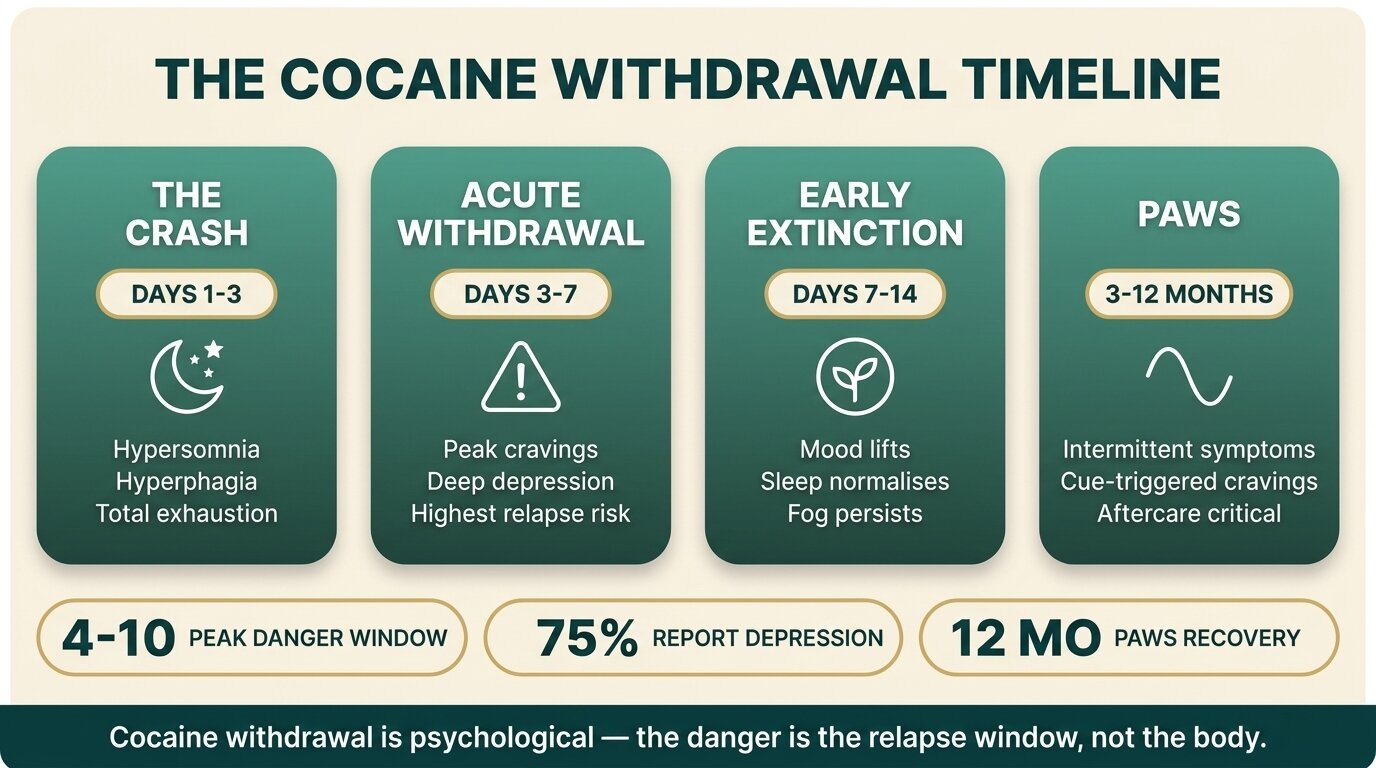
- Days 1-3 is the crash: exhaustion, hypersomnia, constant eating, depression, and total loss of interest in anything that isn’t cocaine.
- Days 3-7 is the worst window. Cravings peak, depression deepens (often including suicidal thoughts), and irritability and dysphoria spike.
- Days 7-14 is early extinction: mood lifts slowly, sleep starts to normalise, but cognitive fog and anhedonia persist and cravings still come in waves.
- Post-acute withdrawal (PAWS) — intermittent depression, low motivation, and cue-triggered cravings — can persist for 3-12 months and is why structured aftercare matters more than detox.
Cocaine withdrawal will not kill you. That is the one true sentence in the cultural narrative that “cocaine has no withdrawal.” Everything else is wrong. Stopping cocaine after sustained heavy use triggers a defined psychological withdrawal syndrome — a three-phase sequence first mapped by Gawin and Kleber in 1986 and refined repeatedly since (Gawin & Kleber, Arch Gen Psychiatry, 1986). The crash arrives within hours. Cravings peak somewhere between days four and ten. Depression touches suicidal in many cases. And the slow recovery of the brain’s reward system can take three to twelve months. This guide walks through what each window actually feels like, what helps, and why most at-home detox attempts fail in the same 4-10 day stretch.
Is Cocaine Withdrawal Real, and How Bad Does It Get?
Yes. Cocaine withdrawal is real, defined in the DSM, and clinically significant — it just isn’t physically dangerous the way alcohol or benzodiazepine withdrawal is. There are no seizures, no autonomic crashes, and no risk of death from the withdrawal itself. The danger is psychological: severe depression, suicidal ideation, and cravings powerful enough to drive almost any decision (Cottler et al., Drug Alcohol Depend, 1993).
The DSM diagnostic criteria require a dysphoric mood plus at least two of: fatigue, vivid and unpleasant dreams, sleep disturbance, increased appetite, and psychomotor slowing or agitation. People who meet the full criteria are also significantly more likely to have a lifetime history of depression — which is part of why the early days feel so dangerous, and why monitoring matters.
The narrative that “cocaine has no withdrawal” comes from comparison with the substances that do require medical detox. Compared to a four-day benzodiazepine taper or an alcohol detox with a seizure-risk window, the cocaine crash looks invisible from the outside. From the inside, it is the worst week of most people’s lives.
What Happens in Days 1-3 — the Crash?
Days 1-3 is the crash phase: the body shutting down after sustained dopaminergic activation. Expect total exhaustion, hypersomnia (sleeping 12-16 hours and still feeling wrecked), hyperphagia (eating constantly, often craving carbs and sugar), depressed mood, and complete loss of interest in anything that isn’t cocaine. Most people barely move from the bed.
This is the body recovering, not the brain. After a long binge, sleep architecture is wrecked, electrolytes are depleted, vitamin stores are run down, and the autonomic nervous system has been on emergency override for days. The crash is what happens when all of that finally stops being suppressed by stimulant.
Cravings in this window are usually mild — paradoxically. The body is too tired to want more cocaine. People often misread this and think they have quit. Then day 3 or 4 arrives.

Why Are Days 3-7 the Most Dangerous Window?
Days 3-7 is when acute withdrawal peaks and the relapse risk is highest. Cravings spike hard, depression deepens (sometimes into suicidal ideation), anxiety and dysphoria intensify, vivid drug-focused dreams disrupt sleep, and irritability makes every interaction feel hostile. The body has rested; now the brain is asking for what is missing. Most at-home detox attempts collapse in this window.
This is the phase Gawin and Kleber originally called “withdrawal” in their three-phase model — distinct from the crash that precedes it and the extinction phase that follows. Modern research has refined the timing but kept the shape: the worst psychological symptoms cluster around days 4-10, then slowly attenuate (Pathiraja et al., Prog Neuropsychopharmacol Biol Psychiatry, 1995).
The depression here is not metaphorical. Roughly three-quarters of patients in clinical studies report significant depressive symptoms during this window, and depression in early cocaine abstinence is independently associated with suicidal ideation. This is why monitoring matters and why the standard of care is supportive residential care, not “white-knuckling it” at home.
The danger of this window is not the discomfort. It is the combination of three things at once: brutal cravings, depressive thinking that says “this will never get better”, and the knowledge that one line will fix all of it for an hour. That is why this is when people relapse.
What Changes in Days 7-14 — the Early Extinction Phase?
Days 7-14 is the early extinction phase. Mood starts to lift, sleep slowly normalises, daytime energy returns in patches, and cravings come in waves with more space between them. Cognitive fog and anhedonia persist — the world still looks grey — but the bottom is no longer dropping out every few hours. This is the first time most people can imagine sustained abstinence.
The clinical name is “early extinction” because the conditioned response between cues (places, people, paraphernalia, certain emotional states) and the drug is starting to weaken without reinforcement. It does not disappear. It weakens. People who relapse in week 3 often do so because they confuse “feeling better” with “being recovered” and re-expose themselves to old cues.
Sleep is the most reliable marker. By day 10-14, most people can sleep 7-9 hours without significant disturbance. Appetite normalises. Energy stops being all-or-nothing. The fog persists but is no longer disabling. This is also when underlying issues — the reasons cocaine got used in the first place — start to surface, which is one reason daily group therapy is essential during this window.
Not sure whether you or someone you love needs residential support to get through the first 14 days? Talk to our team — we will give you an honest answer, including if we think you would be safe trying outpatient first.
What Is Post-Acute Withdrawal (PAWS) and How Long Does It Last?
Post-acute withdrawal syndrome (PAWS) describes the intermittent psychological symptoms that persist after the acute window closes — typically intermittent low mood, anhedonia, sleep disturbance, low motivation, and cue-triggered cravings. For cocaine, PAWS commonly lasts 3-12 months. Symptoms come and go in waves rather than continuously, which is what makes them so hard to predict and plan for.
The biological mechanism is slow recovery of dopamine receptor sensitivity. Heavy stimulant use down-regulates the brain’s reward signalling; rebuilding that signalling is measured in months, not days. This is why people in month four of recovery can have a sudden week of profound anhedonia for no obvious reason, then return to baseline.
The practical implication: residential treatment ending at day 30 or day 60 is not “the end of withdrawal.” It is the end of the acute phase. The PAWS months are where most relapses happen, and they are why structured aftercare and ongoing therapy matter more than the original detox.

Does Cocaine Withdrawal Need Medical Detox?
No — cocaine withdrawal does not require medical detox in the way alcohol or benzodiazepine withdrawal does. There is no autonomic instability, no seizure risk from the withdrawal itself, and no FDA-approved anti-craving medication for stimulants. The standard of care is supportive residential care: structured days, sleep environment, nutrition, peer support, and access to a doctor for symptom management (NIDA, 2024).
That said, “no medical detox” does not mean “no medical input.” A doctor on hand matters for three reasons. First, sleep — severe insomnia in week one is common, and a short course of a non-addictive sleep aid can make the difference between staying in treatment and walking out. Second, depression — if it does not lift by week 2-3, a low-dose antidepressant may be appropriate. These are not started on day 1; they are introduced when the picture stabilises enough to know depression is persisting rather than withdrawal-driven. Third, monitoring for suicidal ideation, which is a known risk in this window (SAMHSA TIP 33, 2021).
The cocaine crash looks small from the outside because nobody seizes and nobody dies of the withdrawal itself. From the inside, days four through ten are the worst week of most people’s lives. We treat that window with structure, sleep, food, and people around — not heavy medication. The medication question is for week three, when we can tell whether the depression is the withdrawal lifting or something underneath that needs treatment.
Dr. Worapakthorn KongpesalaphunConsultant Psychiatrist, One Step Rehab
What Helps the Crash and Withdrawal Beyond Medication?
Non-medical interventions do most of the work in cocaine withdrawal. The four that consistently matter are: structured daily schedule (wake time, meals, therapy slots, lights out — not optional), a sleep environment that supports recovery (dark, quiet, no phones), nutrition that addresses depletion (regular meals, hydration, B-vitamins, electrolytes), and physical distance from cues — the people, places, and paraphernalia tied to use.
Group therapy daily — not weekly — is the single highest-leverage intervention. People in withdrawal lie to themselves; they tell themselves they can handle “just one.” Sitting in a room with other people who have made and broken the same promise to themselves is what interrupts that.
The work after detox is where outcomes are made. Cognitive behavioural therapy and dialectical behavioural therapy teach the specific skills for managing cravings and the emotional dysregulation that drives use. Therapy for cocaine recovery specifically works through the conditioned cue-craving response that PAWS produces. Sleep that has collapsed during use needs deliberate rebuilding — see our guide on sober sleep. And almost everyone benefits from a clear inventory of the 10 most common relapse triggers before they leave residential care.
When Is the Highest Risk of Relapse — and Why?
Days 4-10 carry the highest acute relapse risk. Cravings are at their peak, depression is at its deepest, sleep is still wrecked, and the body now has enough energy to act on impulses it could not act on during the crash. Most people who attempt at-home cocaine detox return to use in this window — not because they are weak, but because the situation is engineered to fail.
The second risk peak comes in month 2-4, during PAWS. By then the acute symptoms have resolved enough that the person looks recovered, feels recovered on good days, and starts re-entering the environments where cocaine was used. A single cue-triggered craving — bumping into an old user, walking past a familiar bar, a stressful week — can produce intense urges that feel disproportionate to the situation. This is the conditioned response Gawin and Kleber described.
The risk profile matters because it determines what aftercare actually has to do. Residential treatment that ends without a plan for months 2-12 is treating the acute window only. The relapse data — across cocaine, methamphetamine, and other stimulants — consistently shows that length of structured engagement, not the intensity of the initial detox, predicts outcomes (SAMHSA TIP 33, 2021).

How Does One Step Handle Cocaine Withdrawal On-Site?
One Step provides supportive on-site detox for cocaine. No partner-hospital escalation is needed for cocaine — it is not severe-detox territory, so the entire withdrawal and treatment cycle happens in one place. Standard programme length is 28-60 days at approximately ฿280,000/month (~$8,500 USD), which covers room, food, therapy, and clinical input. Medication is billed separately if anything is prescribed.
The first 14 days follow a structured pattern. Wake times and meals are fixed. Sleep environment is set up to support recovery — single room, AC, dark, no phones the first week. Doctor input is available throughout for symptom management. Group therapy starts on day 2-3 once the worst of the crash has passed; one-to-one therapy follows. Outdoor activity is introduced gradually as energy returns.
Past day 14, the programme transitions into the active treatment phase. CBT and DBT work through the relapse window. Family programme runs in parallel for those whose recovery involves repairing close relationships. Aftercare extends 12 months, which is the relevant timeframe for PAWS — see our aftercare programme. For more on the substance-specific programme, see our cocaine rehab in Thailand page.
Cocaine recovery in residential treatment also benefits from working through the specific patterns that drove use — whether that was cocaine combined with alcohol, a high-functioning use pattern that hid the problem, or escalation through different forms of the drug. The acute detox is the easy part. The 90 days after are where the work happens.
Frequently Asked Questions
Quick answers to the most common questions about cocaine withdrawal and detox.
The acute physical and psychological withdrawal typically lasts 7-14 days, with the worst window between days 3-7. Post-acute withdrawal (PAWS) — intermittent low mood, anhedonia, and cue-triggered cravings — commonly persists 3-12 months as the brain’s dopamine signalling recovers.
The withdrawal itself is not physically life-threatening — there is no risk of seizures or autonomic crashes the way there is with alcohol or benzodiazepines. The danger is psychological: severe depression and suicidal ideation are common during days 3-10. Supportive residential care with monitoring for suicidal thoughts is the standard.
It is medically possible because cocaine has no dangerous physical withdrawal, but most people who attempt at-home detox relapse between days 4 and 10 when cravings peak and depression deepens. The relapse risk is the reason supportive residential care is the standard of care, not the physical danger.
No medication has been FDA-approved for cocaine cravings. Short-course sleep aids are sometimes prescribed for severe insomnia, and a low-dose antidepressant may be introduced in week 2-3 if depression persists past the acute window. The core of treatment is behavioural, not pharmacological.
Heavy cocaine use down-regulates the brain’s dopamine signalling. When the drug is removed, the reward system temporarily cannot produce normal pleasure responses — clinically called anhedonia. The depression is real and biologically driven, and for most people it lifts substantially by week 2-3 as receptors begin to recover.
PAWS describes the intermittent psychological symptoms that persist after the acute 14-day window — low mood, low motivation, anhedonia, sleep disturbance, and cue-triggered cravings. For cocaine, PAWS commonly lasts 3-12 months. Symptoms come in waves, which is why structured aftercare matters more than the original detox.
Yes. Cocaine detox is handled on-site at One Step — there is no hospital transfer needed because cocaine withdrawal is not in the severe-detox category that requires ICU-level monitoring. The full withdrawal and treatment cycle, including the relapse window and early aftercare planning, happens in one place over 28-60 days.
Written by
Worapakthorn Kongpesalaphun, MD., Ph.D.
Dr. Worapakthorn Kongpesalaphun is a Thai Licensed Medical Doctor and Expert in Preventive Medicine (Community Mental Health) with extensive experience in addiction treatment and public health management. He holds multip...
Learn more about Worapakthorn