

Key Takeaways
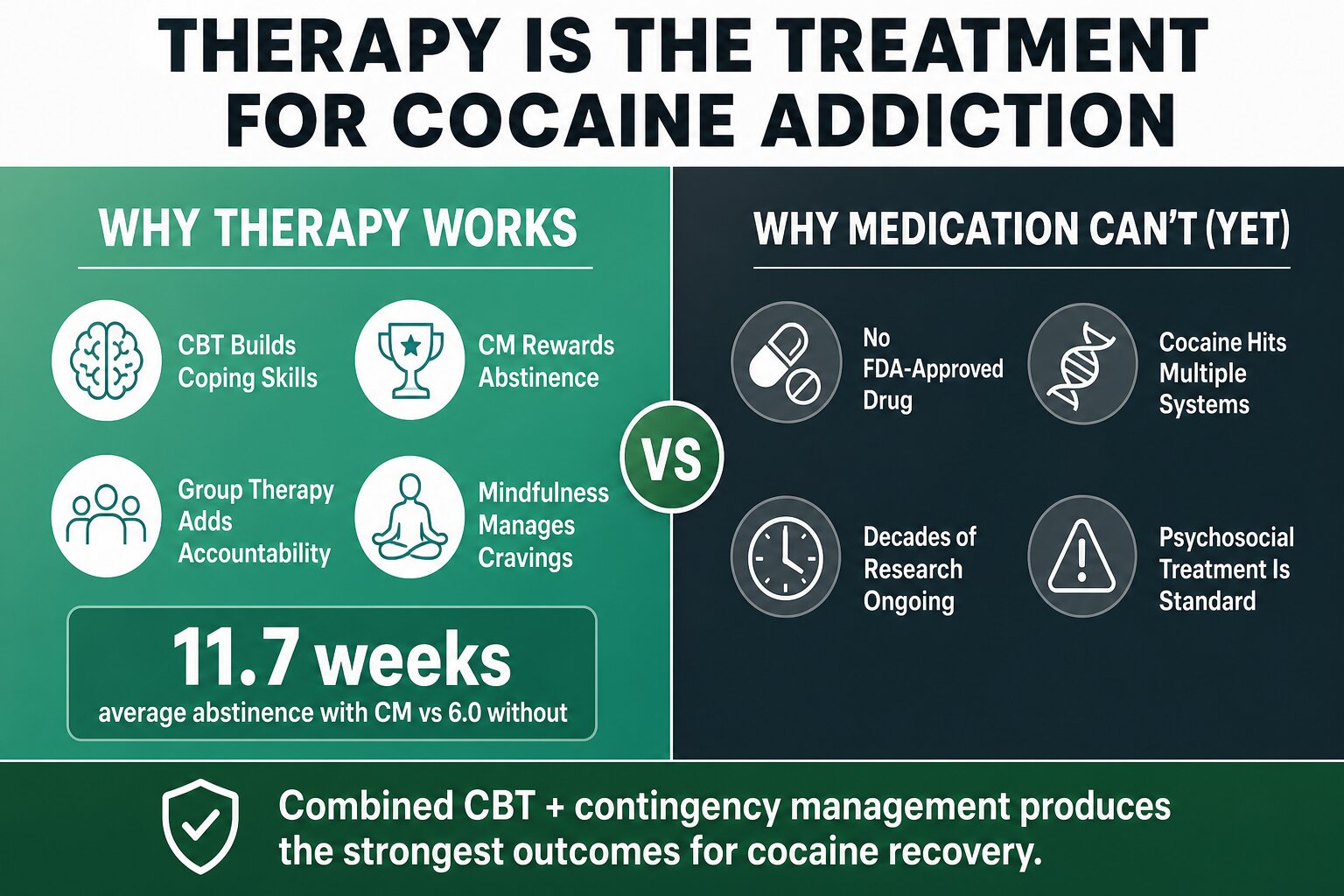
- No medication is approved to treat cocaine addiction — therapy is the frontline treatment, not a backup plan.
- CBT teaches people to recognise and manage cocaine cravings, and its effects actually improve after treatment ends.
- Contingency management (earning rewards for clean drug tests) is the most effective method for achieving initial abstinence from cocaine.
- Combining therapies — CBT for long-term skills, contingency management for early momentum — produces stronger outcomes than any single approach.
- At One Step, therapy runs 25+ hours per week in a residential setting, which removes the triggers that outpatient clients go home to every night.
Therapy isn’t a complement to cocaine addiction treatment — it is the treatment. Unlike opioid or alcohol addiction, there is no FDA-approved medication for cocaine use disorder (Kampman, Science Advances, 2019). That means recovery depends entirely on the quality and structure of the therapeutic programme. The good news: several evidence-based therapies produce real, measurable results — particularly when delivered in a residential setting where the person can focus on nothing else.
Why Is Therapy the Primary Treatment for Cocaine Addiction?
Therapy is the primary treatment for cocaine addiction because no medication has been proven safe and effective for the condition. Researchers have tested dozens of pharmaceutical approaches over several decades, but cocaine affects multiple neurotransmitter systems simultaneously, making a single-drug solution far more difficult than it has been for opioid or nicotine addiction.
This isn’t a gap in research — it’s an active area of investigation. The FDA published its first-ever guidance for developing stimulant use disorder treatments in 2023 (FDA, 2023), and multiple clinical trials are underway. But for now, the approximately 1 million people in the US with cocaine use disorder — and many more worldwide — rely on psychosocial treatments as the standard of care (Kampman, Science Advances, 2019).
That makes the choice of therapeutic programme critically important. Not all therapy is equal, and not all settings deliver the same results. The therapies with the strongest evidence base for cocaine are cognitive behavioural therapy (CBT) and contingency management — and they work even better when combined.
What Types of Therapy Work Best for Cocaine Addiction?
The therapies with the strongest evidence for cocaine addiction are cognitive behavioural therapy (CBT) for long-term relapse prevention, contingency management for achieving initial abstinence, and motivational interviewing for building readiness to change. A large network meta-analysis of 50 studies and 6,942 participants found that contingency management — alone or combined with CBT — produced the best outcomes for both abstinence and treatment retention (Kampman, Science Advances, 2019).
Here’s what each approach does and where it fits:
| Therapy | What It Targets | Strongest Evidence For |
|---|---|---|
| Cognitive Behavioural Therapy (CBT) | Identifying triggers, building coping skills, managing cravings | Long-term relapse prevention — effects improve after treatment ends |
| Contingency Management (CM) | Reinforcing abstinence with tangible rewards for clean drug tests | Initial abstinence — the strongest single predictor of long-term recovery |
| Motivational Interviewing (MI) | Resolving ambivalence about quitting, building internal motivation | Treatment engagement and retention, especially early in recovery |
| Mindfulness-Based Relapse Prevention | Emotional regulation, craving tolerance, stress reactivity | Reducing stimulant use in people with co-occurring anxiety or depression |
| Group Therapy / IOT | Peer support, accountability, shared experience | Treatment retention and social skill development |
Most effective programmes don’t pick one therapy — they layer several together across the treatment stay. That combination approach matters because cocaine addiction involves both behavioural patterns (which CBT addresses) and motivation systems (which contingency management targets).

How Does CBT Help With Cocaine Addiction?
CBT helps people with cocaine addiction by teaching them to identify the specific situations, emotions, and thought patterns that trigger cocaine use — then building practical skills to manage those triggers without using. Its two core components are functional analysis (mapping out what leads to use) and skills training (rehearsing alternatives). Unlike some therapies, CBT’s effects actually get stronger after treatment ends as people continue applying what they learned (Kampman, Science Advances, 2019).
In clinical trials, cocaine-dependent participants who received CBT were significantly more likely to achieve four consecutive weeks of abstinence compared to those in 12-step facilitation therapy. More importantly, a one-year follow-up showed that CBT participants continued to improve during the follow-up phase, while participants in other treatment groups did not. Researchers attributed this to the continued application of coping skills learned during active treatment.
What makes CBT practical for cocaine recovery is its specificity. Sessions don’t deal in abstractions — they work through real scenarios:
- Coping with craving: recognising the physical and emotional onset of a craving and riding it out using rehearsed techniques
- Refusal skills: practising how to turn down cocaine in social situations where it’s available
- Problem solving: addressing the life problems (financial stress, relationship conflict, boredom) that make cocaine feel like a solution
- Managing painful feelings: developing non-drug responses to anxiety, loneliness, anger, or shame
NIDA developed a dedicated CBT manual specifically for cocaine addiction treatment, based on research by Dr. Kathleen Carroll and colleagues at Yale University. The programme runs as 60-minute sessions, typically weekly, covering a structured sequence from motivation building through to relapse prevention (NIDA, 1998). At One Step, we integrate CBT principles into our structured treatment programme alongside other evidence-based approaches — you can see how CBT compares to DBT in addiction treatment in our dedicated guide.
“CBT gives clients a toolkit they take home. It’s not about what happens in the therapy room — it’s about whether someone can pause at 11pm on a Friday, recognise what’s happening in their body, and choose a different response. That skill doesn’t expire when treatment ends.”
Alastair MordeyProgramme Director, One Step Rehab

What Is Contingency Management and Why Does It Work?
Contingency management (CM) rewards people with tangible incentives — vouchers, gift cards, or items that support recovery — for demonstrating measurable behaviours like drug-free urine tests. It is the single most effective therapy for achieving initial cocaine abstinence, and its benefits extend well beyond the incentive period: a SAMHSA review found that CM’s effectiveness lasted a median of 24 weeks after incentives ended (SAMHSA, 2024).
The principle is straightforward: behaviour that gets rewarded gets repeated. In one landmark trial, cocaine-dependent participants receiving contingency management achieved an average of 11.7 weeks of continuous abstinence, compared to 6.0 weeks for those receiving behavioural therapy alone — nearly double the clean time (Kampman, Science Advances, 2019). In another study with cocaine- and opioid-dependent patients, 47% of the CM group achieved two or more weeks of sustained abstinence versus just 6% in the control group.
SAMHSA now describes contingency management as “a primary and potentially life-saving intervention” for the more than 4 million Americans with stimulant use disorders — a significant endorsement given the historical caution around incentive-based treatments (SAMHSA, 2024).
The limitation of CM on its own is that abstinence rates tend to drop once the incentives stop. That’s why the strongest evidence supports combining CM (for early momentum) with CBT (for lasting skills). In a trial of 171 stimulant-dependent patients, those who received CM had higher retention and lower use during treatment, while CBT participants caught up and maintained gains at the 6- and 12-month follow-ups.
Wondering which therapy approach is right for you? Talk to our team — we’ll explain exactly what treatment looks like and give you a straight answer about whether we’re the right fit.

How Do Group Therapy and Residential Treatment Fit In?
Group therapy and residential treatment provide two things that individual outpatient therapy cannot: peer accountability from people going through the same experience, and physical separation from the environments where cocaine use happened. Clinical trials consistently show that treatment involving multiple sessions per week outperforms single weekly sessions, and residential programmes deliver the highest treatment contact hours — typically 25 or more hours per week versus 1-4 hours in outpatient settings.
Group therapy for cocaine addiction isn’t a support circle where people share feelings. It’s structured and skills-based: members practise refusal scenarios, dissect each other’s relapse patterns, and hold one another accountable for homework between sessions. The social learning component is difficult to replicate in individual therapy — watching someone else successfully manage a craving trigger can be more convincing than hearing a therapist describe the technique.
Residential treatment adds another layer: removing access to cocaine during the critical early weeks. This matters because cocaine cravings are intensely cue-driven. The phone, the neighbourhood, the friend group, the time of day — all of these can trigger powerful urges that are difficult to resist while building new coping skills. In a residential setting, those cues are absent, giving the brain time to begin resetting its reward pathways while the person learns the tools they’ll need when they return home.
NIDA’s treatment principles state that remaining in treatment for an adequate period of time is critical, with research suggesting 90 days or longer as the threshold for significantly better outcomes. Residential programmes make that duration achievable because the person’s daily life is structured around recovery rather than squeezed between work, commuting, and the same social environment that sustained the addiction.

Can Mindfulness and Dual Diagnosis Therapy Help With Cocaine Recovery?
Mindfulness-based relapse prevention (MBRP) is a newer addition to the evidence base for stimulant addiction, and it shows particular promise for people dealing with cocaine addiction alongside anxiety or depression. A pilot randomised trial at UCLA found that stimulant-dependent adults with depressive disorders who received MBRP had significantly lower odds of stimulant use compared to a control group, with similar results for those with anxiety disorders (Glasner-Edwards et al., Mindfulness, 2016).
This matters because cocaine addiction rarely exists in isolation. Many people use cocaine to manage underlying anxiety, mask depression, or cope with unresolved trauma. Treating the cocaine use without addressing these co-occurring conditions — what clinicians call dual diagnosis — often leads to relapse because the original driver of the drug use remains untreated.
Mindfulness techniques teach people to observe cravings without acting on them — a skill called “urge surfing.” Instead of fighting the craving or giving in, the person learns to notice it, sit with the discomfort, and watch it peak and fade. For cocaine users, whose cravings tend to be intense but short-lived, this approach can be particularly effective.
At One Step, our treatment programme integrates mindfulness practice alongside CBT and group work. Clients have access to meditation sessions and the natural environment around Chiang Mai — including temple visits and outdoor therapy — which support the development of mindfulness skills in a way that a clinical office setting simply cannot.
“Cocaine cravings hit hard and fast, but they also pass quickly — usually within 15 to 20 minutes. Mindfulness gives clients the ability to ride that wave rather than be swept away by it. Combined with CBT, it addresses both the acute craving and the longer pattern of thinking that feeds addiction.”
What Does Cocaine Addiction Therapy Look Like at One Step?
At One Step Rehab in Chiang Mai, cocaine addiction treatment is a residential programme built around 25+ hours of structured therapy per week — not a handful of sessions squeezed around daily life. The programme combines CBT, group therapy, mindfulness practice, and individual counselling in a structured daily schedule designed to build the skills you’ll need when you go home.
Here’s what the programme actually involves:
- Individual therapy: regular one-on-one sessions using CBT and motivational interviewing, focused on your specific triggers, patterns, and goals
- Group therapy: daily structured group sessions where you practise skills, hear from peers in similar situations, and build the social connections that support recovery
- Mindfulness and meditation: daily practice sessions, plus access to Chiang Mai’s temples and natural environment for real-world mindfulness development
- Fitness and outdoor therapy: structured outdoor activities including Muay Thai, hiking, and swimming — physical activity that helps rebuild dopamine systems depleted by cocaine use
- Aftercare planning: dedicated sessions in the final weeks to build a concrete plan for maintaining recovery at home, including identifying high-risk situations and connecting with local support
Most clients stay 28 to 60 days. The programme fee is approximately ฿280,000 per month (~$8,500 USD), which covers accommodation, all therapy, meals, and activities. Medication prescribed by our visiting psychiatrist is billed separately, similar to flights and personal expenses — see our pricing page for the full breakdown of what’s included and excluded.
Cocaine doesn’t typically require medical detox, which means most clients can begin the full therapy programme from day one. For those also dealing with alcohol or benzodiazepine dependence, One Step provides on-site detox as part of the programme. You can read more about the specific risks of mixing cocaine with alcohol and why addressing both substances matters.
The residential setting in Chiang Mai serves a therapeutic purpose beyond comfort. Being 8,000 miles from your dealer, your drinking friends, and the Friday-night routine that always ended the same way removes the environmental cues that drive cocaine cravings. It gives your brain time to begin healing while you build new patterns in a place where the old ones can’t reach you. Check our daily treatment schedule to see exactly how the days are structured.
Cocaine addiction responds well to structured, evidence-based therapy — especially when delivered in a residential setting that removes environmental triggers. Learn more about the full range of approaches available in our drug addiction treatment programme in Thailand.
Frequently Asked Questions About Therapy for Cocaine Addiction
Common questions about what treatment involves and what to expect.
No. As of 2025, there is no FDA-approved medication for cocaine use disorder. Several candidates are in clinical trials — including dopamine agonists and glutamatergic agents — but none have been proven safe and effective. Therapy-based approaches remain the standard of care for cocaine addiction.
NIDA research indicates that treatment lasting 90 days or longer produces significantly better outcomes. Most residential programmes run 28 to 60 days of intensive treatment, followed by aftercare. Shorter stays can help, but the evidence strongly favours longer engagement — the coping skills taught in CBT take time to practise and internalise.
Research shows the most effective approach combines contingency management (for achieving initial abstinence) with cognitive behavioural therapy (for long-term relapse prevention). Contingency management nearly doubles the period of initial cocaine abstinence, while CBT’s effects continue improving even after treatment ends. Used together, they address both short-term motivation and lasting behaviour change.
Cocaine withdrawal is uncomfortable but rarely medically dangerous — unlike alcohol or benzodiazepine withdrawal. Symptoms include fatigue, depression, increased appetite, and strong cravings, typically peaking within the first few days. Medical detox isn’t usually necessary for cocaine alone, which means most people can begin therapy immediately upon entering a residential programme.
Residential treatment removes the environmental cues — people, places, routines — that trigger cocaine cravings, and delivers 25+ hours of therapy per week compared to 1-4 hours in outpatient. Research shows higher treatment contact hours correlate with better outcomes. For people with moderate to severe cocaine use disorder, residential treatment offers a controlled environment to build coping skills before returning to daily life.
Yes. Mindfulness-based relapse prevention teaches people to observe cravings without acting on them — a technique called urge surfing. A clinical trial at UCLA found that mindfulness training was particularly effective at reducing stimulant use in people with co-occurring depression or anxiety. It works well alongside CBT and contingency management as part of a broader treatment programme.
Written by
Alastair Mordey
Alastair Mordey is one of the pioneers of drug and alcohol treatment globally and specifically in Asia. He has been an addiction’s professional for twenty years. He started his career as an expert in substance abuse w...
Learn more about Alastair
Medically reviewed by
Dr. Worapakthorn Kongpesalaphun
Consultant Psychiatrist · Thai Licensed Medical Doctor · Residency in Psychiatry, Somdet Chaopraya Institute · Doctor of Medicine, Rangsit University
Dr. Worapakthorn Kongpesalaphun is a Thai Licensed Medical Doctor and Expert in Preventive Medicine (Community Mental Health) with extensive experience in addiction treatment and public health management. He holds multip...
Learn more about Dr. Worapakthorn