

Key Takeaways
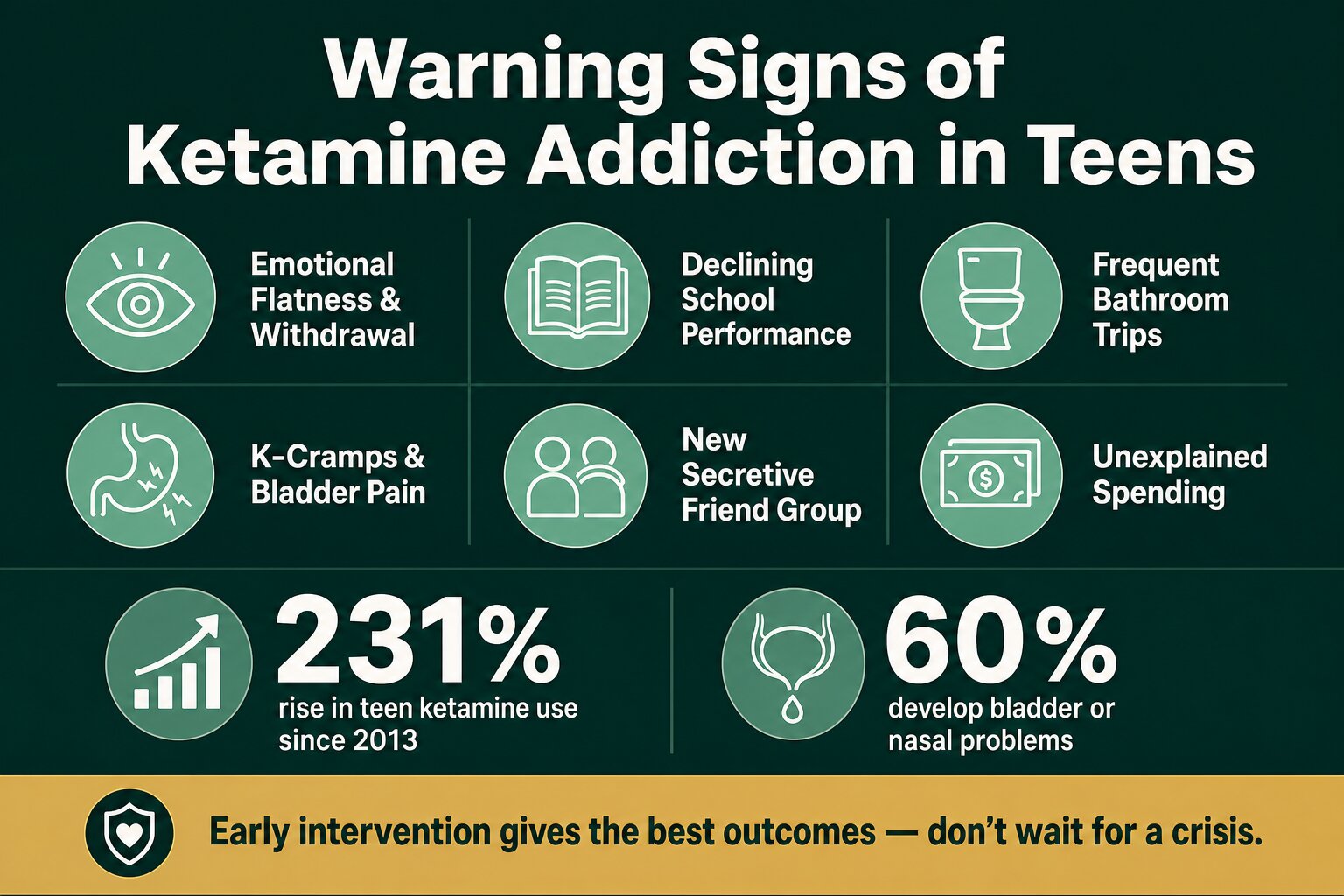
- Recreational ketamine use among 16–24 year olds has surged 231% since 2013 — and most parents don’t know what to look for.
- Warning signs include pulling away from family, declining grades, frequent bathroom trips, and unexplained stomach or bladder pain.
- Ketamine causes real physical damage: 60% of people with ketamine use disorder develop bladder or nasal problems.
- The earlier you intervene, the better the outcome — don’t wait for a crisis to have the conversation.
- Residential treatment with structured daily therapy gives young people the best foundation for sustained change.
The warning signs of ketamine addiction in teens often look like typical adolescence at first — mood swings, new friends, pulling away from family. The difference is speed and severity. A teen developing a ketamine problem will show clusters of behavioural, social, and physical changes that escalate over weeks, not months. And unlike most drugs parents worry about, ketamine causes distinctive physical symptoms — particularly bladder pain and stomach cramps — that can tip you off before things spiral (Harding et al., Addiction, 2025).
Why Is Teen Ketamine Use Rising So Fast?
Teen ketamine use is rising because the drug is cheap, widely available, produces a short high with no harsh comedown, and most young people don’t believe it’s addictive. In England and Wales, recreational ketamine use among 16–24 year olds increased 231% between 2013 and 2023, with school-age use more than doubling from 0.4% to 0.9% in the same period (Moore et al., BJGP, 2026).
Ketamine doesn’t look or feel like “hard drugs” to teens. It’s a white powder snorted in small bumps — often at parties, festivals, or at home. The high hits within minutes and fades in under two hours. There’s no dramatic comedown like MDMA or cocaine, which makes it feel low-risk. A gram costs roughly the same as a few drinks, and it’s one of the easiest illicit drugs to obtain.
The biggest risk factor is ignorance. In a study of 274 people with ketamine use disorder, 59% said there was “definitely not” enough awareness about ketamine risks in education or among peers. Many didn’t know the drug could be addictive until their use was already out of control (Harding et al., Addiction, 2025).
What Are the Behavioural Warning Signs of Ketamine Addiction in Teens?
The behavioural warning signs of ketamine addiction in teens include sudden withdrawal from family activities, dropping old friends for a new peer group, declining school performance, increased secrecy about whereabouts and phone use, loss of interest in former hobbies, and mood instability — especially irritability and a flat, “nothing matters” attitude. A single change is normal; several at once is a red flag (SAMHSA, 2023).
These signs overlap with normal teenage behaviour, which is exactly why they’re easy to miss. The red flag isn’t any single change — it’s a cluster of changes happening at once or escalating quickly.
| Behaviour | Normal adolescence | Possible ketamine problem |
|---|---|---|
| Mood changes | Occasional irritability, testing boundaries | Frequent emotional flatness, “spacey” or disconnected episodes, rapid mood swings |
| Friend groups | Gradual social evolution, still introduces friends | Abrupt switch to new group, refuses to introduce them, secretive about plans |
| School performance | Occasional dips, usually tied to specific subjects | Sudden drop across all subjects, skipping classes, losing interest entirely |
| Sleep patterns | Staying up later, sleeping in on weekends | Erratic sleep, sleeping at unusual times, appearing sedated |
| Money | Normal spending on social activities | Unexplained spending, asking for money more often, items going missing from home |
Pay particular attention to the “spacey” quality. Ketamine is a dissociative — it separates the user from their surroundings. Teens who use regularly can develop a detached, absent quality even when sober. They may seem emotionally flat, struggle to hold a conversation, or respond with a vague blankness that goes beyond typical teenage disengagement.

What Physical Signs Should Parents Watch For?
The physical signs of ketamine abuse include frequent urination, bladder pain or urgency, unexplained abdominal cramps (known as “K-cramps”), nosebleeds or a constantly runny nose from snorting, slurred speech, impaired coordination, and memory problems. Bladder and nasal problems affect 60% of people with ketamine use disorder, making them the most reliable physical red flags (Harding et al., Addiction, 2025).
The bladder symptoms are distinctive and often the first physical sign parents notice. Ketamine metabolites damage the bladder lining directly, causing inflammation that worsens with continued use. Regular ketamine use increases the risk of cystitis symptoms by 3 to 4 times. What starts as needing the bathroom more often can progress to painful urination, blood in urine, and in severe cases, irreversible bladder damage requiring surgery (Anderson et al., Health Psychol Res, 2022).
K-cramps are another telltale sign. These are intense, painful abdominal cramps linked to heavy ketamine use — 56% of those with ketamine use disorder report experiencing them. Many users respond to the pain by taking more ketamine, since the drug’s painkilling properties temporarily relieve the very symptoms it causes. This trap accelerates dependence.
Other physical signs to watch for:
- Nosebleeds or constant sniffing — ketamine is most commonly snorted
- Small bags of white or off-white powder — what recreational ketamine looks like
- Slurred speech and poor coordination — especially in the evening or after being out
- Memory gaps — struggling to remember conversations or events from the day before
- Weight loss — ketamine suppresses appetite and causes nausea
How Can You Tell the Difference Between Experimentation and Addiction?
The difference between experimentation and addiction is loss of control. A teen experimenting with ketamine might try it once or twice at a party and move on. A teen developing an addiction uses more frequently, needs larger doses for the same effect (tolerance), continues despite physical symptoms like bladder pain, and becomes irritable or anxious when they can’t use — the core markers of dependence (NIDA, 2025).
| Indicator | Experimentation | Developing addiction |
|---|---|---|
| Frequency | Occasional — once or twice at events | Regular use — weekly or more, including alone |
| Dose | Same small amount each time | Increasing amounts to get the same effect |
| Consequences | No lasting impact on daily life | Grades dropping, relationships strained, physical symptoms |
| When not using | No change in mood or behaviour | Anxious, irritable, preoccupied with next use |
| Response to concern | Can discuss it openly, may agree to stop | Defensive, secretive, minimises use, makes excuses |
Tolerance is the clearest marker. Ketamine tolerance builds fast — what started as a small bump at a party can become a gram-a-day habit. If your teen’s use is escalating despite obvious consequences, that’s not experimentation.
Worried about changes you’re seeing in your teen? Talk to our team — we’ll give you a straight answer about whether treatment makes sense.

What Should You Do If You Suspect Your Teen Is Using Ketamine?
If you suspect your teen is using ketamine, start with a direct but non-confrontational conversation — state what you’ve observed without accusations, listen more than you talk, and make clear that your concern is their health, not punishment. If the conversation confirms use or your teen won’t engage, involve a healthcare professional experienced in substance use. Early intervention before physical damage sets in gives the best outcomes.
Step 1: Have the conversation. Pick a calm moment — not during an argument or when you suspect they’re high. Be specific about what you’ve noticed: “I’ve seen you going to the bathroom much more often, you seem withdrawn, and your grades have dropped. I’m worried.” Avoid ultimatums or threats. The goal is to open a door, not close one.
Step 2: Educate yourself first. Before the conversation, learn the basics. Know what ketamine looks like (white powder), its street names (Special K, Ket, Ketty, Vitamin K), and its effects. Teens shut down if they sense you don’t know what you’re talking about. The NIDA ketamine resource page is a solid starting point.
Step 3: Get a professional assessment. A GP or addiction counsellor can evaluate how severe the problem is. If your teen has physical symptoms — especially bladder pain or K-cramps — a medical assessment is urgent. Ketamine bladder damage is progressive but often reversible if caught early (Anderson et al., Health Psychol Res, 2022).
Step 4: Match treatment to severity.
- Early/mild use: Outpatient counselling — CBT is the most evidence-supported approach for substance use in young people
- Moderate dependence: Intensive outpatient programme with regular therapy sessions
- Established addiction with physical symptoms: Residential treatment, which removes the person from their using environment and provides structured daily therapy
Step 5: Don’t wait for rock bottom. The idea that someone needs to hit bottom before they’ll accept help is a myth. Every week of continued ketamine use increases the risk of permanent bladder damage. If your teen has physical symptoms and can’t stop on their own, that’s enough to act. For more on what drives people back to use, see our guide to the most common relapse triggers.

How Does Residential Treatment Help Young People With Ketamine Addiction?
Residential treatment works for ketamine addiction because it physically separates the person from their using environment, provides daily structured therapy that addresses the psychological drivers of use, and builds coping skills through a consistent routine. For young adults whose social circles revolve around ketamine, leaving that environment entirely is often the only realistic path to breaking the cycle.
At One Step Rehab in Chiang Mai, our structured treatment programme runs for a minimum of 28 days. The daily schedule includes individual therapy, group sessions, CBT and DBT-based approaches, mindfulness practice, fitness, and structured activities that rebuild routine and purpose. To understand how ketamine affects your teen in the first place, our guide to how ketamine makes you feel explains the effects, risks, and the K-hole in plain language.
Ketamine addiction doesn’t require medical detox — there’s no dangerous physical withdrawal like with alcohol or benzodiazepines. What it does require is addressing the psychological dependence: the cravings, the habit loops, the social triggers, and whatever was driving the use in the first place. That’s therapy work, and it takes time in a structured setting.
We work closely with families through our family programme, which includes regular communication and optional family therapy sessions. Parents are a critical part of recovery — especially for young adults returning to a family home after treatment.
“With ketamine, the psychological grip is often stronger than people expect. Young adults come in thinking they can simply decide to stop — but the cravings, the social patterns, and the emotional avoidance that drove the use don’t resolve through willpower alone. Structured residential treatment gives them the time and the therapeutic tools to address what’s underneath.”
Alastair MordeyProgramme Director, One Step Rehab
One Step treats adults aged 18 and over. If your teen is under 18, a local adolescent substance use service is the right first step — but if they’re 18 or older, our ketamine rehab programme is built for exactly this situation. Full pricing details are on our pricing page, and our aftercare programme provides ongoing support after treatment ends.

If you or someone you love is struggling with substance dependence, explore how a professional drug addiction treatment can provide the structure, clinical support, and environment needed for lasting recovery.
Frequently Asked Questions About Teen Ketamine Addiction
Common questions from parents concerned about ketamine use in their teens.
Yes. Ketamine is addictive. It produces strong psychological dependence — users develop tolerance (needing more for the same effect) and experience cravings, anxiety, and irritability when they stop. NIDA confirms that ketamine can be addictive, and a 2025 study found many users compared their addiction to heroin or cocaine dependence in terms of severity.
Ketamine tolerance builds quickly, and regular use can progress to dependence within weeks to months. There’s no fixed timeline — frequency, dose, and individual factors all play a role. The transition from weekend use to daily use can happen faster than parents expect, especially when peer groups normalise it.
Ketamine blocks NMDA receptors in the brain, which affects learning, memory, and emotional regulation. In the short term, it produces dissociation and euphoria. With repeated use, it can impair memory, concentration, and cognitive function. Because the teenage brain is still developing, these effects may be more pronounced and longer-lasting than in adults.
Ketamine withdrawal is not physically dangerous in the way alcohol or benzodiazepine withdrawal can be. It doesn’t cause seizures or life-threatening complications. However, it produces significant psychological symptoms — cravings, anxiety, low mood, irritability, and sleep disturbance — that make quitting difficult without structured support.
Lead with observations, not accusations: “I’ve noticed you’ve been going to the bathroom a lot and seem withdrawn — I’m worried.” Listen more than you talk. Avoid ultimatums in the first conversation. SAMHSA recommends making clear that your concern is their health and safety, not punishment. If they won’t engage, don’t force it — but do involve a professional.
In many cases, yes — if ketamine use stops early enough. Mild to moderate bladder symptoms often improve significantly within weeks to months of cessation. However, severe or prolonged damage can be permanent and may require surgical intervention. This is why early detection matters: the sooner use stops, the better the chance of full recovery.
Treatment options range from outpatient counselling (typically CBT-based) for early-stage use, to intensive outpatient programmes for moderate dependence, to residential rehab for established addiction. Residential treatment is particularly effective for ketamine because it removes the person from their using environment and social triggers. One Step Rehab offers a structured residential programme for adults aged 18 and over.
Written by
Alastair Mordey
Alastair Mordey is one of the pioneers of drug and alcohol treatment globally and specifically in Asia. He has been an addiction’s professional for twenty years. He started his career as an expert in substance abuse w...
Learn more about Alastair
Medically reviewed by
Dr. Worapakthorn Kongpesalaphun
Consultant Psychiatrist · Thai Licensed Medical Doctor · Residency in Psychiatry, Somdet Chaopraya Institute · Doctor of Medicine, Rangsit University
Dr. Worapakthorn Kongpesalaphun is a Thai Licensed Medical Doctor and Expert in Preventive Medicine (Community Mental Health) with extensive experience in addiction treatment and public health management. He holds multip...
Learn more about Dr. Worapakthorn