

Key Takeaways
- You don’t need to be sober yourself to flag that a friend is in trouble — your own use can be the bridge, not the disqualification.
- Lead with the bladder, not the addiction label. Roughly 1 in 4 regular ketamine users report urinary symptoms (ACMD, 2026), and “you should see a urologist” lands harder than “you’re an addict.”
- If they won’t quit, harm reduction matters: no mixing with alcohol, GHB/GBL, benzos or opioids — all of which slow breathing and stack the overdose risk.
- A friend going into a K-hole alone is a safety call, not a vibe. Unconscious + airway-down + vomit = aspiration risk. Recovery position, then 1669.
- You’re allowed to stop being the usage buddy. Pulling out of the supply chain isn’t betrayal — it’s the most honest signal you can send.
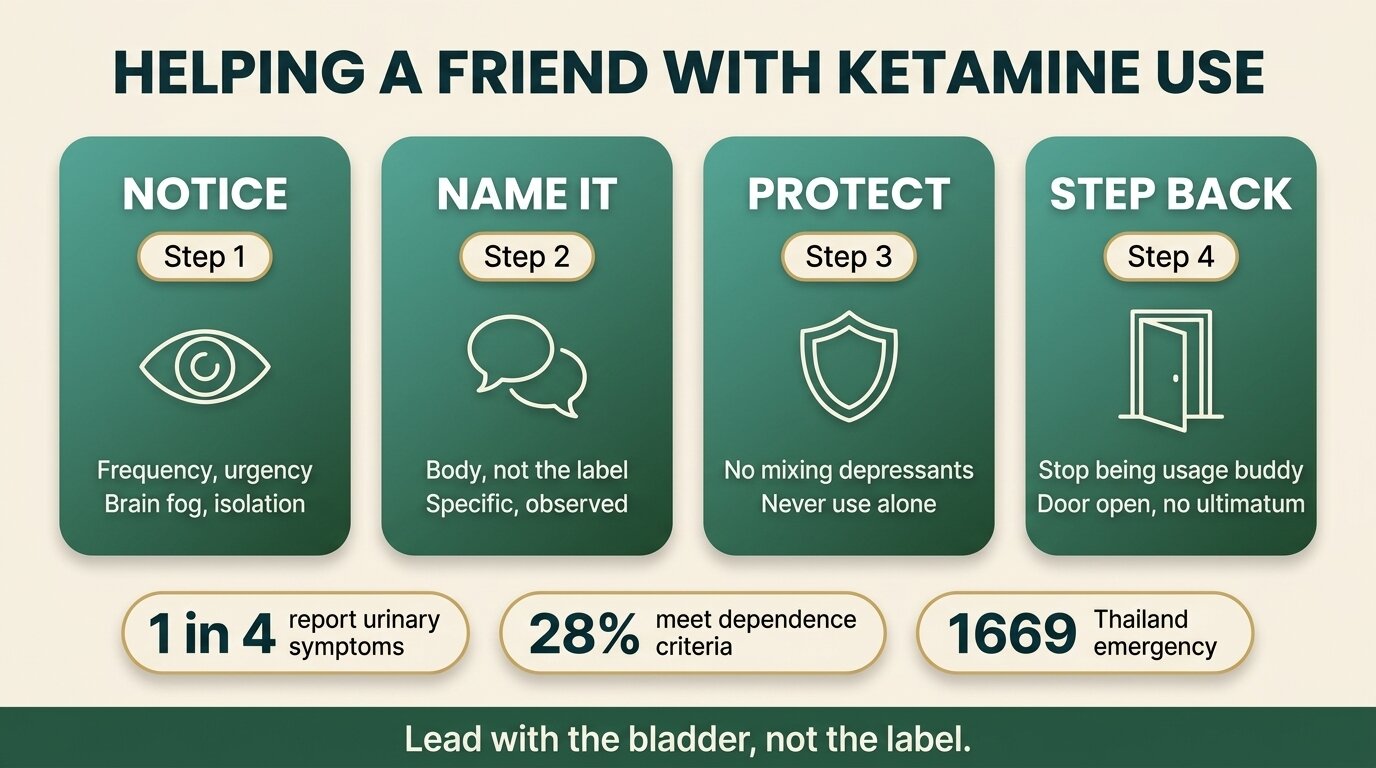
Helping a friend with ketamine dependency starts with one honest sentence: “I’m worried about your bladder and your memory, not your morals.” Frame it as health, not addiction. Stop being a usage buddy. Push them toward a urologist before you push them toward rehab — the urinary symptoms scare people into action in a way that the word “addict” doesn’t. And if they’re going into K-holes alone, that’s already an emergency (Morgan & Curran, Addiction, 2012).
“I Use Too — What Right Do I Have to Say Anything?”
You don’t need a clean record to flag that someone you love is heading somewhere dark. Your own use can actually be the most credible thing you bring to the conversation — “I cut back when I started pissing blood, I’m worried you can’t” is harder to dismiss than a lecture from a parent who’s never touched the stuff. Honesty about your own pattern is the bridge, not the barrier.
The instinct to stay quiet because of guilt is understandable, but it protects no one. Your friend already knows you use. What they don’t know is that someone close to them has noticed they’ve crossed a line — gone from a bump on a night out to bumps in the bathroom at work, to daily, to alone. That noticing is exactly what makes you the right person to say something. Parents, partners, and doctors come at this from outside the scene. You come at it from inside.
If you’re worried that bringing it up means giving up your own use too, that’s a separate question, and it’s worth sitting with. But it shouldn’t gate the conversation. People who use occasionally can absolutely flag dependence in someone who’s gone past occasional.

How Do You Talk to a Friend Without Sounding Like a Parent?
Talk about the body, not the morality. Skip “you have a problem” and lead with “I noticed you’re peeing every 20 minutes, that’s not normal, that’s the ketamine.” Use specifics you’ve actually seen — brain fog, isolation, K-pissing, the fact they’ve stopped coming out and started staying in to use alone. Concrete observations land. Diagnoses don’t.
The fastest way to lose the conversation is to use the language of recovery before they’re in recovery. “Addict,” “in denial,” “rock bottom” — these read as judgement, not concern, and they activate every defence your friend has. A peer-aged friend already feels patronised by the rehab industry; don’t replicate it.
What works instead:
- Pick a sober moment. Not at 4am, not mid-session, not the morning after when they’re crashing and ashamed. A daytime coffee or a walk works better than anything that feels like an ambush.
- Lead with one specific thing you’ve noticed. “You disappeared for two hours at Sam’s birthday and came back grey” beats “I’m worried about you.”
- Use open questions. “How are you feeling about how much you’re using?” gives them somewhere to go. “Don’t you think you have a problem?” doesn’t.
- Don’t issue an ultimatum on day one. The first conversation is not where you fix anything. It’s where you make it possible for them to come back to you later.
- Name your own use, briefly. “I still use sometimes — that’s not the point. The point is I’m watching you slide and I can’t pretend not to see it.”
You may need to have this conversation three or four times before anything moves. That’s normal. The point of the first one isn’t to get them into treatment — it’s to plant the flag that someone they trust has noticed, and that the door is open. Our guide on the 10 most common relapse triggers covers how social-circle pressure shapes both use and recovery, which is exactly the dynamic you’re navigating here.

Why “See a Urologist” Lands Harder Than “Go to Rehab”
Ketamine destroys the bladder, and friends often notice the symptoms before parents or partners do. Pointing it out is the most effective wedge into the conversation, because it’s medical, visible, and impossible to argue with. Around 1 in 4 regular ketamine users report at least one urinary symptom (ACMD, 2026), and in severe cases the bladder shrinks to the point of needing surgery.
The original syndrome was described in Hong Kong in 2008 — a cohort of 59 ketamine users referred to urology clinics with a pattern that looked identical to chronic interstitial cystitis, including cases where secondary kidney damage was irreversible and patients ended up on dialysis (Chu et al., BJU Int, 2008). Subsequent systematic review work confirmed the pattern globally and broke it down by severity (Castellani et al., Neurourol Urodyn, 2020).
Symptoms to look (and listen) for:
| Symptom | What you might notice | Why it matters |
|---|---|---|
| Frequency | Going to the loo every 20-30 minutes; can’t sit through a film | Earliest sign; often dismissed as “weak bladder” |
| Urgency | Sudden, desperate need to go — has to leave conversations mid-sentence | Indicates bladder wall inflammation |
| Pain on urinating | Winces, mentions “burning” | Active cystitis — needs medical assessment |
| Blood in urine | They’ve mentioned it once, joked it off | Serious — urology referral needed now, not later |
| Suprapubic pain | Holds their lower abdomen, stops eating much | Bladder contraction or pelvic pain syndrome |
How to use this in a conversation: skip the rehab framing entirely. Try “have you talked to a doctor about the bladder thing? That’s not something you can wait on — there’s a window where it’s reversible and a point where it isn’t.” Most people will agree to see a GP about their bladder long before they’ll agree to see anyone about ketamine. Once they’re in a urology appointment and a specialist tells them the only treatment that works is stopping, the case for addressing the use stops being yours to make.
The friend who spots the bladder symptoms first is often the one who finally gets through. Parents talk about destruction in the abstract; mates point at the actual pissing and the actual blood. That specificity is what cuts through denial. We see people come in for what they thought was a urology issue and leave a month later having dealt with the dependence underneath it.
Craig GagnonSenior Therapist, One Step Rehab
What If They Won’t Quit? Harm Reduction You Can Actually Push
If they’re not ready to stop, your goal shifts to keeping them alive until they are. The single most important rule is no mixing with depressants — alcohol, GHB/GBL, benzos, opioids. All of these slow breathing on their own, and ketamine compounds the effect, which is how people end up not waking up. Hydration, route changes, and a urology check-in are the three other things worth pushing.
The harms aren’t theoretical. The 2026 ACMD review of ketamine harms is explicit: guidance should strongly advise against concurrent use of ketamine with depressants because the combination substantially increases overdose risk (ACMD, 2026). Cognitive harms stack quickly with frequent use, particularly to working and episodic memory (Morgan & Curran, Addiction, 2012); some of that recovers with abstinence, some doesn’t (Morgan et al., Drug Alcohol Depend, 2004). The brain fog they’re complaining about is real and it’s caused by the thing they’re holding.
Practical harm reduction asks you can make:
- Never mix with alcohol, GHB/GBL, benzodiazepines, or opioids. Stacked respiratory depression is what kills, not the ketamine alone.
- Don’t use alone. A K-hole with no one watching is a medical risk — vomiting while unconscious causes aspiration.
- Hydrate, but not insanely. Bladder irritation gets worse with concentrated urine; constant top-ups also irritate. Aim for normal hydration, not “water-loading.”
- Book the urology appointment. Even one consultation reframes the use from “fun” to “health decision.”
- Use a measured amount, not a bag on the table. Eyeballing in a state of cognitive impairment is how doses creep upward across a night.
- Take breaks of weeks at a time, not days. Tolerance climbs steeply with daily use; the friend doing a key bump every morning is the one we worry about most.
None of this is permission. It’s keeping them alive while they figure out what they want.
Not sure whether the conversation is yours to have? Talk to our team — we’ll help you work out what’s worth saying and what isn’t, before you say it.

When Do You Stop Being the Usage Buddy?
The moment your presence is helping the use happen — supplying, holding, sourcing, sitting with them while they take more than you would — you’ve become part of the dependence, not part of the help. Pulling out of that role is not betrayal. It’s the clearest signal you can send that this stopped being recreational. Stop being the buddy before you stop being the friend.
This is the part friends most resist, because it feels like abandoning someone. It isn’t. The dynamic you want to break is the one where your friend uses with you because using with you feels normal and safe, which lets them avoid the question of whether their use is normal at all. When the people who used to use alongside them stop, the use stops being social and starts being what it actually is.
What pulling back looks like in practice:
- You don’t carry for them, hold for them, or order for them.
- You don’t go to sessions where you know the only point is heavy ketamine use.
- If you’re going out together, you set a limit out loud before you arrive — “I’m doing one line tonight, not the whole bag.”
- You don’t lend money. The brain fog is real and short loans become long ones.
- You don’t cover for them with their partner, family, or work. Lying for them is how the use stays consequence-free, which is how it grows.
If you cut back yourself, name it. “I’m doing way less because I noticed what it was doing to me” is one of the most powerful things a peer can say to someone in dependence. It demonstrates change without asking them to change. They will sit with that for weeks.
What Do You Do If a Friend Is in a K-Hole Alone?
This is a safety call, not a vibe to ride out. Get to them. If they’re conscious but dissociated, sit with them quietly in a dim space — talking, lights, and movement make it worse. If they’re unconscious, put them in the recovery position so they can’t aspirate vomit, check their breathing, and call 1669 (Thailand) or your local emergency number. Don’t leave them alone.
The most dangerous part of a K-hole alone isn’t the dissociation itself — it’s that ketamine causes nausea, vomiting is common, and someone unconscious on their back can choke on vomit before anyone notices. That’s the mechanism behind most ketamine-related deaths that don’t involve a depressant mixture. The fix is simple: side, not back.
Call emergency services if:
- They are unconscious and you cannot rouse them.
- Their breathing is shallow, irregular, or they are turning grey/blue around the lips.
- They have vomited and are not fully awake.
- They have taken ketamine with alcohol, GHB/GBL, benzodiazepines, or opioids.
- You don’t know what they’ve taken, only that they’re not okay.
You are not in trouble for calling. Paramedics in Thailand and most jurisdictions are there for the person, not the police report. Hesitation is what kills.
If this happens once, it has happened on another night when you weren’t there. Use it as the most concrete possible opening for the next conversation: “When I found you, I thought you were dead. I’m not doing that again.”
How Do You Bring Up Treatment Without an Ultimatum?
Frame treatment as an option you’ve researched on their behalf, not a verdict you’ve reached about them. Say what you’ve looked into, why you think it might fit their situation specifically, and what would happen next if they wanted to explore it. The goal of the conversation isn’t to get a yes — it’s to take away the excuse that they don’t know what’s out there.
Concrete script that works:
“I’ve been reading about how people actually deal with this. There’s a place in Chiang Mai called One Step that takes ketamine cases — it’s not luxury, it’s not 12 steps, it’s actual therapy plus space away from the supply. I’m not telling you to go. I just looked it up because I didn’t want to bring it up without knowing what I was talking about. If you ever wanted to know more, I’ve got the link.”
What that script does: removes judgement, removes pressure, removes ignorance. They can say “not now” without anyone losing face, and if they ever do reach the point of considering it, you’ve already given them the path.
Avoid these phrasings:
- “You need to go to rehab.” (Pushes them away.)
- “If you don’t get help I can’t be in your life.” (Ultimatum without a plan; they’ll choose the drug.)
- “My mate’s cousin went to a place in Phuket.” (Vague; gives them nothing to act on.)
- “Everyone agrees you need help.” (Triangulation; they’ll feel cornered and shut down.)
Sometimes the person isn’t ready and you have to wait. Waiting is not doing nothing — it’s keeping the door open while staying out of the supply chain. The companion conversation, when a family member needs to have a similar talk, is covered in our piece on how to talk to a loved one about ketamine addiction — the dynamics are different, and worth knowing about if the family eventually asks you to help them have the talk too.
How Does One Step Handle Ketamine Cases?
One Step Rehab in Chiang Mai runs a residential programme for ketamine dependence that combines therapy, time away from the scene and supply, and coordination with urology if bladder symptoms are present. The fee is around ฿280,000/month (~$8,500 USD). Most clients stay 28 to 60 days. We’ve found shorter stays rarely hold for ketamine specifically — the cognitive recovery takes weeks.
What’s involved:
- Detox on-site. Ketamine withdrawal isn’t medically dangerous in the way alcohol or benzo withdrawal is, but it’s miserable — cravings, low mood, sleep disruption, profound fatigue, and brain fog. We manage it on-site without hospital referral.
- Therapy core. Individual and group sessions five days a week, using CBT and DBT as the working models. DBT in particular gives clients tools for the emotion-regulation pieces ketamine was being used to numb.
- Urology coordination. If the client has bladder symptoms, we arrange specialist consultation locally. Bladder damage doesn’t pause for rehab — it needs to be assessed and treated in parallel.
- Cognitive recovery support. The brain fog and memory issues that bring people in often start to lift in weeks two to four. Our nutrition programme and outdoor therapy play into this.
- Aftercare planning. Before discharge, we work out what going home looks like — including the social-circle problem, which is often what brought the friend reading this article to the situation in the first place.
What’s not included in the fee: medication prescribed during the stay, flights, visas, additional counselling beyond the core programme, hospital visits if specialist care is needed, and personal items. Medication is billed separately like flights or visas — a clearly excluded personal cost. Full pricing breakdown is on our pricing page.
How a friend gets started: contact us via the contact page or through our admissions process. The intake conversation is with the friend if possible, or with you on their behalf for an initial enquiry. We don’t take admissions cold — there’s always a conversation first. For more on the cluster of issues at stake, see our pages on ketamine rehab and our broader treatment programme.
For more on what the dependence pattern looks like from the inside, read our piece on how ketamine makes you feel, and for the warning-sign pattern specifically, see warning signs of ketamine addiction in teens — much of which applies to peer-aged users in their twenties as well.
If you or someone you love is struggling with substance dependence, explore how a drug addiction treatment in Thailand can provide the structure, clinical support, and environment needed for lasting recovery.
Frequently Asked Questions
Common questions from friends trying to figure out what to do about someone’s ketamine use.
Yes. You don’t need a perfect record to flag that someone has crossed a line. Honesty about your own use can actually be the most credible thing you bring to the conversation. The bar isn’t moral authority — it’s noticing what others haven’t and being willing to say so.
Lead with the body, not the label. “I’m worried about your bladder and your memory” lands harder than “I think you’re addicted.” Specific, observed, medical concerns sidestep the defences that words like “addict” trigger immediately.
Call 1669 in Thailand (or your local emergency number) if they’re unconscious and can’t be roused, if their breathing is shallow or irregular, if they’ve vomited while not fully awake, or if they’ve combined ketamine with alcohol, GHB, benzos or opioids. Recovery position first, then call. Don’t hesitate over consequences — paramedics are there for the person, not the report.
Pattern of frequency (every 20-30 minutes), urgency, burning on urination, or visible blood in someone using ketamine regularly is highly suggestive. A urologist is the one who confirms it. The point isn’t for you to diagnose — it’s to get them to an appointment. “You should see a urologist” is a sentence they’re more likely to accept than “you should see a counsellor.”
Stop being the usage buddy anyway. You don’t need their permission to change your own behaviour. Pull out of supply, sessions, and lying-for. That shift speaks louder than another conversation. Most people come back to talk weeks or months later, once the social structure around their use has thinned out.
Yes — both. About 28% of recreational users meet criteria for dependence, and the cognitive deficits seen in heavy users have been shown to recover meaningfully in those who stop using for a year or more. Some early bladder damage is also reversible if the use stops in time. The window matters.
Only in genuine safety situations — repeated K-holes alone, a serious medical event, escalating self-harm. Going behind their back to family is a one-shot move and it usually ends the friendship. If it’s not a safety call, talk to them first. If it is, tell them you’re going to before you do.
Written by
Craig Gagnon
Craig Cagnon is an American counseling psychologist and addiction counselor. He holds Masters degrees in community counseling and counseling psychology and completed his clinical residency at The Mayo Clinic, in Rochest...
Learn more about Craig
Medically reviewed by
Dr. Worapakthorn Kongpesalaphun
Consultant Psychiatrist · Thai Licensed Medical Doctor · Residency in Psychiatry, Somdet Chaopraya Institute · Doctor of Medicine, Rangsit University
Dr. Worapakthorn Kongpesalaphun is a Thai Licensed Medical Doctor and Expert in Preventive Medicine (Community Mental Health) with extensive experience in addiction treatment and public health management. He holds multip...
Learn more about Dr. Worapakthorn