

Key Takeaways
- Pick the moment carefully — never mid-dissociation, never when you’re angry, never with an audience. Private, sober, daylight, no other family members ambushing them.
- Open with what you noticed and how it affected you, not a diagnosis. “I noticed you missed your sister’s birthday and your nose was bleeding again — I’m scared” works. “You have a problem” doesn’t.
- Expect deflection specific to ketamine — “it’s a medicine now,” “it’s not addictive,” “you don’t understand.” Don’t argue the chemistry. Pivot back to what you’ve seen with your own eyes.
- No ultimatums on a first conversation. The goal isn’t to get them into rehab today — it’s to become the safe person they come back to when their own resolve cracks.
- You can’t force someone into recovery, but you can stop being part of the avoidance system. Choose what you’ll no longer cover for, then say it once, calmly, and follow through.
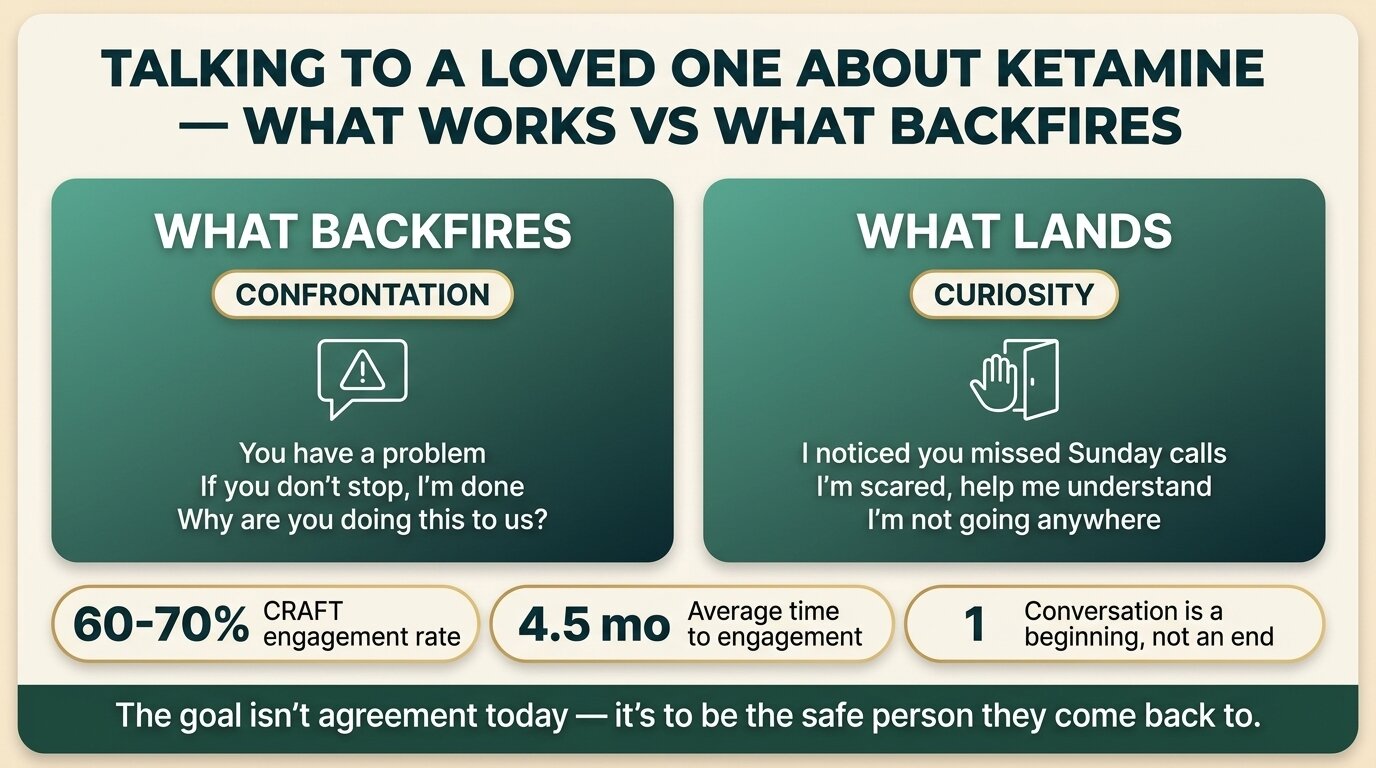
The first conversation about a loved one’s ketamine use shouldn’t aim to get them into rehab — it should aim to keep the door open. Confrontational interventions backfire more often than they work. The approach with the strongest evidence base is Community Reinforcement and Family Training (CRAFT), which engages around 60–70% of treatment-refusing loved ones into care over time, compared to roughly 10–30% for Al-Anon-style detachment or one-shot ambush interventions (Manuel et al., J Subst Abuse Treat, 2012). The work is slow. It’s also the only thing that consistently works.
When Should You Have the Conversation?
Have the conversation when they are sober, you are calm, the setting is private, and there is no audience. Avoid the hours after a dose — ketamine’s dissociation can last hours and impairs memory of the conversation itself. Avoid the morning after a heavy session, when they’re physically rough and emotionally raw. Pick daylight, a quiet room, and forty uninterrupted minutes.
The Hazelden Betty Ford Foundation’s guidance for families is explicit: never confront someone who is intoxicated, and choose neutral, sober ground for the conversation (Hazelden Betty Ford, 2024). For ketamine specifically, the practical translation is: not within four to six hours of a known dose, not when they’re slurring or staring through you, not when their pupils are doing the slow ketamine drift. If you’re not sure they’re sober, postpone.
What also matters is your own state. If you’re shaking with anger, you’ll say something you can’t take back. If you’ve been crying for two hours, you’ll signal crisis and they’ll match it with shutdown. Wait until you can describe what you’ve seen in a normal voice. That might mean writing it down first.
| Don’t have the conversation when… | Do have it when… |
|---|---|
| They’ve just used or are mid-dissociation | They’ve been sober at least 24 hours |
| You’re heated, crying hard, or just discovered something new | You can describe what you’ve seen in a calm voice |
| Other family members are present unannounced | It’s just the two of you, private, no audience |
| It’s late at night or in a bar/restaurant | It’s daylight, at home, no alcohol around |
| You have 15 minutes before something else | You have at least 40 uninterrupted minutes |

What Are the Actual Opening Lines That Don’t Trigger Defensiveness?
Open with a specific thing you noticed and a specific feeling you had — not a label, not a diagnosis, and not a question that demands they justify themselves. “I noticed [specific behaviour], and I’m worried” is the structure. It works because it gives them nothing to argue with. They can’t tell you that you didn’t notice what you noticed.
Motivational interviewing research is consistent on this point: confrontation raises defensiveness, and defensiveness shuts down change talk before it can start (SAMHSA TIP 35, 2019). The phrasing you use in the first thirty seconds sets the tone for the next hour.
| What backfires | What lands |
|---|---|
| “You have a problem.” | “I noticed you spent most of last weekend in your room and you weren’t responding to my texts. I’m worried.” |
| “You’re a ketamine addict.” | “I saw the bag in your drawer when I was looking for the charger. I’m not going through your stuff. I just need to talk about what I saw.” |
| “Why are you doing this to us?” | “I don’t understand what’s going on, and I want to. Can you tell me what’s been happening for you?” |
| “You’re throwing your life away.” | “You used to call your brother every Sunday. He told me you haven’t picked up in two months. I noticed that, and I miss you.” |
| “Do you know what ketamine does to your bladder?” | “You’ve had stomach pain four times this month. I’m scared something is wrong with your body and you’re not telling me.” |
Notice the pattern. The lines that land are observation-plus-feeling, not accusation-plus-demand. They give the other person room to respond without having to defend against a label. The Hazelden guidance phrases this as “be specific” and “use ‘I’ statements” — the technique sounds simple, but it’s the difference between a conversation that continues and one that ends in a slammed door.
How Do You Handle Ketamine-Specific Deflections?
Ketamine users often deflect with two specific arguments: “it’s a medicine now” (referencing FDA-approved esketamine for depression) and “it’s not really addictive.” Both contain enough truth to make arguing the chemistry a losing position. Don’t argue it. Acknowledge the half-truth, then pivot back to what you’ve actually seen happen to them.
Ketamine is genuinely complicated as a recreational drug. The FDA approved esketamine for treatment-resistant depression in 2019, and ketamine clinics now operate in most major cities — which means the cultural framing of ketamine has shifted in five years (NIDA, 2024). And in pure pharmacology terms, ketamine produces psychological dependence and craving more reliably than it produces classic physical withdrawal — which lets users argue it isn’t “really” addictive in the way alcohol or opioids are. A 2025 study of people with ketamine use disorder found that 71% reported cravings during abstinence, 62% reported low mood, and 60% reported bladder problems — but only 40% were actively trying to stop (Harding et al., Addiction, 2025).
| They say… | You say (don’t argue the chemistry — pivot to impact) |
|---|---|
| “It’s a medicine now. It’s literally prescribed for depression.” | “I know it can be. The version you’re using, the amount you’re using, and where you’re using it isn’t medicine. I’m talking about what I see happening to you, not what a doctor prescribes someone else.” |
| “Ketamine isn’t addictive.” | “I’m not going to argue the science with you. I’m telling you what I’ve watched — you used to do it once a month, then once a week, then most days. Whatever we call that, I’m scared by it.” |
| “You don’t understand. It actually helps me.” | “Help me understand. Walk me through what it does for you. I want to hear it.” (Then listen. Don’t interrupt. Don’t refute.) |
| “I can stop whenever I want.” | “Then I’d love to see that. Not as a test — because I want my person back. When was the last time you went a week without it?” |
| “You’re overreacting.” | “I might be. I’d rather overreact and be wrong than under-react and lose you. I need to say this even if I’m wrong.” |
| “Why are you in my business?” | “Because I love you and I’m scared. That’s the only reason. I’m not trying to control you — I’m trying not to lose you.” |
The pattern under all of these: you concede every technical point and stay anchored to what you’ve observed. They can’t argue you out of what you’ve seen. The moment you try to win the “is ketamine addictive” debate, you’ve lost — because they’ll find one paper or one Reddit thread that lets them dismiss everything else you said. Don’t go there. Stay in the room with what’s actually happening.
The families who keep the conversation going aren’t the ones with the perfect script. They’re the ones who can hear “you don’t understand” without flinching, and respond with “you’re right, help me understand.” Curiosity beats confrontation every time. The person using ketamine has heard every lecture already — what they haven’t heard is someone who actually wants to know what it’s like inside their head.
Craig GagnonSenior Therapist, One Step Rehab

What Should You Never Say in a First Conversation?
Never deliver an ultimatum, never compare ketamine to a “real” drug they don’t use, and never tell someone else’s recovery story as if it predicts theirs. A first conversation is for opening a channel, not closing a deal. Ultimatums work in carefully staged interventions led by a trained professional with the family aligned — not in a single conversation over the kitchen table.
The Hazelden Betty Ford Foundation’s family guidance specifically warns against blame-focused language and sweeping statements, which trigger denial as a defensive reflex rather than honest reflection (Hazelden Betty Ford, 2024). The list below isn’t moralistic — it’s tactical. Every line on it is something families say with the best intentions that reliably ends the conversation.
| Don’t say | Why it backfires |
|---|---|
| “If you don’t go to rehab, I’m done.” | Ultimatums on first contact force a no. They lock the user into a public position they then have to defend. |
| “At least it’s not heroin.” | Confirms they’re using a “safer” drug. Removes urgency. Tells them you’ll only take it seriously if it gets worse. |
| “I had a friend who used ketamine and they’re fine now.” | Other people’s stories aren’t evidence. Comparisons either minimise the issue or feel like manipulation. |
| “You’re killing your mother.” | Guilt cycles strengthen the use. Shame is one of the most reliable predictors of continued substance use. |
| “How can you do this to me?” | Centres your pain. Tells them your hurt is the problem they have to fix, which they can’t, so they’ll numb it. |
| “You’re better than this.” | Sounds supportive, lands as judgmental. Implies their using identity is who they really are. |
| “You need to go to rehab. Today.” | Skips three or four conversations the person hasn’t had with themselves yet. They’ll refuse and the refusal hardens. |
Want to talk it through with someone who’s done this before? Talk to our team — we’ll help you think through your specific situation, and we’ll tell you honestly whether residential treatment is the right next step or whether something less drastic comes first.
What Do You Do When They Minimise or Deflect?
When they minimise — “it’s not that bad,” “everyone does it,” “you’re being dramatic” — don’t escalate. Reflect what they said back to them without agreeing or disagreeing, then ask a question that returns to your direct observation. This is the core of motivational interviewing as a family member: you reduce defensiveness by refusing to argue, and you let the discrepancy between their words and their life do its own work (SAMHSA TIP 35, 2019).
A reflection sounds like: “So what I hear you saying is that it’s helping you sleep and you’ve got it under control. Can I ask — you mentioned last week you’d had three nights with no sleep at all. Does that fit with having it under control?” You aren’t accusing. You’re holding two of their own statements next to each other.
If they shift to attack — “this is none of your business,” “you’re the one with a problem” — don’t take the bait. The line that usually de-escalates is some version of: “I’m not here to fight. I’m here because I love you. We can stop talking about this any time you want, but I’m not going to pretend I didn’t notice.” Then sit with the silence. Most families fill silence by talking themselves out of the position they just took. Don’t.
If they shut down entirely and refuse to engage — that’s still a successful first conversation. You said the thing. They heard it. The seed is planted. Forcing them to respond in that moment doesn’t make them respond more honestly; it makes them respond more defensively. Walk away with: “I’m not done worrying about this, but I’m done for today. I love you.”

What Does a Realistic Positive Outcome Look Like?
A realistic positive outcome is not “they agree to rehab by the end of the conversation.” It’s “they didn’t deny everything, and they didn’t shut the door on us talking about it again.” That’s it. Recovery happens over months. The first conversation either opens or closes the channel. Anything that keeps it open is a win.
The Community Reinforcement and Family Training (CRAFT) model, which Hazelden Betty Ford and a growing number of family programs now teach, treats engagement as a process measured in weeks to months. Across multiple randomised trials, CRAFT engages around 60–70% of treatment-refusing loved ones into care — but the average time-to-engagement is around 4.5 months of patient, structured family work, not a single conversation (Bischof et al., Drug Alcohol Depend, 2016). The first conversation is a foundation, not a finish line.
| What happened | What it means |
|---|---|
| They denied everything and walked out | A bad outcome, but not a closed door. Give it two weeks, then reopen — same calm, same specifics, same care. Most second conversations go better than the first. |
| They cried and said they’d think about it | A good outcome. They heard you. Don’t push for a commitment in the moment. Let them sit with it. |
| They minimised but kept talking | A win. Most resolve cracks start with someone arguing they don’t have a problem while continuing to talk about it. |
| They asked one specific question about treatment | A very good outcome. Answer it honestly, briefly, and don’t oversell. “I don’t know — would you want to find out together?” is a good response. |
| They agreed to rehab immediately | Move fast. The window is real but short. Have one number ready to call before you started the conversation. Don’t wait until tomorrow. |
How Do You Stop Being Part of the Avoidance System?
You can’t force someone into recovery, but you can stop being the safety net that lets the using continue without consequence. Choose one or two specific things you’ve been doing that protect them from the fallout of their use — calling in sick for them, paying their phone bill while they buy ketamine, telling their boss they have the flu — and decide you’re not doing those things anymore. Say it once, calmly, and follow through.
This isn’t punishment. It’s withdrawal of cover. The CRAFT model frames it as removing positive reinforcement for using and allowing natural consequences to register. Patrick Smith and Robert Meyers, who developed CRAFT, were explicit that this is not “tough love” — it’s a structured way to stop protecting someone from the reality of their choices while remaining present, available, and warm (Hazelden Betty Ford, 2024).
The framing for your loved one, when you say it: “I love you. I’m not going to lie to your work for you anymore. I’m not going anywhere — call me anytime — but I’m done being the reason you don’t have to deal with what’s happening.” Then keep your word. The first time you cave undoes a month of work.
And be honest with yourself about what you can sustain. Don’t announce three boundaries you won’t keep. Pick one. Hold it. Add another in a month if it’s working.

How Does One Step Support Families Through This?
One Step Rehab is a residential treatment centre in Chiang Mai, Thailand, treating addiction including ketamine use disorder on-site. Most of our work is with the person using — a structured 28 to 60-day inpatient programme combining group therapy, individual counselling, and a daily schedule that breaks the using pattern. Family work runs alongside it, including video calls and an optional family programme.
For ketamine specifically, we handle detox on-site. Ketamine doesn’t produce the kind of severe physical withdrawal that requires hospital-level monitoring — the hard work is psychological: cravings, low mood, irritability, and the specific dissociative pull of the drug. Our ketamine rehab programme is built around that reality. If you want to understand what your loved one is actually experiencing day-to-day, our breakdown of how ketamine makes you feel and what a K-hole is is the post we send to most family enquiries.
Practical operational details:
- Programme fee: approximately ฿280,000/month (~$8,500 USD). The fee covers accommodation, all therapy sessions, meals, the intake assessment with our visiting psychiatrist, and routine progress check-ins. Full pricing breakdown here.
- Not included: medication is billed separately — you pay for what the doctor prescribes. Flights, visa, supplements, additional counselling outside the standard schedule, and personal items are also separate.
- Length of stay: we recommend a minimum of 28 days. Most ketamine clients stay 45–60 days because the psychological pull of the drug takes longer to lose its grip than the physical symptoms suggest.
- Family contact: structured family video calls during treatment, plus an optional family programme that teaches you the CRAFT approach so you can keep doing this work after treatment ends.
- What we’re not: not a hospital, not a luxury resort. Mid-range, treatment-focused, structured. If your loved one needs locked psychiatric care for acute crisis or active psychosis, that’s a hospital, not us.
If your situation involves teen ketamine use — which has its own patterns — our post on warning signs of ketamine addiction in teens covers what to watch for. And if you’re trying to work out whether what they’re using is recreational or therapeutic, our breakdown of recreational vs medical ketamine is the cleanest comparison we’ve found.
The honest part: One Step can’t fix this from a website. What we can do, if you call our admissions team, is talk you through your specific situation, tell you whether residential treatment makes sense as the next step or whether outpatient counselling and CRAFT-based family coaching gets you further for now, and not push you toward a bed if a bed isn’t what helps.
If you or someone you love is struggling with substance dependence, explore how a structured drug addiction treatment can provide the structure, clinical support, and environment needed for lasting recovery.
Frequently Asked Questions
What families ask us most often about talking to a loved one about ketamine use.
Denial is the default response, not a sign the conversation failed. Don’t argue them into agreement — agreement isn’t required for change to start. Stay calm, restate what you’ve actually observed, and end the conversation with the door open. Most people need to hear specific concerns several times from someone they trust before the resolve to keep using cracks. The seed is planted whether they admit it or not.
Sometimes — usually after several lower-key conversations haven’t moved anything and the situation is escalating. A trained interventionist makes the staged confrontation safer and more likely to land. But a one-shot ambush intervention without professional planning has a high failure rate and can permanently damage trust. If you’re considering it, hire someone who does this for a living. Don’t improvise.
Frequency increasing over time is the clearest signal. Going from monthly to weekly to most days within six months is a pattern, not a phase. Physical signs include unexplained abdominal pain (K-cramps), needing to urinate often, nosebleeds, and weight loss. Behavioural signs include withdrawal from people they used to call, missed work, secrecy about their movements, and an inability to enjoy things sober.
Possibly not entirely — esketamine is genuinely approved for treatment-resistant depression, and ketamine clinics use carefully dosed, supervised infusions for mental health. But that is not what street ketamine, used daily, alone, at escalating doses, does. The therapeutic protocol is short, supervised, and infrequent. Recreational daily use produces the opposite effect over time — more depression, more anxiety, more dissociation between sessions. Don’t argue the science; point to the pattern.
Usually no. Searching destroys trust in a way that’s hard to repair, and the conversation works without it. Behavioural changes you’ve observed are enough to open the conversation. If you find evidence by accident — a bag in their car, residue on a surface — you can mention it without apology, calmly, as part of what you noticed. But going through their things to build a case usually backfires.
Let them leave. Don’t chase, don’t text fifteen times, don’t apologise for having raised it. Anger is a defensive reaction, not a verdict. Send one short message a few hours later: “I love you. I’m still worried. I’m here when you want to talk.” Then wait. Most people circle back within days, especially if the conversation was specific and not accusatory.
Family support groups (Al-Anon, Nar-Anon, SMART Recovery Family & Friends) help, and a counsellor who works with families of substance users helps more. Sleep, eat, see your own friends, keep going to work. The instinct to put your whole life on pause until they get better isn’t sustainable and doesn’t actually help them. You are more useful to them as a calm, present, intact person than as someone who’s burning down their own life trying to fix theirs.
Written by
Craig Gagnon
Craig Cagnon is an American counseling psychologist and addiction counselor. He holds Masters degrees in community counseling and counseling psychology and completed his clinical residency at The Mayo Clinic, in Rochest...
Learn more about Craig
Medically reviewed by
Dr. Worapakthorn Kongpesalaphun
Consultant Psychiatrist · Thai Licensed Medical Doctor · Residency in Psychiatry, Somdet Chaopraya Institute · Doctor of Medicine, Rangsit University
Dr. Worapakthorn Kongpesalaphun is a Thai Licensed Medical Doctor and Expert in Preventive Medicine (Community Mental Health) with extensive experience in addiction treatment and public health management. He holds multip...
Learn more about Dr. Worapakthorn