

Key Takeaways
- Cravings behave like waves: they build, peak in roughly 20-30 minutes, and fall on their own — whether you use or not.
- Urge surfing is a six-step mindfulness skill developed by Alan Marlatt: name the urge, locate it in the body, breathe through it, observe without judgment, ride the wave, and recommit to a value.
- In a 12-month JAMA Psychiatry trial, Mindfulness-Based Relapse Prevention (which teaches urge surfing) cut substance use days significantly compared to standard relapse prevention and treatment as usual.
- The trick is not fighting the craving or distracting yourself away from it — both strategies make urges louder. Acknowledging the urge without acting on it weakens the link between trigger and use over time.
- Urge surfing isn’t enough on its own for severe withdrawal. It’s a skill that works alongside professional treatment, not a substitute for medical care during detox.
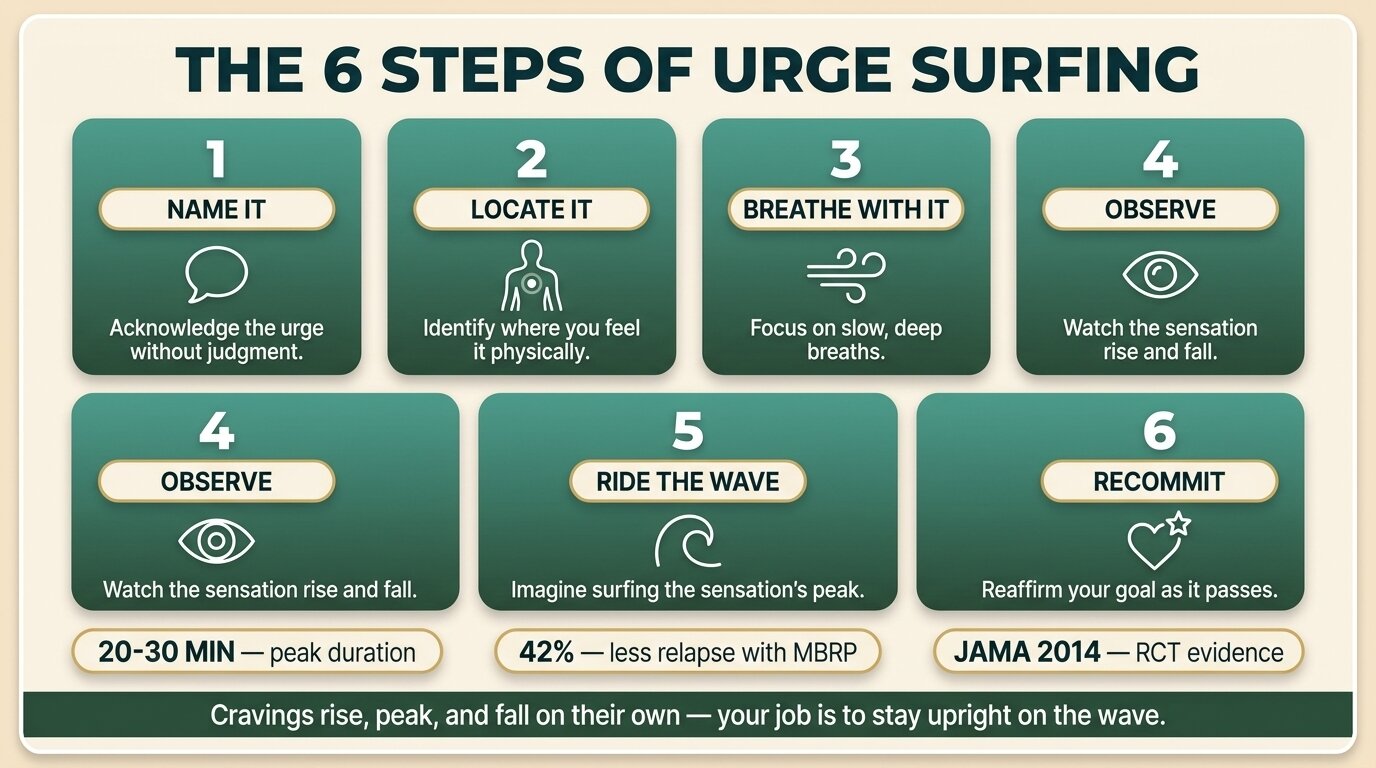
Urge surfing is a six-step mindfulness skill for riding out a craving instead of fighting it or giving in. You name the urge, locate it as a physical sensation, breathe with it, observe it without judgment, ride the wave to its peak, then recommit to what matters. The wave metaphor isn’t poetic license — cravings genuinely rise, peak in 20-30 minutes, and fall on their own. The technique was developed by addiction researcher G. Alan Marlatt, refined into the Mindfulness-Based Relapse Prevention (MBRP) protocol, and shown to reduce relapse risk in a 12-month randomised trial (Bowen et al., JAMA Psychiatry, 2014).
What Is Urge Surfing and Where Did It Come From?
Urge surfing is a mindfulness technique for managing cravings by observing them as temporary physical and mental events rather than commands to act. Psychologist G. Alan Marlatt developed it in the 1980s as part of his cognitive-behavioural Relapse Prevention model, then it was formalised into Mindfulness-Based Relapse Prevention (MBRP) by Sarah Bowen and Katie Witkiewitz at the University of Washington (Larimer et al., Alcohol Research & Health, 1999).
The core insight is borrowed from Buddhist meditation: every sensation, however intense, has a beginning, a middle, and an end. A craving that feels like it will last forever is actually a wave of neural activity that — left alone — peaks and recedes within roughly half an hour. Marlatt’s contribution was turning that meditative principle into a concrete skill that someone in early recovery could use at 2am when their brain is screaming for cocaine, alcohol, or anything else.
The wave metaphor matters because it changes what you’re trying to do. You’re not trying to make the urge go away. You’re not trying to outsmart it. You’re staying upright on top of it while it does what waves do.

How Long Does a Craving Actually Last?
Untreated cravings — ones you observe rather than feed or fight — typically peak within 15 to 30 minutes and then fall on their own. They feel permanent in the moment, but the neural and physiological activity behind them is time-limited. This is the structural fact that makes urge surfing possible: if you can stay present through the peak, the wave will break without you having to do anything.
This timing isn’t intuitive. When you’re inside a craving, the experience is one of escalating pressure with no end in sight. Most people in early recovery believe two things that aren’t true: that the urge will keep getting stronger forever, and that the only way to make it stop is to give in. Both beliefs are reinforced every time someone uses to “make it stop,” because the relief that follows trains the brain to expect that relief next time.
Urge surfing breaks that loop. You’re not waiting for the craving to fade because you used. You’re watching it fade because it’s a wave, and that’s what waves do.
| Time | What the urge feels like | What’s happening physiologically |
|---|---|---|
| 0-5 min | Sudden, sharp pull. Specific image of using. | Cue triggers dopamine anticipation. Sympathetic nervous system spike. |
| 5-15 min | Pressure builds. Body tension, racing thoughts, bargaining. | Stress hormones rising. Prefrontal cortex losing influence. |
| 15-25 min | Peak. Feels like it will not stop. This is the hard part. | Wave crests. Body cannot sustain this level indefinitely. |
| 25-40 min | Edge dulls. Thoughts move on. Surprise that it passed. | Parasympathetic recovery. Dopamine signal extinguishes. |

What Are the 6 Steps of Urge Surfing?
The six steps are: name the urge, locate it in your body, breathe with it, observe without judgment, ride the wave to its peak, and recommit to your value. Each step takes seconds, not minutes, and the whole sequence runs in parallel — you keep returning to all six as the craving rises and falls. The point is to stay with the experience instead of running from it or feeding it.
Step 1: Name the urge
Out loud or silently, label what’s happening. “I am having an urge to use cocaine.” “I want a drink.” Naming the urge does two things at once: it engages the prefrontal cortex (which the craving has been trying to drown out), and it creates a small piece of psychological distance between you and the experience. You move from “I need this” to “I’m noticing I want this.” The grammar matters.
Specific phrases that work for people we see in treatment:
- “This is a craving. I’ve had cravings before. They pass.”
- “My brain is making a request. I don’t have to grant it.”
- “I’m not the urge. I’m the person watching the urge.”
Step 2: Locate it in your body
Cravings live in the body, not just the mind. Scan for where you actually feel it. The throat tightening. A pressure behind the sternum. Heat in the jaw. Restlessness in the legs. A pit in the stomach. This step is the heart of urge surfing because it moves your attention out of the looping thought (“I should just have one”) and into the physical sensation, which is concrete and observable and — crucially — already changing.
Body-anchoring techniques that help during this step:
- Five-point check. Feel your feet on the floor, your seat on the chair, your hands resting somewhere, your jaw, your shoulders. Each anchor pulls attention out of craving thoughts.
- Hand on the chest. Place your hand where you feel the urge most strongly. The physical contact gives the sensation somewhere to be held.
- Temperature shift. Cold water on the wrists, ice cube in the hand. Sharp, harmless sensory input anchors you in the present body.
Step 3: Breathe with it, not away from it
Most people instinctively try to breathe the craving away. Urge surfing asks the opposite — breathe with the urge, letting it be there. Slow, even breaths. In through the nose for four counts, out through the mouth for six. The longer exhale activates the parasympathetic nervous system, which is the body’s brake pedal. You’re not trying to make the wave stop. You’re settling into the boat.
Step 4: Observe without judgment
Notice the craving the way you’d notice the weather. Not good, not bad. Not a sign you’re weak or that recovery isn’t working. Just a sensation in a body. Judgment is what turns a craving into a relapse risk — the spiral of “I shouldn’t be having this urge, I’ve failed, what’s the point” is more dangerous than the urge itself.
Useful internal scripts:
- “This is what a craving feels like. This is information, not a verdict.”
- “I’m allowed to want a drink and still not have one.”
- “This is the brain doing what it learned to do. It can learn something else.”
Step 5: Ride the wave to the peak
Stay with it. The peak is where most people give up — the urge feels like it will keep escalating forever, and that’s the moment when relapse looks rational. But that’s the top of the wave. If you can stay present for another five to ten minutes past the peak, the sensation will begin to soften. Not because you did something clever. Because that’s what waves do.
What helps you stay through the peak:
- Counting your breaths to 10, then starting over
- Naming three things you can see, three you can hear, three you can feel
- Calling a sponsor, counsellor, or trusted friend (without arguing for or against using)
- Looking at the time and committing to wait 20 more minutes before any decision
Step 6: Recommit to a value
As the wave breaks, reconnect to why you’re doing this. Not abstract recovery. A specific value. Being present for your daughter’s school pickup. Waking up without shame. Keeping the job you fought to get back. Sleeping next to your partner without lying. The craving was loud; values are quieter. The recommitment is what closes the loop and prepares you for the next wave.
The reason urge surfing works is counterintuitive — the more you fight a craving, the more attention you give it, and attention is exactly what cravings feed on. What we see with clients in early recovery is that the first time they ride out an urge without using, something shifts. They stop being afraid of the wave. After that, the urges keep coming, but they’re no longer running the show.
Alastair MordeyProgramme Director, One Step Rehab
Does Urge Surfing Actually Work? What the Research Shows
Yes. The Mindfulness-Based Relapse Prevention protocol — built around urge surfing and related practices — produced significantly fewer substance use days and less heavy drinking at 12 months compared to standard relapse prevention and treatment as usual in a randomised trial of 286 adults with substance use disorders (Bowen et al., JAMA Psychiatry, 2014). Mindfulness training appears to weaken the link between craving and use, not just reduce the craving itself.
The mechanism matters. A secondary analysis of the MBRP trial found that participants in mindfulness training reported similar levels of craving as those in standard relapse prevention — but the cravings translated into fewer relapses. In other words, mindfulness didn’t make the urges disappear; it made the urges less able to drive behaviour (Witkiewitz et al., Addictive Behaviors, 2013).
More recent work by Eric Garland on Mindfulness-Oriented Recovery Enhancement (MORE) extended the finding to opioid use disorder, with brain imaging showing that mindfulness training restored the brain’s response to natural rewards — which is exactly what addiction erodes (UCSD/JAMA, 2025). The picture across studies is consistent: training the brain to observe cravings without acting changes how cravings translate into behaviour.
Worried about cravings during early recovery? Talk to our team — we’ll tell you honestly whether urge surfing alone is enough for your situation, or whether you need structured treatment first.
When Urge Surfing Fails (and What to Do Instead)
Urge surfing fails when you treat it as a willpower exercise instead of a skill, when you try to use it during acute withdrawal that requires medical care, or when you’re isolated and exhausted and the wave is bigger than the practice. It is a recovery skill, not a substitute for treatment. Knowing when not to rely on it is part of using it well.
Signs urge surfing isn’t the right tool right now:
- You’re physically withdrawing from alcohol, benzodiazepines, or opioids. The body symptoms are too loud, and severe withdrawal needs medical support, not mindfulness alone. Read our guide on reducing relapse risk during withdrawal and our overview of detox at One Step.
- Cravings are happening 20+ times a day for weeks. That’s the post-acute pattern that needs structured treatment, not a self-help skill. See our piece on the 10 most common relapse triggers for what to plan for.
- You’re using urge surfing to white-knuckle in environments that keep firing the cues. The skill works best in combination with reducing exposure to triggers, not as the only line of defence.
- You’re alone, sleep-deprived, and the craving keeps coming back. Exhausted brains lose access to mindfulness. Call someone. Even a five-minute call breaks the spiral.
What to do when urge surfing isn’t enough on its own:
- Call your sponsor, counsellor, or a sober friend. Not to argue about using — just to talk for ten minutes.
- Change your physical location. Walk outside. Move to a different room. Cravings are state-dependent, and a state change weakens them.
- Eat something with protein. Hunger and low blood sugar amplify cravings. The HALT check (Hungry, Angry, Lonely, Tired) catches this.
- If the wave keeps coming, that’s a signal to escalate care — call a treatment centre, go to a meeting, ask for help. Repeated waves without relief are not a personal failing; they’re a sign the situation needs more support than self-management.

How We Teach Urge Surfing at One Step
At One Step Rehab in Chiang Mai, urge surfing is one of several skills we teach in our group therapy and one-to-one counselling. We introduce it in the second week of treatment, after detox is complete and the brain has cleared enough to actually use a skill. Clients practise it in low-stakes moments first — boredom, mild restlessness — so that when an actual high-intensity craving hits, the technique is already familiar.
The structure that matters:
- Daily mindfulness practice. Mindfulness in a crisis only works if you’ve practised mindfulness when there is no crisis. Our morning meditation sits inside the broader treatment schedule for this reason.
- CBT and DBT-informed counselling. Urge surfing pairs with cognitive techniques for reframing the thoughts that escalate cravings. Read more about CBT and DBT in addiction recovery.
- Aftercare and relapse planning. Clients leave with a written plan that includes urge surfing as one tool among several, mapped to their actual high-risk situations. See our aftercare programme for what continued support looks like.
- Honest framing. We tell clients up front that urge surfing isn’t a magic technique. The first time you ride out a craving without using, it’s hard. The tenth time, it’s still hard. But the cravings get weaker, less frequent, and easier to spot before they peak.
The cost of our 28-day residential programme is approximately ฿280,000/month (~$8,500 USD), covering accommodation, group therapy, individual counselling, meals, and the structured daily schedule. Medication prescribed during your stay, flights, visas, and personal items are billed separately. Full breakdown on our pricing page.
Frequently Asked Questions
Common questions about urge surfing and managing cravings in recovery.
Most cravings peak within 15 to 30 minutes and then fall on their own. The wave metaphor isn’t poetic — it reflects how the underlying physiological and neural activity actually behaves. The hardest part is staying present through the peak, which often feels as if the urge will keep escalating forever. It won’t.
No — and this is where most people get it wrong. Distraction tries to make the craving go away by pointing attention elsewhere. Urge surfing turns attention towards the craving, observing it as a physical sensation without acting on it. The research suggests that observation weakens the craving’s hold on behaviour over time, while distraction tends to leave the underlying response untouched.
Yes, but you’ll need to practise it before you need it. Mindfulness skills are hardest to access in a crisis. Five to ten minutes of daily breath-awareness practice builds the mental muscle you’ll use during a craving. Trying urge surfing for the first time at the peak of an urge is like learning to swim in a riptide.
For most people, cravings get less frequent and less intense over months and years, but they don’t disappear entirely. What changes is your relationship to them. A craving at year five is no longer a five-alarm fire — it’s more like background weather. Urge surfing makes that shift happen faster because each ridden-out urge weakens the next.
For someone with a mild use pattern and stable support, urge surfing as part of regular counselling and mutual-aid attendance may be enough. For anyone with physical dependence, frequent relapses, or a chaotic environment, a recovery skill on its own won’t be sufficient — you need a structured treatment programme that teaches the skill within a broader plan, plus medical support for any withdrawal.
Sometimes a wave peaks, falls, and a fresh wave starts within minutes — especially in early recovery or when you’re in an environment full of cues. That’s not failure of the technique; it’s a signal that the environment is firing too many triggers at once. Leave the situation, call for support, and treat the rolling cravings as a sign to change conditions rather than to keep white-knuckling.
Yes. The technique applies to any craving-driven behaviour — gambling, compulsive eating, problem porn use, smartphone compulsion. The mechanism is the same: a triggered urge rises, peaks, and falls if not acted on. The Mindfulness-Based Relapse Prevention protocol has been adapted for several behavioural patterns beyond substance use, with similar findings on reducing the urge-to-behaviour link.
Written by
Alastair Mordey
Alastair Mordey is one of the pioneers of drug and alcohol treatment globally and specifically in Asia. He has been an addiction’s professional for twenty years. He started his career as an expert in substance abuse w...
Learn more about Alastair
Medically reviewed by
Dr. Worapakthorn Kongpesalaphun
Consultant Psychiatrist · Thai Licensed Medical Doctor · Residency in Psychiatry, Somdet Chaopraya Institute · Doctor of Medicine, Rangsit University
Dr. Worapakthorn Kongpesalaphun is a Thai Licensed Medical Doctor and Expert in Preventive Medicine (Community Mental Health) with extensive experience in addiction treatment and public health management. He holds multip...
Learn more about Dr. Worapakthorn