

Key Takeaways
- Alcohol doesn’t help you sleep — it sedates you for the first half of the night, then fragments your sleep for the rest of it.
- Insomnia in early sobriety is a neurological rebound, not a sign something is wrong with you. Your brain needs time to recalibrate.
- Sleep problems can persist for weeks or months after quitting, and untreated insomnia is a major relapse risk factor.
- Structured sleep habits, physical activity, and cognitive behavioural therapy for insomnia (CBT-I) are the most effective fixes — not sleeping pills.
- At One Step, sleep recovery is built into the daily programme: set wake times, physical activity, no screens at night, and clinical support if sleep issues persist.
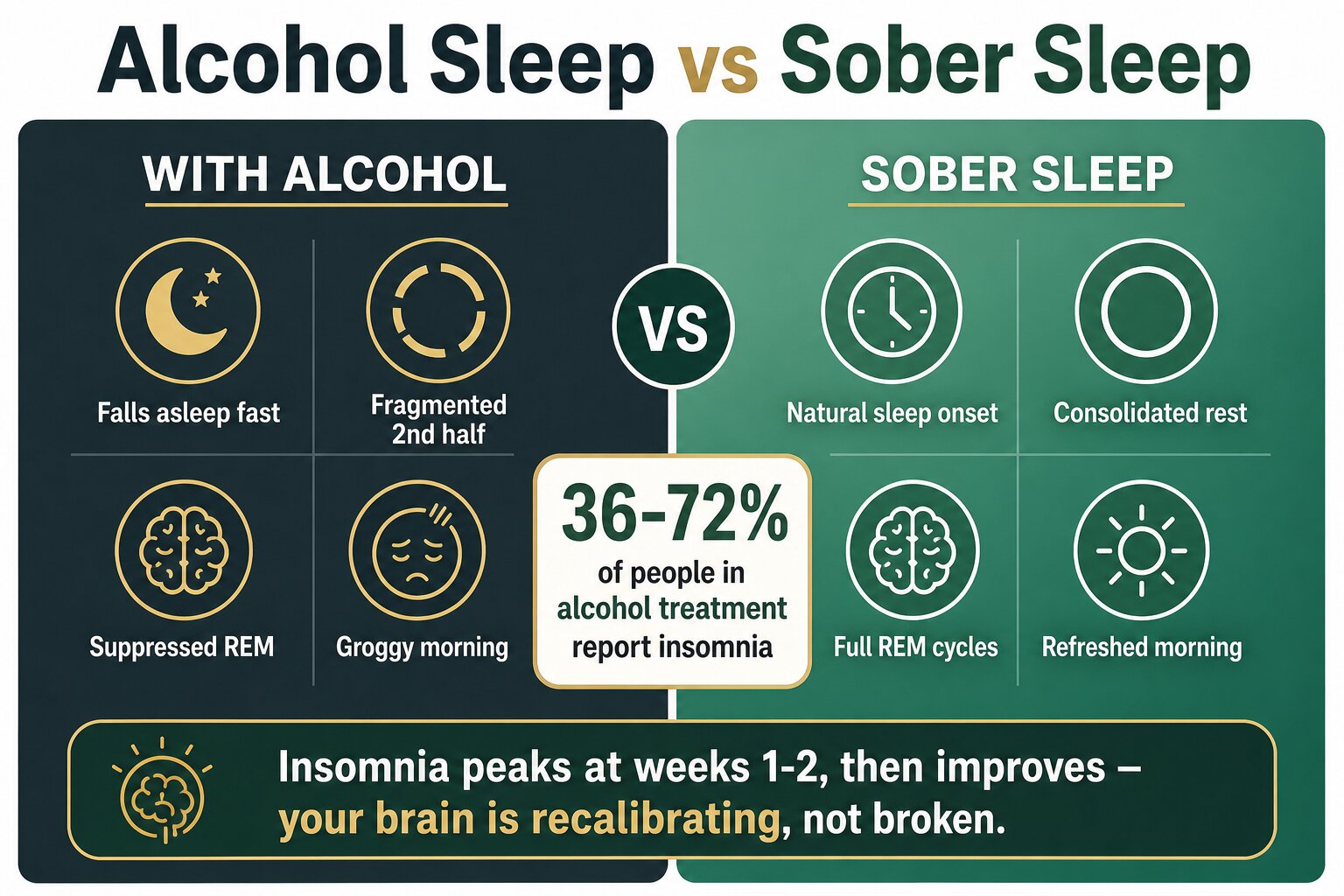
You’re not imagining it — sleep really does get worse when you stop drinking. Alcohol suppresses your brain’s natural sleep-wake regulation, and when you remove it, your nervous system overcompensates. The result: you lie awake at 3am, wired and exhausted, wondering if sobriety is supposed to feel this miserable. It is — temporarily. Research shows that alcohol-related insomnia affects 36–72% of people entering treatment (Brower, Alcohol Res Health, 2001), but it does resolve. Here’s what’s actually happening in your brain, how long it lasts, and what you can do about it right now.
Why Can’t You Sleep Without Alcohol?
Alcohol disrupts your brain’s sleep homeostasis — the internal system that builds sleep pressure during the day and releases it at night. When you drink regularly, your brain adapts to alcohol’s sedative effect by increasing its excitatory activity to compensate. Remove the alcohol, and that heightened excitatory state remains, leaving you wired, restless, and unable to fall asleep (Thakkar et al., Alcohol, 2015).
Think of it like this: alcohol is a heavy blanket thrown over your brain’s alarm system. Your brain turns up the alarm volume to compensate. When you pull the blanket off, the alarm is blaring — and it takes time to turn it back down.
This isn’t a character flaw or weakness. It’s neurochemistry. Your brain adapted to a depressant, and now it needs to recalibrate without it. The discomfort is real, but it’s also temporary.
What Does Alcohol Actually Do to Your Sleep?
Alcohol acts as a sedative during the first half of the night — it shortens the time it takes to fall asleep and increases deep sleep initially. But during the second half, it fragments your sleep, suppresses REM (dream) sleep, and causes frequent awakenings. The net effect: you feel like you slept, but your brain didn’t get the restorative rest it needed (Thakkar et al., Alcohol, 2015).
| Sleep phase | With alcohol | Without alcohol (healthy) |
|---|---|---|
| First half of the night | Fall asleep faster, more deep sleep | Normal sleep onset, balanced sleep stages |
| Second half of the night | Fragmented, frequent waking, suppressed REM | Consolidated sleep with healthy REM cycles |
| Morning | Groggy, unrested despite hours in bed | Refreshed, alert |
| Long-term effect | Brain adapts, needs more alcohol for same sedation | Stable, self-regulating sleep cycle |
Regular drinkers often don’t realise how poor their sleep quality is because they associate “falling asleep fast” with “sleeping well.” In reality, alcohol-assisted sleep skips critical restorative stages. When you stop drinking and suddenly can’t sleep at all, it feels worse — but you’re actually on the path toward genuinely better sleep for the first time in years.

How Long Does Insomnia Last After You Quit Drinking?
Insomnia after quitting alcohol typically peaks in the first 1–2 weeks, improves noticeably by week 3–4, but can linger for several months in heavy or long-term drinkers. Research shows that some sleep abnormalities — particularly reduced deep sleep and increased nighttime waking — may persist for months to years in people with alcohol dependence, though they do continue improving over time (Brower, Alcohol Res Health, 2001).
| Timeframe | What to expect |
|---|---|
| Days 1–3 | Acute withdrawal symptoms; difficulty falling and staying asleep; possible night sweats, anxiety, vivid dreams |
| Week 1–2 | Insomnia peaks; REM rebound causes intense, sometimes disturbing dreams; frequent waking at 2–4am |
| Week 3–4 | Sleep onset improves; nighttime waking begins to decrease; dream intensity fades |
| Month 2–3 | Most people report significantly better sleep quality; deep sleep stages begin normalising |
| Month 3–6+ | Sleep architecture continues healing; residual issues typically manageable with good habits |
The hardest part is the first two weeks. Your brain is mid-reboot. REM sleep, which alcohol had been suppressing, comes flooding back — a phenomenon researchers call “REM rebound.” This is why early sobriety brings vivid, sometimes unsettling dreams. It’s not a sign of damage; it’s your brain catching up on the dream sleep it was denied.
“Sleep disturbance during early recovery is one of the most common complaints we hear, and one of the most important to address. Untreated insomnia creates a vicious cycle — the person can’t sleep, they become irritable and anxious, and alcohol starts to look like a solution again. Building a stable sleep routine early in treatment is a clinical priority, not a luxury.”
Craig GagnonSenior Therapist, One Step Rehab
Why Is Insomnia Dangerous for Recovery?
Insomnia isn’t just uncomfortable — it’s a clinical risk factor for relapse. People who enter addiction treatment with insomnia tend to relapse earlier than those who sleep normally, according to a one-year follow-up study of patients in treatment for substance use disorders (Esteve-Abellan et al., Eur Psychiatry, 2021). Sleep-deprived brains are worse at impulse control, emotional regulation, and learning new coping skills — exactly the capacities you need most in early recovery.
Poor sleep also impairs memory consolidation, which means the therapeutic work you’re doing in counselling — learning to identify triggers, practising new responses, building relapse prevention plans — doesn’t stick as well when you’re exhausted (NIDA, 2020). Sleep isn’t a side issue in recovery. It’s foundational.
This is why good treatment programmes don’t ignore sleep complaints or tell you to “just push through.” If your sleep isn’t recovering, it needs to be addressed directly — not treated as an afterthought.
Struggling with sleep in early sobriety? Talk to our team — we’ll give you a straight answer about what to expect and how we can help.
How Can You Fix Your Sleep Without Alcohol?
Restoring healthy sleep after alcohol dependence requires structured behavioural changes — not just willpower or waiting it out. Cognitive behavioural therapy for insomnia (CBT-I) is the most effective evidence-based treatment, producing large reductions in insomnia severity that persist at follow-up. Unlike sleeping pills, CBT-I addresses the root causes of insomnia rather than masking symptoms (Chakravorty et al., Alcohol Clin Exp Res, 2016).
Here’s what actually works, ranked by evidence and practicality:
1. Lock your wake-up time
Pick a wake time and stick to it every single day — including weekends. This is the single most powerful lever you have. A consistent wake time anchors your circadian rhythm and builds reliable sleep pressure for the following night. Don’t try to “catch up” on sleep by lying in. It backfires.
2. Restrict time in bed
If you’re only sleeping 5 hours, don’t spend 9 hours in bed. Compressing your time in bed to match your actual sleep builds stronger sleep drive. This feels counterintuitive — and uncomfortable — but it’s a core CBT-I technique that works faster than anything else.
3. Get physical during the day
Exercise — even a 30-minute walk — improves sleep quality in people recovering from alcohol use disorder. The key is timing: finish vigorous exercise at least 3–4 hours before bed. Morning or afternoon activity is ideal.
4. Cut the screen light after sunset
Blue light from phones, laptops, and TVs suppresses melatonin production and delays sleep onset. After 8pm, switch to dim lighting and avoid screens. If you must use a device, enable a blue-light filter — though putting the phone in another room is more effective.
5. Build a wind-down routine
Your brain needs a signal that sleep is coming. A consistent 30-minute routine — shower, read a physical book, breathing exercises, herbal tea — trains your nervous system to downshift. The content matters less than the consistency.
6. Don’t lie in bed awake
If you’ve been awake for 20+ minutes, get up. Sit somewhere dim, read something boring, and return to bed only when you feel sleepy. Lying awake teaches your brain that bed is a place for frustration, not sleep. Breaking that association is critical.
7. Skip the nightcap substitutes
Caffeine after noon, heavy meals before bed, and nicotine all disrupt sleep. In early sobriety, your nervous system is already hypersensitive — these inputs make it worse. Chamomile tea or warm milk are fine. Energy drinks at 4pm are not.

How Does One Step Approach Sleep in Recovery?
At One Step, sleep recovery isn’t a separate programme — it’s embedded in the daily structure. Every element of the residential schedule is designed to support circadian rhythm restoration, which is one of the reasons residential treatment works better for alcohol recovery than outpatient programmes where you’re left managing your own sleep in an unstructured environment.
Here’s what that looks like in practice:
- Fixed wake time at 7am daily — no exceptions, no sleeping in. This is the foundation of circadian reset.
- Morning meditation and mindfulness — reduces the hyperarousal state that keeps recovering drinkers awake at night.
- Structured physical activity — from gym sessions to outdoor therapy and activities and excursions, regular movement is built into every week.
- Therapy sessions including CBT and DBT — these modalities address the anxiety and rumination patterns that fuel insomnia.
- No screens after a set time — the residential environment removes the temptation to scroll at midnight.
- Nutritional support — our nutrition programme avoids heavy, late-night eating and supports neurotransmitter recovery.
- Clinical oversight — if sleep problems persist beyond what behavioural changes can address, our visiting psychiatrist can assess whether short-term, non-addictive medication support is appropriate.
Our treatment programme runs for a minimum of 28 days — and that’s not arbitrary. Research consistently shows that sleep architecture needs at least 3–4 weeks to begin stabilising after alcohol cessation. A shorter stay often means leaving before your sleep has had a chance to recover, which increases relapse risk. You can see the full daily schedule and pricing on our website.
We don’t promise luxury amenities — we focus on treatment quality and daily structure. For alcohol recovery specifically, that structure is what makes the difference between “I still can’t sleep” and “I’m sleeping better than I have in years.”

Should You Take Sleeping Pills in Recovery?
Most sleeping pills are a bad idea in early recovery. Benzodiazepines (like diazepam or temazepam) and Z-drugs (like zolpidem) carry addiction risk and work on the same brain receptors as alcohol — swapping one sedative dependency for another. They may knock you out, but they don’t restore natural sleep architecture.
That said, not all medication is off the table. A few options have shown promise specifically for people recovering from alcohol use disorder:
| Medication | Evidence | Addiction risk | Notes |
|---|---|---|---|
| Gabapentin | Strong — improves both sleep and drinking outcomes | Low | Most studied for this specific combination |
| Melatonin | Moderate — helps with circadian rhythm, not deep insomnia | Very low | Useful for sleep timing, not sedation |
| Trazodone | Moderate — commonly prescribed, limited alcohol-specific data | Low | Non-addictive; often used off-label for insomnia |
| Benzodiazepines | High for short-term sedation | High | Generally avoided in recovery — cross-addiction risk |
The bottom line: medication can play a supporting role, but it shouldn’t be the primary strategy. Behavioural approaches (CBT-I, sleep restriction, consistent schedule) address the root cause. Medication, if needed, should be prescribed by a clinician who understands addiction and monitored carefully. At One Step, medication costs are billed separately from the programme fee — you pay only for what the doctor prescribes.

When Should You Get Professional Help for Sober Insomnia?
If you’ve been sober for more than 4–6 weeks and your sleep still isn’t improving — or if insomnia is making you seriously consider drinking again — that’s a signal to get professional support. Persistent insomnia in recovery isn’t something to white-knuckle through. It’s a treatable condition that, left unaddressed, significantly increases your risk of relapse (Esteve-Abellan et al., Eur Psychiatry, 2021).
Red flags that your sleep needs clinical attention:
- You regularly take more than 45 minutes to fall asleep
- You wake up multiple times per night and can’t get back to sleep
- Daytime exhaustion is affecting your ability to function, work, or engage in therapy
- You’re having thoughts about drinking to get to sleep
- Anxiety about sleep itself has become a nightly pattern
A residential treatment programme like One Step’s alcohol treatment programme addresses sleep as part of a structured recovery environment. If you’re trying to fix your sleep while still living in the same environment where you were drinking — same stresses, same triggers, same bedroom — it’s dramatically harder. Sometimes the most effective sleep intervention is removing yourself from the context that created the problem.
Frequently Asked Questions About Sober Sleep
Common questions about sleep and alcohol recovery, answered directly.
Yes, completely normal. Insomnia affects 36–72% of people entering alcohol treatment. Your brain adapted to alcohol’s sedative effect by increasing excitatory activity, and that overcompensation takes weeks to settle down. Most people see significant improvement by week 3–4 of sobriety.
For most people, the worst insomnia lasts 1–2 weeks. Noticeable improvement usually comes by week 3–4. However, some sleep abnormalities — particularly reduced deep sleep and increased night waking — can persist for several months in people with long-term alcohol dependence. Sleep continues improving gradually over the first 3–6 months of sobriety.
Alcohol suppresses REM sleep — the sleep stage where dreaming occurs. When you stop drinking, your brain compensates with a surge of REM sleep called “REM rebound.” This causes unusually vivid, intense, and sometimes disturbing dreams. It’s a sign your brain is recovering, not a sign of damage. The intensity typically fades within 2–4 weeks.
Melatonin has very low addiction risk and can help regulate your circadian rhythm — your body’s internal clock for when to feel sleepy. It’s most useful for adjusting your sleep timing rather than treating deep insomnia. It won’t sedate you the way alcohol did, but it can support a consistent sleep-wake cycle. Talk to a doctor before starting any supplement in recovery.
Yes. Regular physical activity improves both sleep quality and mood in people recovering from alcohol use disorder. Even moderate exercise like a 30-minute walk helps. The key is timing — finish vigorous workouts at least 3–4 hours before bedtime. Morning or early afternoon exercise works best for improving nighttime sleep.
For most people, yes. While some studies show subtle sleep differences in long-term sober individuals compared to people who never drank heavily, the functional improvement is substantial. Most people in sustained recovery report sleeping far better than they did during active drinking — and they’re getting genuinely restorative sleep instead of alcohol-induced sedation.
Insomnia is one of the most common symptoms of alcohol withdrawal, along with anxiety, sweating, tremors, and irritability. During acute withdrawal (first 24–72 hours), sleep disruption can be severe. If you’re experiencing withdrawal symptoms, especially if you’ve been a heavy daily drinker, seek medical supervision — alcohol withdrawal can be medically dangerous. One Step provides on-site detox with medical support during the early days of alcohol withdrawal.
Written by
Craig Gagnon
Craig Cagnon is an American counseling psychologist and addiction counselor. He holds Masters degrees in community counseling and counseling psychology and completed his clinical residency at The Mayo Clinic, in Rochest...
Learn more about Craig
Medically reviewed by
Dr. Worapakthorn Kongpesalaphun
Consultant Psychiatrist · Thai Licensed Medical Doctor · Residency in Psychiatry, Somdet Chaopraya Institute · Doctor of Medicine, Rangsit University
Dr. Worapakthorn Kongpesalaphun is a Thai Licensed Medical Doctor and Expert in Preventive Medicine (Community Mental Health) with extensive experience in addiction treatment and public health management. He holds multip...
Learn more about Dr. Worapakthorn