

Key Takeaways
- You cannot legally force an adult into rehab in most situations, and involuntary commitment rarely produces durable change for substance use disorder.
- What you say and what you do still changes the odds: the CRAFT model engages 64-74% of treatment-refusing loved ones, versus around 30% for traditional confrontational interventions (Meyers et al., J Subst Abuse, 1998).
- Stop arguing about the label (“you’re an addict”). Pivot to specific observable impact: lost jobs, hospital visits, the kids’ school run you missed.
- State limits, not threats. “I will leave the house if you use here” — and then actually leave. Threats you don’t follow through on teach them you don’t mean what you say.
- Get your own support. Al-Anon, Nar-Anon, SMART Recovery Family & Friends, or a private therapist. You cannot carry this alone, and you don’t have to.
You can’t drag an adult to rehab. You probably already know that. What this article gives you is the next thing — specific lines to say when they refuse, when they minimise, when they flip the conversation back on you, and when they tell you they’ll quit “when they’re ready.” These are scripts drawn from Community Reinforcement and Family Training (CRAFT), an evidence-based model that engages 64-74% of treatment-refusing loved ones into treatment within six months — about twice the rate of traditional confrontational interventions (Bischof et al., Drug Alcohol Depend, 2016). Scripts aren’t magic. They give you a way to stay engaged without becoming part of the problem.
Can You Actually Force Someone Into Rehab?
In most countries you cannot legally force an adult into rehab. Involuntary commitment for substance use exists in some US states (Marchman Act, Casey’s Law), parts of Australia, and a handful of European jurisdictions — but it usually requires evidence of immediate danger to self or others, lasts only days to weeks, and produces poorer long-term outcomes than voluntary treatment.
The research is consistent on this: people who enter treatment voluntarily stay longer, engage more, and relapse less than those compelled by law (NIDA, 2018). What does work — what the rest of this article is about — is changing what you say and what you stop doing, so that the cost of using becomes higher than the cost of going to treatment.
What Do You Say When They Insist “I Don’t Have a Problem”?
Stop arguing about the word “problem” or “addict.” That fight is unwinnable and it’s the fight they want — because while you’re debating the label, you’re not talking about what’s actually happening. Pivot to observable impact: the job they lost, the hospital visit, the friend’s wedding they missed. You can’t argue someone out of a definition. You can only describe what you see.
Try lines like these. Read them aloud first; they need to sound like you, not like a script:
- “I’m not going to argue about whether it’s a problem. I want to tell you what I’ve noticed. Last month you missed three days of work. On the 14th I drove you to A&E. I’m not labelling you. I’m telling you what I’ve seen.”
- “I hear you saying you don’t have a problem. The thing I’m worried about is [specific event]. Can we talk about that one event, separately from the label?”
- “You may be right that you’re not an addict. I still don’t think this is sustainable. Help me understand how you see the next six months going.”
Notice what these lines don’t do. They don’t diagnose. They don’t ultimatum. They don’t moralise. They name a concrete event and ask one question.
How Do You Respond to “I’ll Quit When I’m Ready”?
“When I’m ready” is a delay tactic when it’s been used for eighteen months. The right response is not to accept it for another eighteen, and not to threaten — it’s to say what you’re actually going to do, and then do it. The CRAFT model calls this “natural consequences”: stop shielding the person from the cost of using, while staying warmly available for the moment they say yes to help (Manuel et al., J Subst Abuse Treat, 2012).
Lines that work:
- “I believe you when you say you’ll quit when you’re ready. I’ve believed it for two years. I’m not waiting any more — not because I’m giving up on you, but because waiting is costing me too. Here’s what I’m changing on my side, starting today.”
- “I’m not asking you to be ready today. I’m asking you to take one phone call. The treatment team can talk to you about what ‘ready’ actually looks like.”
- “If you’re not ready for residential, will you come to one assessment with me? Just to find out what’s available. No commitment beyond the meeting.”
The smallest next step almost always works better than the biggest one. An assessment is not rehab. A phone call is not an assessment. You’re trying to lower the height of the first step.

How Do You Handle “Rehab Is for Losers / Weak People”?
The stigma reframe works because it’s true: rehab is medical treatment for a medical condition, and the people who go there are the same people who go to hospital for any other condition that’s bigger than they can manage alone. Don’t argue the stigma — reframe it. Use comparisons drawn from things they respect.
Useful lines:
- “Our family doctor goes to rehab for the same thing every other doctor goes to a hospital for — to be looked after by people who do this every day. That’s not weakness. That’s just where the right help is.”
- “You wouldn’t tell someone with a broken leg to walk it off because casts are for losers. Withdrawal physically rewires your brain. You need the equivalent of a cast — somewhere to heal while it does.”
- “The people I’ve met who’ve been to treatment are some of the most honest, hardest-working people I know. The image you have in your head is from films. The real thing looks different.”
If the stigma is specifically Asian or Thai-cultural (“rehab is a Western thing, I should be able to handle this with my family”), the answer is the same shape but with a different reference point: addiction is not a Western invention, and seeking help is not failure of character.
What If They Say “I Can’t Afford to Leave Work, Family, or School”?
This is often a real concern wrapped around a refusal. The right move is to split the two — take the practical objection seriously, answer it, and then notice whether the refusal still stands. If it does, the affordability piece was cover. If it dissolves, you’ve actually helped.
Practical answers you can offer:
- Work. In the UK, addiction is recognised as a disability under the Equality Act 2010 in some circumstances; sick leave is a legal right. In Australia, personal/carer’s leave under the Fair Work Act covers it. In the EU, occupational health pathways exist. We’ll be publishing detailed leave-law guides later this year — for now, the short version is: most employers have a pathway, and HR usually knows it before you do.
- Telling the employer. You don’t have to disclose addiction by name. “Medical leave for a treatable condition” is enough in most jurisdictions.
- Childcare and family logistics. 28 days is shorter than most parental leave allowances. Most families find a way for a death in the family or a surgery — this is closer to surgery than to a holiday.
- Money. Our pricing page lists the full fee (฿280,000/month, ~$8,500 USD) and exactly what is and isn’t included. We’re not the cheapest. We’re not the most expensive. Compared to losing a job or a marriage, the maths usually points one direction.
- Insurance. Some private health insurers cover overseas residential treatment. We’ll be publishing an umbrella guide to this later — in the meantime, call your insurer and ask specifically about “out-of-network inpatient mental health and substance use treatment.”
Lines to use:
- “Tell me which of these is the real reason — work, money, or the kids — and let’s solve that one. If we solve it and you still don’t want to go, that’s a different conversation.”
- “You’re right that 28 days is a lot of time off. So is being in hospital for a stroke. Both are bigger than the leave you take to play golf. You’d take it for the stroke.”
When They Say “I’ll Just Go to Outpatient Instead” — Is That Real or Avoidance?
Outpatient is a legitimate level of care for some people, and a delay tactic for others. The honest test isn’t “will outpatient work for you” — it’s “have you ever managed any sustained reduction without residential structure?” If the answer is no, outpatient is most likely a bridge to the next relapse. If the answer is yes, it might actually be the right level.
Use the comparison honestly. There’s a full breakdown in our inpatient vs outpatient rehab post, but the short version is in the table below.
| Situation | Outpatient might work | Residential is probably needed |
|---|---|---|
| Severity of use | Daily but moderate, no withdrawal medical risk | Heavy daily use, prior withdrawal seizures, fentanyl-laced supply |
| Home environment | Sober, supportive, no triggers in the house | Partner uses, dealer lives nearby, kids exposed to use |
| Prior attempts | Never tried structured treatment before | Multiple outpatient failures already |
| Motivation | Genuinely wants change, willing to attend most days | Will use the freedom to keep using |
If they’re proposing outpatient as a compromise to avoid the conversation about residential, name that gently: “I want to support outpatient if it’s the right thing. I want to be honest that I think we both know it might be a smaller version of the same conversation in six months. Can we talk about what would tell us, either way, in 60 days?”
The families I see who eventually get their person into treatment are not the ones who delivered the most cutting speech. They’re the ones who stayed calm, stopped paying the rent on the using, and were still picking up the phone on the day their loved one finally said yes. Persistence without rescue — that’s the combination that works.
Alastair MordeyProgramme Director, One Step Rehab
Not sure how to start the conversation? Talk to our team — we’ll walk you through what the next 48 hours could look like, with no pressure to commit to anything.
What Do You Do When They Minimise — “It’s Not That Bad”?
Minimisation is the most common defence and the easiest to over-react to. The mistake is jumping straight to “yes it is” — which just escalates the argument. The CRAFT approach uses reflective listening first: name what they said back to them, then add what you’ve noticed. The combination disarms the defence without surrendering the ground.
The pattern is: reflect, then add.
- “So you’re saying it’s not as bad as I think. I hear that. The thing I can’t get past is that on Tuesday you didn’t remember Friday. That’s the bit I’d like to understand.”
- “I believe you that it’s not as bad as a lot of people. The question I have is whether ‘not as bad as a lot of people’ is the bar we want.”
- “You might be right that I’m worrying more than I need to. Can you help me see what would tell me I don’t need to worry? What does ‘fine’ actually look like, in numbers?”
The last one is powerful because it forces them to define their own goalposts. If “fine” means “no use for two weeks,” you have something concrete to come back to in two weeks.
How Do You Respond When They Flip It — “You’re Making This About You”?
This is usually a deflection, sometimes a real point, and almost always an opportunity to lower the temperature instead of raising it. The trap is defending yourself. The escape is acknowledging the part that’s true, then coming back to the original concern without escalating.
Lines to use:
- “You’re partly right. The way I’ve been bringing this up has been about me, because I’m scared. I’d still like to come back to what we were talking about — your hospital visit last month.”
- “It is partly about me. I’m exhausted and I’m worried. That doesn’t make what I’m seeing about you less real. Can we hold both at the same time?”
- “Okay. Tell me what part of this you think is about me, and what part you think is about you. I want to understand the difference.”
Do not say “this is not about me” — even if it’s not. Acknowledging the kernel of truth dissolves the deflection. Denying it locks in the fight.
What About “If You Cared, You Wouldn’t Push Me”?
This is the manipulation script, and it works on you precisely because you do care. The answer is to refuse the false choice it sets up — caring and not pushing are not the same thing, and you don’t have to defend the love behind your concern.
Lines that hold the line without escalating:
- “I’m pushing because I care. The version of caring you’re describing is the one that’s killing you. I’m not doing that one any more.”
- “If I didn’t care, I wouldn’t be here having this conversation. I’d have left. The fact that I’m still asking is the proof of how much I care.”
- “I love you. I’m also not going to pretend I don’t see what I see. Both of those things are true.”
Then stop. Don’t justify further. Manipulation scripts work by getting you to keep explaining. The defence is a short answer and a closed mouth.

What Is the CRAFT Approach and Does It Actually Work?
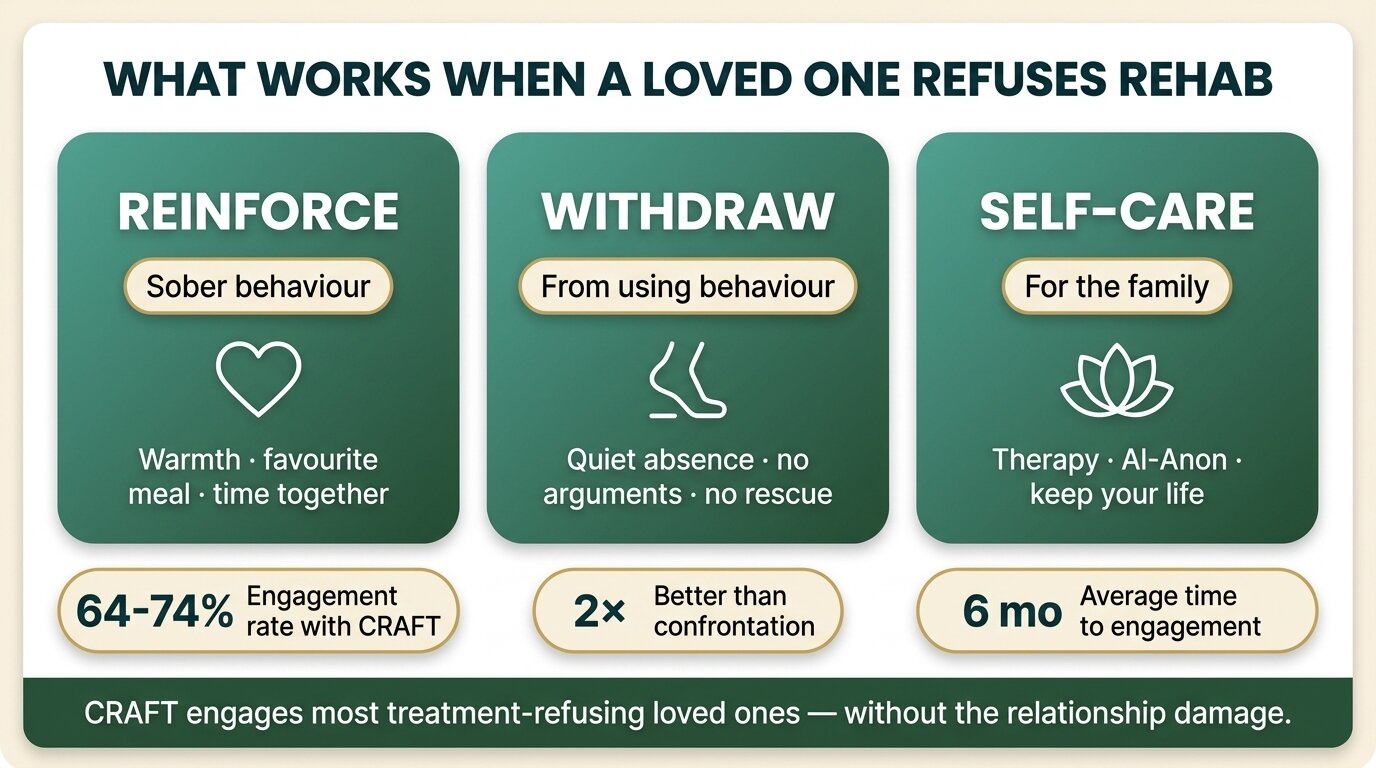
CRAFT — Community Reinforcement and Family Training — is the evidence-based model for working with the family of someone refusing treatment. Developed by Robert Meyers and Jane Smith in the 1990s, it trains the concerned family member in three things: reinforce sober behaviour, withdraw reinforcement for using behaviour, and take care of yourself. Across multiple randomised trials it engages 64-74% of treatment-refusing loved ones — about double the rate of traditional confrontational approaches (Meyers et al., J Subst Abuse, 1998).
The three practical pillars:
- Reinforce sober behaviour. When they’re not using, that’s when you cook the favourite meal, do the thing they enjoy, give the warmth. Not as a reward in a manipulative sense — as a clear signal that life with you is better when they’re sober.
- Withdraw reinforcement for using. When they’re using, you don’t fight, you don’t punish, you don’t moralise — you just go quiet and absent. Watch the football somewhere else. Eat dinner separately. They learn that using costs them your company.
- Take care of yourself. Get a therapist, go to Al-Anon, sleep, eat, see friends. This isn’t selfish — it’s a strategic necessity. People who burn out cannot continue the long game CRAFT requires.
A 2016 German randomised trial confirmed the model: families trained in CRAFT engaged 50%+ of alcohol-refusing loved ones into treatment within six months, versus roughly half that for matched control conditions (Bischof et al., Drug Alcohol Depend, 2016). It is, by some distance, the best-evidenced thing a family member can do.
What Should You Stop Doing — Today?
The single most useful list in this article. Most family members are doing some version of all of these, with the best intentions, and each one makes it harder for the person to want to change. Stopping is not punishment. It’s removing the cushion that lets using stay sustainable.
| Stop doing this | Do this instead |
|---|---|
| Paying the rent, the phone bill, the petrol | Pay rent directly to the landlord if necessary, but not to them. If you’re going to pay for things, pay for things that don’t free up cash for using. |
| Calling work to make excuses | Let them call in sick themselves, or not. Their relationship with their employer is theirs to manage. |
| Paying off debts to dealers or shady friends | Tell them once, calmly, that you won’t pay any debts arising from use. Then don’t. |
| Cleaning up the consequences (mess, vomit, broken things) | Let them clean it up when they sober up, or let it sit. Cleaning teaches them it doesn’t matter. |
| Arguing while they’re high or drunk | Say “I’m not going to talk about this now. We can talk tomorrow when you’re sober.” Then disengage. Nothing said while they’re intoxicated counts. |
| Lying for them to their family or friends | Stop volunteering excuses. You don’t have to expose them, but you don’t have to actively cover for them either. |
What Should You Start Doing?
Five concrete shifts, drawn from CRAFT and from years of watching families do this well. None of them are confrontations. Most of them are small operational changes you can begin today.
- State limits, not threats. “I will leave the house if you use here tonight” is a limit. “If you use one more time, I’m gone forever” is a threat. The difference: the limit is something you will actually do. Threats you don’t follow through on teach them you don’t mean what you say.
- Keep your own life going. Go to the work dinner. See your friend at the weekend. Walk the dog. If you put your life on hold waiting for them to get better, you’ll resent them, and resentment is the slow poison that ends families.
- Get your own therapist. Not for them. For you. The person of an active user usually needs more support than the user does — they’re carrying it without the analgesic.
- Join a family programme. Al-Anon, Nar-Anon, SMART Recovery Family & Friends, or one of the online equivalents. Sitting in a room with people who get it changes something. Our family programme at One Step is built around weekly contact with the clinical team for the family at home — not just the person in treatment.
- Be available when they’re ready. The hardest one. After all the no’s, you still pick up the phone when they finally say yes. Persistence without rescue.
What Is the “Lights Moment” — and Why Shouldn’t You Prevent It?
The lights moment is the consequence that lands hard enough to change the calculation. It’s the night in a police cell, the morning they wake up next to someone they don’t recognise, the look on a child’s face. Most people who get sober have one. Most family members try to prevent it. The kindest thing is often to let it happen.
This is not the same as wishing harm on them. It’s recognising that the cushion you keep providing — the rescue, the cover-up, the bailout — is what makes using sustainable. Each time you intervene to soften a natural consequence, you postpone the moment that might have moved them. CRAFT calls this “allowing natural consequences.” Hazelden Betty Ford and most family-recovery literature say the same thing in different words.
The exception is acute medical danger. If they’re overdosing, you call the ambulance. If they’re suicidal, you call the crisis line. Not letting them die is not the same as cushioning the consequences of use.
When Should You Step Back Entirely?
There are situations where continued direct engagement becomes the relationship — where every interaction is a version of the same conversation, and you’re losing yourself trying to win one you can’t win. In those situations, sometimes the kindest thing is to love them at a distance for a season.
The signs:
- You’ve stopped seeing your own friends because every conversation circles back to them.
- You’re not sleeping. You’re losing weight or gaining it. You’re not present at work.
- Your other relationships — children, partner, parents — are deteriorating because you’ve got no bandwidth left.
- You’ve started using yourself, or drinking more, to cope with the stress.
- You’ve delivered the same conversation more than ten times and nothing has shifted.
Stepping back doesn’t mean abandoning them. It means: shorter phone calls, fewer visits, less involvement in the day-to-day, more boundary around what you’ll discuss. “I love you. I’m not going to talk about your use any more. I’m here when you’re ready to talk about treatment. Tell me about your week.” That can hold for years if it has to.

What Resources Should You Use Right Now?
Five things you can do today. None of them require their permission. All of them work whether they get sober or not — they’re for you.
- Al-Anon Family Groups. Free, worldwide, peer-led. There is meaningful evidence that participation reduces depression and improves coping in families of drinkers (Timko et al., Psychol Addict Behav, 2015). Online meetings exist if you can’t get to a physical one.
- Nar-Anon. The drug-focused equivalent. Same structure, different name. Most major cities have meetings.
- SMART Recovery Family & Friends. A secular, CRAFT-informed alternative for families who don’t connect with the 12-step approach. Online meetings daily.
- A therapist with addiction experience. Not a generalist. Someone who has worked with families of users specifically. Look for “CRAFT-informed” or “Adfam-trained” in the UK.
- Our family programme at One Step. If your person ends up in treatment with us, your family gets structured weekly contact with our clinical team — group calls, individual sessions, and a clear what-to-expect from the moment of admission through discharge. More on the family programme here.
How Does One Step Handle the Family Side?
If you reach the point where they say yes — even tentatively — here’s what actually happens with us. We talk to you, not just to them. Our admissions process starts with a phone call from the family in nearly half of cases. We’ll talk you through what residential looks like, what we can and can’t do, and what to expect for the first 30 days at home after treatment.
The programme costs ฿280,000/month (~$8,500 USD). That covers room, meals, therapy, group sessions, on-site detox for most cases, and full access to the treatment programme and activities. Medication, flights, visas, and personal items are billed separately — the full inclusions and exclusions are on the pricing page. We are not the cheapest. We are also not pretending to be a luxury retreat.
For the family at home, the practical detail that matters: we run weekly video calls between you and the clinical team — not just between you and the person in treatment. You get to ask “is he actually showing up to group?” and “what should I do when she calls upset at 2am?” and get a real answer from someone who’s seeing them every day. That’s what the family programme is for. It’s free if your person is with us; it’s structured into the admission. You don’t have to ask for it.
The honest limitation: we cannot make them say yes. None of this works until they’re in the room. What we can do is give you a clear answer when you call, and keep the door open until they’re ready.
Frequently Asked Questions
Quick answers to the questions families ask us most often about loved ones refusing treatment.
In most countries no. Some US states (Marchman Act in Florida, Casey’s Law in Kentucky), parts of Australia, and a few European jurisdictions allow short-term involuntary commitment when there’s immediate danger. These commitments typically last days to weeks and produce poorer long-term outcomes than voluntary treatment.
CRAFT (Community Reinforcement and Family Training) trains the family to reinforce sober behaviour, withdraw warmth during use, and look after themselves. Across multiple randomised trials, CRAFT engages 64-74% of treatment-refusing loved ones — roughly double the rate of confrontational Johnson-style interventions, and with less collateral relationship damage.
Paying their bills directly to them frees up cash for use. Paying the landlord, the utility company, or the school keeps them housed and fed without funding use. If you have to support them financially, route the money around them, not through them. That single change is one of the highest-impact things a family can do.
Stay calm, short, and warm. “I love you. I’m not going to fight about this. I’m here when you want to talk about treatment.” Then end the conversation. Anger from them is usually fear — yours from arguing back makes them lock in. The shortest, calmest response almost always wins.
Traditional Johnson-style interventions engage roughly 30% of refusing loved ones and frequently damage the relationship when they fail. CRAFT-based family work engages 64-74% with less collateral damage. If you do choose an intervention, work with a CRAFT-trained interventionist — not a TV-style confrontational one.
Both. Peer-reviewed research has documented improvements in depression, anxiety, and coping among Al-Anon participants over six and twelve months. It is one of the few free, widely-available resources for families with a meaningful evidence base. SMART Recovery Family & Friends is a secular alternative with similar mechanics.
Some people don’t. You can still build a life that doesn’t revolve around their use. CRAFT improves family wellbeing whether or not the person engages — depression and anxiety scores in the family member drop regardless of the loved one’s outcome. Working the model is worth it for you, even if they never come round.
Written by
Alastair Mordey
Alastair Mordey is one of the pioneers of drug and alcohol treatment globally and specifically in Asia. He has been an addiction’s professional for twenty years. He started his career as an expert in substance abuse w...
Learn more about Alastair
Medically reviewed by
Dr. Worapakthorn Kongpesalaphun
Consultant Psychiatrist · Thai Licensed Medical Doctor · Residency in Psychiatry, Somdet Chaopraya Institute · Doctor of Medicine, Rangsit University
Dr. Worapakthorn Kongpesalaphun is a Thai Licensed Medical Doctor and Expert in Preventive Medicine (Community Mental Health) with extensive experience in addiction treatment and public health management. He holds multip...
Learn more about Dr. Worapakthorn