

Key Takeaways
- Opiates are the natural ones: morphine, codeine, and heroin — all derived from the opium poppy. Opioids is the umbrella term covering opiates plus everything semisynthetic (oxycodone, hydrocodone) and fully synthetic (fentanyl, tramadol, methadone).
- Heroin is a semisynthetic opioid made from morphine. It hits the brain faster than morphine, which is why it’s both more addictive and more dangerous. The DEA classifies it as Schedule I — no accepted medical use in the US.
- Fentanyl is roughly 50 to 100 times more potent than morphine. A few milligrams can kill an opioid-naive person, and it’s now mixed into heroin, cocaine, meth, and counterfeit pills — often without the user knowing.
- In 2024, about 88% of US opioid overdose deaths involved fentanyl or another synthetic opioid (CDC). The “I only use prescription opioids” framing stopped being protective the moment the illicit market got contaminated.
- One Step Rehab treats opioid dependence on a residential basis in Chiang Mai. Severe withdrawal cases detox first at our partner hospital — which has intensive and intermediary intensive care units — then transfer to us for the rehab programme.
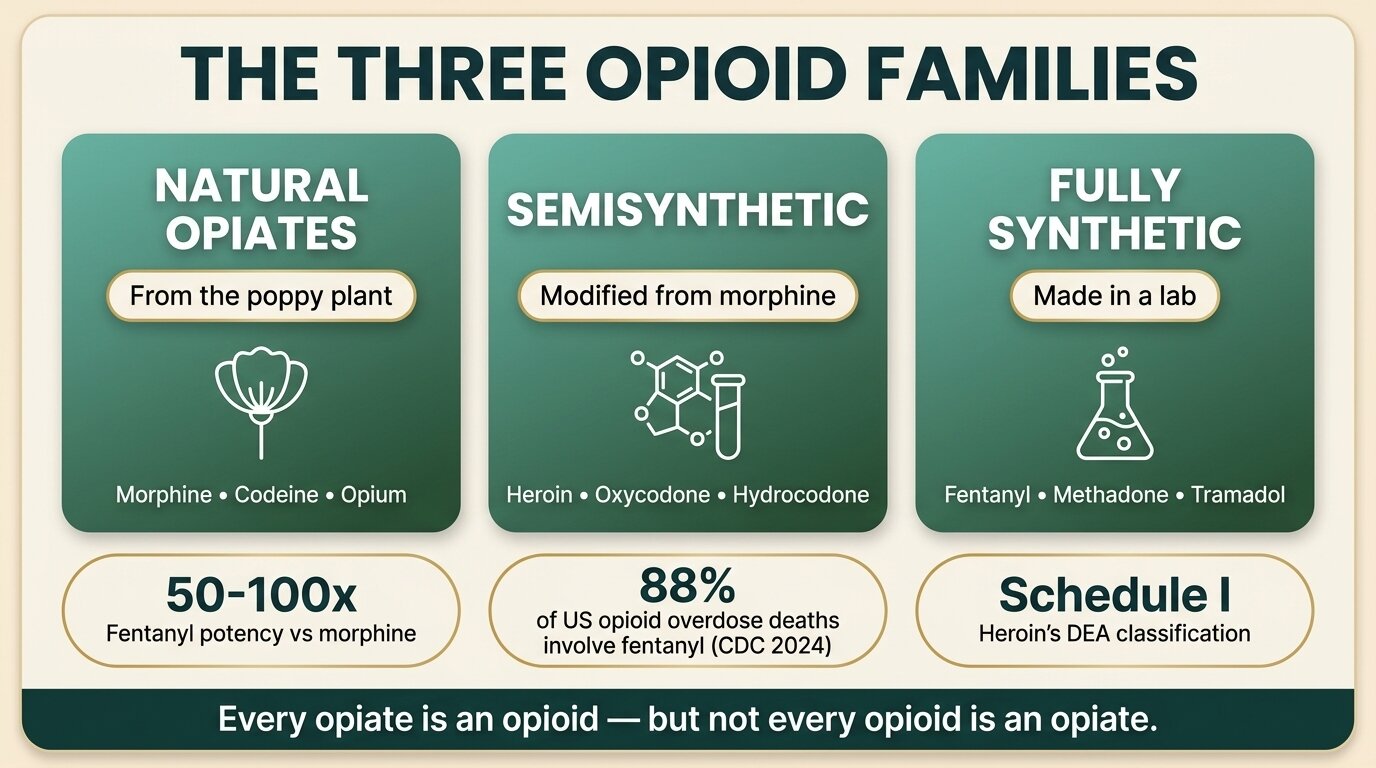
Opiates are natural, opioids are the whole family, and heroin is a semisynthetic opioid that sits in between. If you remember nothing else: every opiate is an opioid, but not every opioid is an opiate. The reason this distinction matters in 2026 is fentanyl — a fully synthetic opioid roughly 50 to 100 times more potent than morphine — has contaminated the illicit drug supply to the point where users frequently consume it without knowing (CDC, 2025).
What Is an Opiate?
An opiate is a drug derived directly from the opium poppy plant (Papaver somniferum). The three you’ll hear about are morphine, codeine, and heroin — though heroin is technically one chemical step removed from the plant. “Opiate” is the older, narrower word. It refers only to the natural opium-derived family. Every opiate is also an opioid, but the reverse isn’t true.
Morphine and codeine occur naturally in the opium latex. Heroin is morphine that’s been chemically modified — adding two acetyl groups — which lets it cross the blood-brain barrier faster, producing a more intense rush. Because of that modification, some textbooks classify heroin as semisynthetic. Either way, it traces back to the poppy.
The WHO defines opioids as “compounds that are extracted from the poppy plant… as well as semisynthetic and synthetic compounds with similar properties that can interact with opioid receptors in the brain” (WHO, 2025). That distinction — receptor activity, not chemical origin — is what makes the modern definition useful. A drug counts as an opioid if it binds opioid receptors, regardless of whether it came from a plant or a chemist’s bench.
What Is an Opioid?
An opioid is any substance — natural, semisynthetic, or fully synthetic — that acts on the body’s opioid receptors. Opioids reduce pain, slow breathing, and produce euphoria. The category includes prescription painkillers (oxycodone, hydrocodone, morphine, codeine, fentanyl), medications used in addiction treatment (buprenorphine, methadone), and illegal drugs (heroin, illicitly manufactured fentanyl).
The category splits into three groups by origin. Knowing which is which helps you read a label, understand a doctor’s prescription, and recognise what’s circulating on the street.
| Family | Origin | Examples | Where you find them |
|---|---|---|---|
| Natural opiates | Extracted from the opium poppy | Morphine, codeine, thebaine, opium | Hospital pain relief, cough syrup |
| Semisynthetic opioids | Chemically modified from a natural opiate (usually morphine or thebaine) | Heroin, oxycodone, hydrocodone, hydromorphone, oxymorphone, buprenorphine | Prescription painkillers; heroin on the street |
| Fully synthetic opioids | Made entirely from lab chemicals — no poppy required | Fentanyl, tramadol, methadone, pethidine (meperidine), nitazenes | Surgical anaesthesia, chronic pain patches, MAT, illicit market |
The legal classification follows the abuse potential, not the chemistry. The DEA places heroin on Schedule I — no accepted US medical use. Fentanyl, oxycodone, hydrocodone, morphine, and methadone are all Schedule II — accepted medical use but tight controls because of dependence risk (DEA, 2024). Buprenorphine sits on Schedule III; tramadol on Schedule IV. Same drug class, very different legal status.
Where Does Heroin Fit In?
Heroin is a semisynthetic opioid made by chemically modifying morphine. It’s significantly more potent than morphine and reaches the brain faster, which produces a quicker, more intense high — and a higher risk of dependence and overdose. In the US it has no legal medical use; in some other countries it’s prescribed under controlled conditions for heroin-assisted treatment of severe opioid use disorder.
Three things make heroin distinctly dangerous compared to other opioids:
- Speed of onset. Injected heroin reaches the brain in roughly 15 to 30 seconds. Snorted or smoked heroin takes minutes. That fast hit is part of what makes it so reinforcing — and part of why a single overdose can kill before help arrives.
- Variable street purity. Heroin you buy on the street is cut with other powders. You don’t know what dose you’re actually taking. A “normal” amount from one bag can be a fatal dose from the next.
- Fentanyl contamination. The single biggest change in the heroin supply over the past decade. Dealers cut heroin with fentanyl — either to stretch supply or to make a weak batch feel stronger. Users frequently don’t know it’s there.
The fentanyl contamination problem isn’t theoretical. Macmadu and colleagues found that among young adults in Rhode Island who used prescription opioids non-medically, exposure to fentanyl-contaminated heroin was strongly associated with regular heroin use, injection drug use, and prior overdose (Macmadu et al., Addictive Behaviors, 2017). A separate Rhode Island study by Carroll and colleagues found that the majority of fentanyl-exposed users did not know in advance that their heroin contained fentanyl (Carroll et al., International Journal of Drug Policy, 2017). That’s the world a heroin user is operating in now.
Why Did Fentanyl Change Everything?
Fentanyl is roughly 50 to 100 times more potent than morphine, which means a microscopic amount produces a large effect. In hospitals that’s an asset — anaesthesiologists can dose with precision. On the illicit market, where dosing is done by hand in unregulated labs, it’s a public health catastrophe. A counterfeit pill can contain anywhere from no fentanyl to a lethal dose, and the user has no way to tell.
The CDC reports that illicitly manufactured fentanyl is found in powder form, pressed into counterfeit pills resembling oxycodone (the “M30” pill) or alprazolam (Xanax), and mixed into heroin, cocaine, and methamphetamine (CDC, 2025). The Lancet Regional Health — Americas analysis of US forensic data from 2013 to 2023 found that fentanyl co-occurrence with every major drug category — heroin, cocaine, meth, cannabis, prescription opioids — increased steadily across the decade (Lancet Regional Health — Americas, 2024). The illicit supply is no longer cleanly segregated by drug type.
The death numbers tell the story bluntly. In 2024 the US recorded 79,384 drug overdose deaths, of which roughly 88% of opioid-involved deaths were attributable to fentanyl or other synthetic opioids — that’s about 47,735 deaths involving synthetic opioids alone (Garnett & Miniño, NCHS Data Brief No. 549, 2026). The 2024 figure is down meaningfully from the 2023 peak — naloxone access, fentanyl test strips, and treatment expansion are working — but synthetic opioids are still the dominant driver of US overdose mortality.
What we see clinically is that the old mental model — “I’m safer because I only take prescription pills” — collapsed once illicit fentanyl arrived. A pressed counterfeit pill on the street has no quality control. Two pills from the same batch can contain wildly different doses. That’s why we now treat any illicit opioid use as a fentanyl-exposure scenario by default, even when the person says they only use heroin.
Dr. Worapakthorn KongpesalaphunConsultant Psychiatrist, One Step Rehab
Worried about your own use — or someone else’s? Talk to our team — we’ll give you a straight answer about whether residential treatment in Chiang Mai is the right fit.
How Do These Opioids Compare in Potency?
Potency means how much drug you need to produce a given effect. A more potent opioid achieves the same painkilling — or the same overdose — at a smaller dose. The numbers below are clinical reference points used in pain medicine; they don’t reflect “high” intensity, which depends on route, formulation, and individual tolerance.
| Opioid | Relative potency vs morphine | Notes |
|---|---|---|
| Codeine | ~1/10 (weaker) | Converted to morphine by the liver; ceiling effect |
| Tramadol | ~1/10 (weaker) | Also has SNRI activity; seizure risk at high doses |
| Morphine | 1x (reference) | The benchmark |
| Hydrocodone | ~1x | Common in Vicodin and Norco |
| Oxycodone | ~1.5x | OxyContin, Percocet |
| Heroin | ~2-5x (depending on route) | Faster brain uptake than morphine — bigger “rush” |
| Hydromorphone (Dilaudid) | ~5x | Common hospital injectable |
| Fentanyl | ~50-100x | A few milligrams can kill an opioid-naive person |
| Carfentanil | ~10,000x | Veterinary anaesthetic; appears as adulterant in illicit supply |
Two things to take from the table. First, the prescription opioids most people are familiar with — oxycodone, hydrocodone — sit close to morphine. They’re not exotic. Second, fentanyl is in a different league. The same teaspoon-sized bag of “heroin” that contains 100 mg of heroin and would dose six people will, if cut with 2 mg of fentanyl, kill three of them.

Why “I Only Use Prescription Opioids” Stopped Being Safer
For decades the harm-reduction logic was straightforward: prescription pills had known strengths and predictable effects, so they were safer than street drugs. That logic broke when (a) prescribing crackdowns pushed some users toward the street, and (b) counterfeit pills laced with illicit fentanyl appeared in the same supply chain. Now a “Percocet” bought from a friend or online can be a pressed fentanyl pill with no oxycodone in it.
The transition from prescription pills to heroin to fentanyl is well-documented. NIDA reports that a substantial proportion of people who began using heroin in recent years first misused prescription opioids (NIDA, 2024). The pipeline is real. What’s changed is that the “pill” stage is no longer protective — counterfeit pills are now the entry point for many overdose deaths, particularly among teens and young adults who think they’re taking a Xanax or a Percocet they bought through social media.
If you’re using any opioid that didn’t come from a pharmacy, the working assumption in 2026 is that it may contain fentanyl. That changes the calculus for everything — what counts as a safe dose, what counts as a relapse risk, what counts as a survivable single use. If you’re considering treatment, this is the context that should drive the decision, not the question of which specific drug you started with. The opioid rehab programme at One Step treats opioid dependence regardless of the entry drug, because the modern treatment problem is the same shape: opioid receptor dependence, withdrawal, and craving management.

How Does One Step Treat Opioid Dependence?
One Step runs a residential rehab programme in Chiang Mai, Thailand, treating clients with opioid dependence alongside other substance and process addictions. Most opioid clients arrive having tried outpatient options that didn’t hold. The residential setting removes the physical access to the drug and gives the person a sustained therapeutic environment — usually 28, 60, or 90 days.
What that looks like in practice:
- Intake and medical assessment. A clinician reviews substance history, current use, prior overdoses, mental health history, and any prescriptions. This determines whether on-site detox is appropriate or whether the partner hospital is needed first.
- Detox. Most opioid clients with moderate dependence can detox on-site at One Step with medical oversight, comfort medications, and structured support. For severe opioid withdrawal — particularly in clients with serious medical complications, or those using high-dose fentanyl — we may detox you first at our partner hospital, which has intensive and intermediary intensive care units, then you transfer to One Step for the rehab programme.
- Rehab programme. Group therapy, one-to-one counselling, evidence-based modalities (CBT and DBT), a structured daily schedule, physical training, mindfulness, and family work. The programme runs the same framework whether the primary substance is opioids, alcohol, or stimulants — the therapeutic content adapts to the client.
- Relapse prevention and aftercare. Opioid dependence has high relapse rates, particularly in the first 90 days post-discharge. We build relapse-prevention plans during treatment, identify triggers (see our piece on common relapse triggers), and connect clients to aftercare before they leave.
The programme fee is approximately ฿280,000 per month (~$8,500 USD). That covers accommodation, three meals per day, the therapy programme, intake assessment, on-site nursing support, and group activities. Medication prescribed by the doctor is billed separately — that includes anything used during detox, any psychiatric medications, and any newly prescribed drugs. Flights, visas, hospital visits, and personal items are also not included. The full inclusion and exclusion list is on the pricing page.
One honest limitation worth knowing for opioid dependence specifically: One Step is not a hospital. Clients whose withdrawal needs ICU-level monitoring detox at our partner hospital first. The partner facility handles the acute medical phase; we handle the rehab phase. That split is what allows us to take opioid clients safely without overstating what a residential programme is.
When Should You Seek Help for Opioid Use?
If you’re using any illicit opioid in 2026 — heroin, street pills, anything not from a pharmacy — the threshold for seeking treatment should be lower than it was a decade ago, because the fentanyl-contaminated supply means a single dose can be fatal. If you’re using prescription opioids beyond what your doctor prescribed, or finding you can’t stop without withdrawal symptoms, that’s dependence regardless of where the drug came from.
Concrete signs that residential treatment is worth considering:
- You’ve tried to stop and the withdrawal symptoms (sweats, body aches, anxiety, insomnia, GI distress) drove you back to using.
- You’ve had a prior overdose — your own or one you witnessed.
- Your use is now around the clock, not occasional.
- You’re using to avoid withdrawal more than to get high.
- Outpatient treatment hasn’t held.
- You’ve lost control over how much you use or how often.
The decision between inpatient and outpatient treatment isn’t a moral question — it’s about what level of structure and medical oversight you actually need. Residential treatment removes physical access to the drug for a defined period, which for opioids with high relapse rates often makes the difference between a serious attempt at recovery and another failed try.
Frequently Asked Questions
Quick answers to the questions readers ask most about the opiate/opioid/heroin distinction.
Both, depending on how strictly you define “opiate.” Heroin is made by chemically modifying morphine (a natural opiate), so most modern sources call it a semisynthetic opioid. Older texts call it an opiate because its parent compound comes from the poppy. Either way it acts on opioid receptors and behaves like the rest of the opioid class.
No. Fentanyl is a fully synthetic opioid — it’s manufactured from lab chemicals, not derived from the opium poppy at all. It acts on the same opioid receptors as morphine and heroin, which is why it produces similar effects, but its origin is entirely synthetic.
Technically they’re semisynthetic opioids, not natural opiates. Both are chemically derived from thebaine, an alkaloid in the opium poppy, so they trace back to a natural source but have been modified in a lab. They act on opioid receptors the same way morphine does.
Fentanyl is roughly 50 to 100 times more potent than morphine, and heroin is about 2 to 5 times more potent than morphine depending on route, so fentanyl is in the range of 10 to 50 times stronger than heroin by dose. A few milligrams of fentanyl can kill an opioid-naive person; the equivalent heroin dose would be much larger.
Fentanyl is cheap to synthesise, easy to ship in small quantities, and extraordinarily potent — so a tiny amount goes a long way. Suppliers cut it into heroin, cocaine, methamphetamine, and counterfeit pills to stretch supply and increase potency. CDC data from 2024 shows fentanyl or another synthetic opioid was involved in roughly 88% of US opioid overdose deaths.
Yes — methadone is a long-acting fully synthetic opioid. It’s used clinically both for pain and as a maintenance medication for opioid use disorder, where its long half-life allows once-daily dosing without the peaks and crashes of shorter-acting opioids. It has its own dependence and overdose risk and is prescribed under strict regulation.
Yes. We treat opioid dependence regardless of the entry drug — fentanyl, heroin, prescription painkillers, or a mix. Clients with severe withdrawal or high-dose fentanyl use detox first at our partner hospital, which has intensive and intermediary intensive care units, and then transfer to One Step for the rehab programme. Medication used during detox is billed separately from the programme fee.
Written by
Worapakthorn Kongpesalaphun, MD., Ph.D.
Dr. Worapakthorn Kongpesalaphun is a Thai Licensed Medical Doctor and Expert in Preventive Medicine (Community Mental Health) with extensive experience in addiction treatment and public health management. He holds multip...
Learn more about Worapakthorn