

Key Takeaways
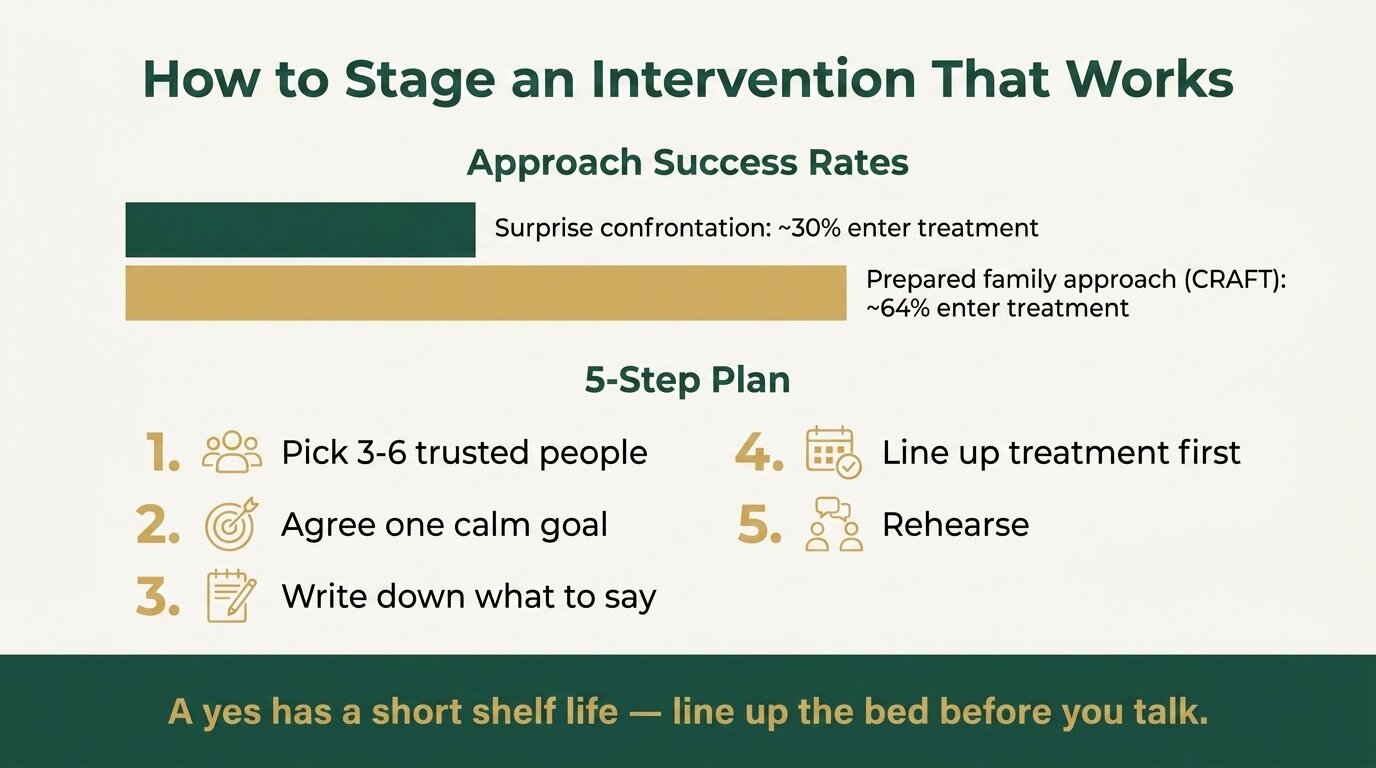
- Skip the surprise ambush. The confrontational “Johnson” intervention gets roughly 30% of people into treatment; the CRAFT approach, where family learns new responses over several weeks, gets about 64% (APA Monitor, 2017).
- Plan before you speak: pick the right people, write down what you’ll say, and decide the treatment option in advance so there’s no scramble if your loved one says yes.
- Interventions backfire when they turn into a pile-on, when there’s no bed booked, or when the family has no plan for a “no.”
- Have the treatment logistics settled first — a program that can admit quickly, handle detox safely, and start within days, not weeks.
- An intervention is a starting line, not a cure. What the family does in the months after matters as much as the conversation itself.
To stage an intervention that works, drop the movie-style ambush and plan a calm, prepared conversation built around getting your loved one into a specific treatment program you’ve already lined up. The evidence is clear that the trained, non-confrontational family approach called CRAFT engages roughly two-thirds of resistant people in treatment — far more than a one-shot confrontation (Roozen et al., Addiction, 2010). This guide walks through what actually moves someone toward help, and the mistakes that send them out the door instead.
What Is an Intervention, and Do They Actually Work?
An intervention is a planned conversation in which family and close friends ask someone with an addiction to accept help. They work when they’re prepared, calm, and tied to a concrete treatment option — trained family approaches engage about 64% of resistant people, versus roughly 30% for surprise confrontations (APA Monitor, 2017).
The version most people picture — everyone hiding in the living room, a surprise arrival, a stack of letters read aloud — is the “Johnson Model.” It can get someone into treatment, but two problems show up in the research. First, most families never go through with the confrontation: in one comparison, around 70% of networks that planned a Johnson-style meeting never held it. Second, even when it works to get someone through the door, retention tends to fade faster than with gentler approaches (APA Monitor, 2017).
The approach with the strongest evidence is CRAFT (Community Reinforcement and Family Training). Instead of one dramatic meeting, the family learns, over several weeks, how to change the way they respond day to day — reinforcing sober behaviour, stepping back from enabling, and looking after their own wellbeing. It produces roughly three times the engagement of Al-Anon and twice that of the Johnson approach (Roozen et al., Addiction, 2010).

How Do You Plan an Intervention Step by Step?
Plan an intervention in five steps: choose 3–6 people your loved one trusts, agree on one calm goal, write down what each person will say, decide on a specific treatment program in advance, and rehearse. Never improvise it, and never hold it when the person is intoxicated. Preparation is what separates a breakthrough from a blow-up.
Here’s the sequence in practice:
| Step | What to do | Why it matters |
|---|---|---|
| 1. Pick the group | 3–6 people the person genuinely trusts and respects. No one with unresolved grudges. | A crowd feels like an ambush. Trust lowers defences. |
| 2. Agree the goal | One clear ask: “We want you to accept treatment, starting now.” | Mixed messages let the person negotiate their way out. |
| 3. Write it down | Each person prepares specific, factual “I” statements — what they’ve seen, how it affects them. | Written notes keep it calm and stop it drifting into blame. |
| 4. Line up treatment | Confirm a program, a bed, and how admission works — before the conversation. | A “yes” with nowhere to go often becomes a “no” by morning. |
| 5. Rehearse | Run through it once. Decide the order of speakers and who leads. | Practice removes the panic that makes people say the wrong thing. |
Consider working with a trained interventionist or counsellor, especially if there’s a history of violence, serious mental health issues, or previous failed attempts. A neutral professional keeps the room steady and knows how to respond when things get heated. If your loved one is also struggling with depression, anxiety, or trauma alongside the addiction, look for a program that treats both together — our dual diagnosis treatment page explains why splitting the two rarely works.

What Should You Actually Say During an Intervention?
Speak in specific, factual “I” statements: what you saw, how it affected you, and what you’re asking for. Lead with love, not accusation (“I’m scared for you,” not “you’ve ruined this family”). Keep each person’s turn short, avoid labels like “addict” or “junkie,” and end with the direct ask to accept help today.
Two versions of the same point land completely differently:
| Say this | Not this |
|---|---|
| “On Tuesday I found you passed out and I was terrified.” | “You’re always drunk and you scare everyone.” |
| “I love you and I want you here for the kids’ birthdays.” | “You’re a terrible parent.” |
| “There’s a place ready for you. We can go today.” | “You need to sort yourself out.” |
Decide beforehand what each person will do if the answer is no — and only name boundaries you will genuinely keep. “I won’t cover your rent again” only works if you mean it. Empty threats teach your loved one that nothing has really changed. This is the same principle behind the day-to-day boundary work in our family program.
The families who get the best result are almost never the ones who staged the most dramatic confrontation. They’re the ones who stayed calm, said “we love you and we’ve already found you a place,” and had somewhere real for the person to go that same day. Momentum is everything — a yes has a short shelf life, so the logistics need to be sorted before anyone says a word.
Craig GagnonSenior Therapist, One Step Rehab
Not sure how to approach the conversation? Talk to our team — we’ll help you plan it and tell you honestly whether an intervention is the right next step.
Why Do Interventions Backfire, and How Do You Avoid It?
Interventions backfire when they become a pile-on of blame, when the person is confronted while intoxicated, when no treatment is actually lined up, or when the family has no plan for a refusal. Each of these turns a request for help into a fight, and a fight almost always ends with the person walking away and using again.
The most common ways they go wrong:
- It turns into an attack. The moment it feels like an ambush, the person’s defences go up and the shame spiral kicks in — which for many people is a direct trigger to use.
- No bed is booked. If your loved one says yes and then has to wait a week to be admitted, that window usually closes. Have the admission ready.
- The person is high or drunk. You can’t reason with someone who’s intoxicated. Wait for a sober window, even if it’s early morning.
- No plan for “no.” A refusal isn’t failure. Calmly stating the boundaries you’ll keep — and keeping them — often does more over the following weeks than the meeting itself.
- Enabling resumes the next day. If the money, the excuses, and the covering-up all come back, nothing has changed. This is exactly where the CRAFT skills matter most.
One reassuring point from the research: even when the person doesn’t immediately say yes, families who learn these skills report real improvements in their own stress, mood, and functioning (Roozen et al., Addiction, 2010). You are not just doing this for them — it helps you too. If addiction has already come and gone once before, our post on the most common relapse triggers can help you spot the warning signs earlier next time.

What Happens After Someone Says Yes at One Step?
At One Step Rehab in Chiang Mai, once your loved one agrees, we move fast: our team walks you through the admissions process, confirms a place, and gets the person into our residential program — usually within days. The fee is about ฿280,000/month (~$8,500 USD), and we’ll tell you upfront exactly what that covers.
Speed is the whole point. Because a “yes” fades fast, the practical questions families ask us during an intervention are almost always about logistics: how quickly can they come, what does a day look like, and how do you handle the risky early part.
- Fast admission. We can often confirm a place the same day you call, so you’re not sitting on a “yes” while it cools.
- Detox handled safely. Most clients detox on-site with medical oversight. For severe alcohol, benzodiazepine, or opioid withdrawal, we may detox your loved one first at our partner hospital — which has intensive and intermediary intensive care units — before they transfer to us for the rehab program. Read more on our detox page.
- Structured days. A set daily schedule of group therapy, one-to-one counselling, and physical activity, built around evidence-based methods — see our treatment programme and how CBT and DBT are used in recovery.
- Family stays involved. Recovery doesn’t stop at admission. Our family program and aftercare planning keep you part of the process well past the first week.
What the fee does not cover: medication is billed separately — you pay for what the doctor prescribes — along with flights, visas, and personal items. Our pricing page lists the full breakdown so there are no surprises.
Frequently Asked Questions
Common questions from families planning an intervention.
Not always, but it helps. A trained interventionist or counsellor keeps the conversation calm and knows how to respond if it goes sideways. Consider one strongly if there’s a history of violence, serious mental health issues, or previous failed attempts.
A surprise confrontation is the most dramatic version but not the most effective. Approaches where the family prepares and changes its responses over time engage far more people in treatment than a single ambush, and are less likely to trigger anger or shame.
A no is common and not the end. Calmly state the boundaries you’ll actually keep, then keep them. Families who learn these skills often see their loved one accept help weeks later — and they report less stress and better mood for themselves in the meantime.
Three to six people your loved one genuinely trusts and respects. Avoid anyone with an unresolved grudge or a temper that could ignite the room. A smaller, trusted group feels like support; a crowd feels like an ambush.
Yes — this is the single most important logistical step. Confirm a program and how admission works before you talk. A “yes” often has a short shelf life, so being able to act the same day dramatically improves the odds it sticks.
No. Never hold an intervention while your loved one is intoxicated — you can’t reason with someone who’s high or drunk, and it usually escalates. Wait for a sober window, even if that means an early-morning conversation.
Written by
Craig Gagnon
Craig Cagnon is an American counseling psychologist and addiction counselor. He holds Masters degrees in community counseling and counseling psychology and completed his clinical residency at The Mayo Clinic, in Rochest...
Learn more about Craig
Medically reviewed by
Dr. Worapakthorn Kongpesalaphun
Consultant Psychiatrist · Thai Licensed Medical Doctor · Residency in Psychiatry, Somdet Chaopraya Institute · Doctor of Medicine, Rangsit University
Dr. Worapakthorn Kongpesalaphun is a Thai Licensed Medical Doctor and Expert in Preventive Medicine (Community Mental Health) with extensive experience in addiction treatment and public health management. He holds multip...
Learn more about Dr. Worapakthorn