
Key Takeaways
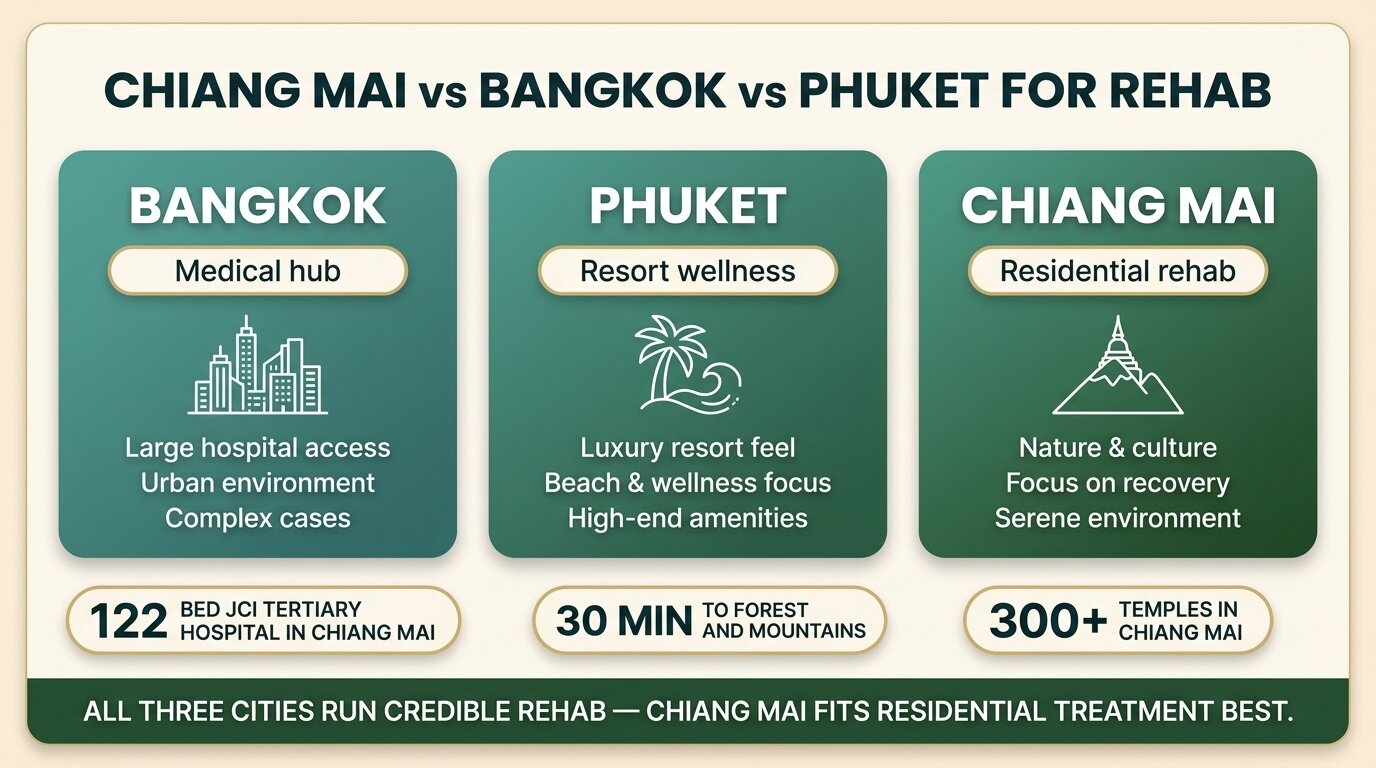
- All three Thai cities run credible rehab programmes — but they suit different clients. Bangkok suits short stabilisation stays and complex medical cases needing specialist hospitals. Phuket suits clients who want a beach-resort wellness vibe. Chiang Mai suits residential rehab where stillness, distance, and a slower pace are part of the treatment.
- Bangkok has the strongest hospital network and the fastest airport transfer, but the city itself is loud, polluted, and full of bars — environmental factors that work against early recovery.
- Phuket offers the most luxury options, but tourist density, alcohol-everywhere bar streets, and peak-season chaos make it the easiest of the three to “slip out” of treatment mentally or physically.
- Chiang Mai is the smallest and calmest of the three, with a deeper Buddhist culture, mountain and forest access within 30 minutes, and a cost-of-living gap that allows higher staff-to-client ratios at lower price points.
- Chiang Mai has tertiary hospital cover for serious medical events — Bangkok Hospital Chiang Mai is a 122-bed JCI-accredited tertiary facility. One Step uses a partner-hospital arrangement for severe medical or psychiatric situations.
Bangkok, Phuket and Chiang Mai are all credible rehab destinations in Thailand — they just suit different people. Bangkok is built for medical complexity. Phuket is built for resort-style wellness. Chiang Mai is built for what residential rehab actually needs: stillness, slower pace, nature on the doorstep, and a culture organised around contemplation rather than nightlife (Nation Thailand, 2025).
If you’re choosing between the three, the honest answer isn’t “Chiang Mai is best.” It’s “Chiang Mai is best for residential rehab, and here’s how to tell whether it fits your situation.” This post draws the line cleanly: who each location serves, what each one trades off, and where One Step sits inside that picture.
What Are the Real Differences Between Bangkok, Phuket and Chiang Mai for Rehab?
The three cities differ on four dimensions that matter for treatment: medical infrastructure, environment, temptation density, and cost-to-quality ratio. Bangkok wins on hospitals and airport access. Phuket wins on luxury amenity and beach setting. Chiang Mai wins on environment, cultural fit for contemplative work, and affordability — the factors that most directly shape day-to-day rehab experience.
Thailand’s medical-tourism sector is on track for 125 billion baht in revenue from roughly 580,000 medical tourists in 2025, with all three cities credentialed as regional hubs (Nation Thailand, 2025). The infrastructure exists in all three. What changes is the setting that infrastructure sits inside.
| Factor | Bangkok | Phuket | Chiang Mai |
|---|---|---|---|
| Setting | Dense urban centre | Beach and resort island | Smaller city, mountains 30 min away |
| Airport access | Direct, fastest | Direct international flights | Connection via Bangkok, ~1 hr flight |
| Hospital network | Deepest specialist coverage | Strong, international-facing | JCI-accredited tertiary cover (Bangkok Hospital Chiang Mai) |
| Nightlife / temptation | High — bars and clubs throughout the city | High — beach bars, Bangla Road | Low — small nightlife footprint, early-closing |
| Nature access | Limited within the city | Beach, limited inland nature | Forest, mountains, rural villages nearby |
| Buddhist culture | Present but urbanised | Less prominent | 300+ temples, daily monastic life visible |
| Cost-to-quality ratio | Higher costs, premium pricing | Highest costs on average | Lower costs allow higher staff-to-client ratios |
When Does Bangkok Make Sense for Rehab in Thailand?
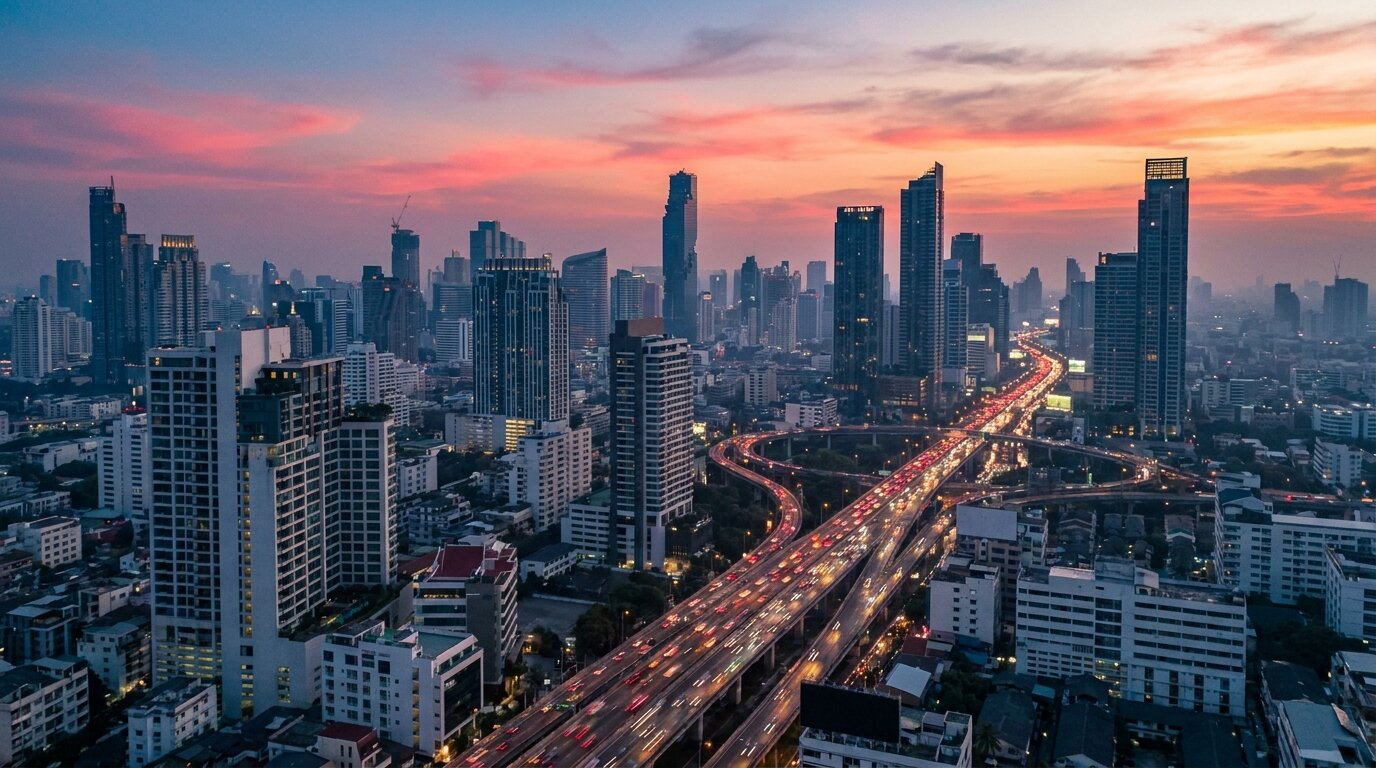
Bangkok makes sense for clients who need fast airport access, complex medical co-morbidity, short stabilisation stays, or specialist-hospital backup that goes beyond what most residential rehabs maintain. The city’s hospital ecosystem is the deepest in Southeast Asia. The trade-off is environmental: noise, traffic, urban pollution, and bars on every corner work against the calm that early recovery needs.
Bangkok suits:
- Clients with significant medical complexity — cardiac comorbidity, recent surgery, advanced liver disease — who need a specialist hospital within minutes rather than within a partner-hospital arrangement.
- Short stabilisation stays where the priority is medical detox first and the residential rehab piece happens afterwards, possibly elsewhere.
- Executives or public figures who need a non-residential model — private psychiatric care delivered alongside a hotel stay rather than committed residential treatment.
- Clients who genuinely need the city — embassy access, urgent business proximity, family living in Bangkok.
What Bangkok doesn’t offer is the environmental shift that most clients in residential rehab benefit from. Research on nature exposure consistently shows reductions in salivary cortisol and improvements in anxiety symptoms after even brief contact with green space (Jimenez et al., Int J Environ Res Public Health, 2021). That’s not a Bangkok-friendly environment by default — the parks exist, but the city around them is loud and dense.

When Does Phuket Make Sense for Rehab in Thailand?
Phuket suits clients drawn to a beach-resort wellness model and who can afford a premium price point. The island has serious luxury facilities, an international hospital network, and a long history of wellness tourism. The trade-off is tourist density: Bangla Road’s bar strip, peak-season crowds, and easy access to alcohol make Phuket the easiest of the three locations to leave the bubble, mentally or physically.
Phuket suits:
- Clients who want a “wellness retreat” feel — beach access, spa amenity, swimming and yoga as part of the daily rhythm.
- Clients who’ve already done one residential rehab and want a step-down setting that combines therapy with a vacation-adjacent atmosphere.
- Clients with bigger budgets where luxury amenity is a non-negotiable.
Where Phuket gets harder is for clients whose addiction is tied to bar culture, alcohol, or party drugs. Beach towns in Thailand sell alcohol everywhere. Holiday-mode psychology — the same psychology that powers a relapse — is exactly what a resort island markets to tourists. For some clients that’s tolerable. For many it’s a constant low-grade pressure during the most vulnerable weeks of treatment.
Cost is also a factor: Phuket is the most expensive of the three locations on average. Premium pricing buys amenity, not necessarily better therapy hours, better staff-to-client ratios, or longer therapeutic engagement — the factors most consistently linked to treatment outcomes (NIDA Principles of Drug Addiction Treatment, 2018).
Why Does Chiang Mai Fit Residential Rehab So Well?
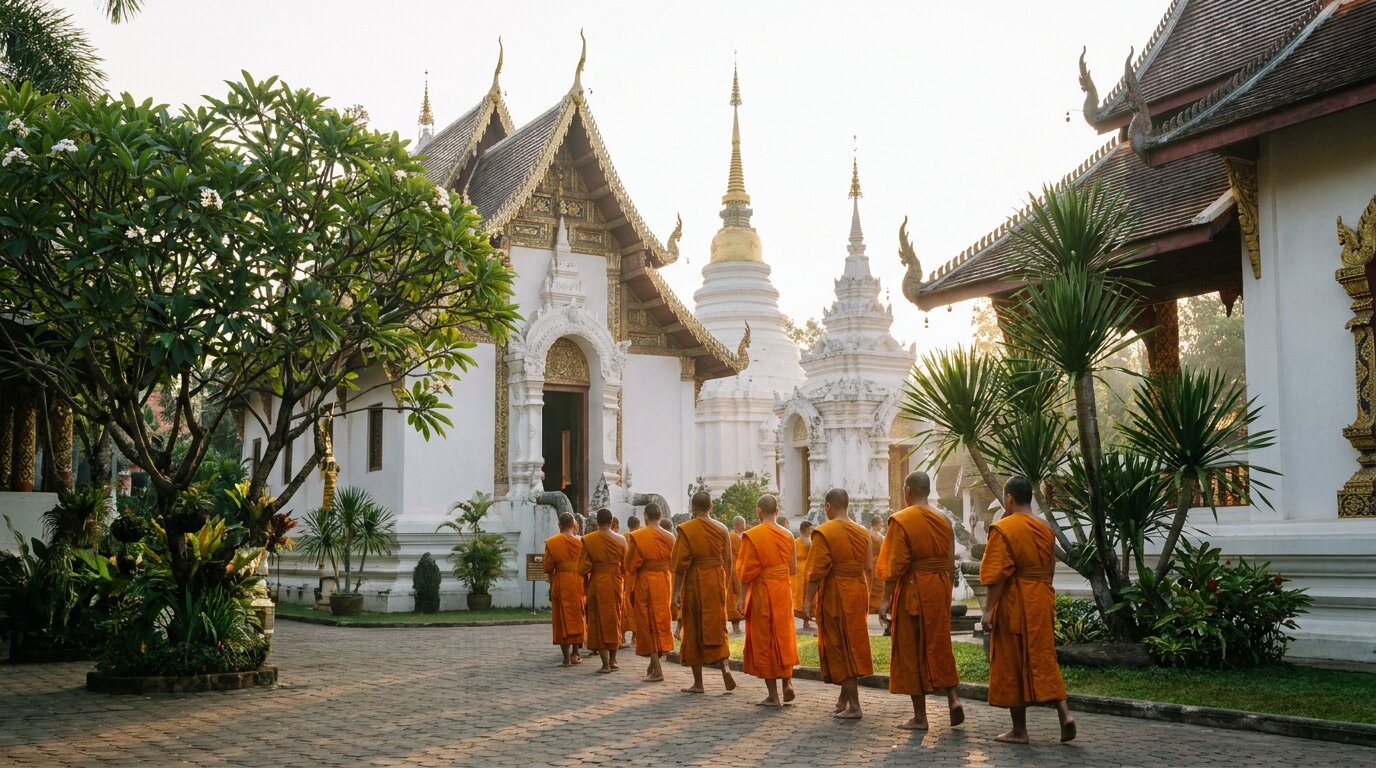
Chiang Mai’s pace, environment, and culture do part of the treatment work for you. The city has a small footprint, an early-closing nightlife scene, a forest-and-mountain backdrop within a 30-minute drive, and a Buddhist culture organised around stillness rather than nightlife. Wat Phra That Doi Suthep alone draws around 120,000 visitors a month — the contemplative life is part of the city’s daily fabric, not an add-on.
What that gives a client in residential rehab:
- Lower temptation density. Central Chiang Mai doesn’t have an equivalent of Bangkok’s Sukhumvit nightlife or Phuket’s Bangla Road. It’s easier to focus when the environment isn’t pushing in the opposite direction.
- Nature on the doorstep. Doi Suthep, Mae Sa, the rural villages of San Kamphaeng — all within 30 minutes. Nature exposure of 20–30 minutes reduces measured cortisol and acute stress (Paredes-Céspedes et al., Eur J Investig Health Psychol Educ, 2024). Building that into a weekly rehab schedule is straightforward in Chiang Mai. It’s structural friction in Bangkok and inconvenient in Phuket.
- A Buddhist-culture fit for mindfulness work. Mindfulness-based interventions show clinically meaningful effects across alcohol, nicotine, cocaine and opioid use disorders (Priddy et al., Subst Abuse Rehabil, 2018). Vipassana and mindfulness practice didn’t arrive in Chiang Mai through a wellness brochure — they’re embedded in the local culture, taught by working monks at temples that have operated for centuries.
- Cost gives you more therapy, not less amenity. Lower staff and food costs in northern Thailand allow residential rehabs to run higher staff-to-client ratios and longer programmes at price points that look mid-range internationally. Length of stay is one of the most consistent predictors of treatment outcome — clients who stay 90+ days do significantly better than those who stay 30 (NIDA, 2018). Chiang Mai’s cost base makes a longer stay possible for more clients.
What the city itself contributes is hard to fake. In Bangkok you spend the day pulling clients out of the urban noise — the traffic, the bar culture, the constant motion. In Chiang Mai the city is on your side. The monks walk past on alms rounds at 6 am. The mountain is visible from most of the property. Clients settle faster here than they do in cities where the environment is fighting them.
Alastair MordeyProgramme Director, One Step Rehab
Trying to decide between Thai cities for rehab? Talk to our team — we’ll tell you honestly whether Chiang Mai fits your situation or whether somewhere else would serve you better.
What About Medical Backup — Doesn’t Bangkok Have More Hospitals?
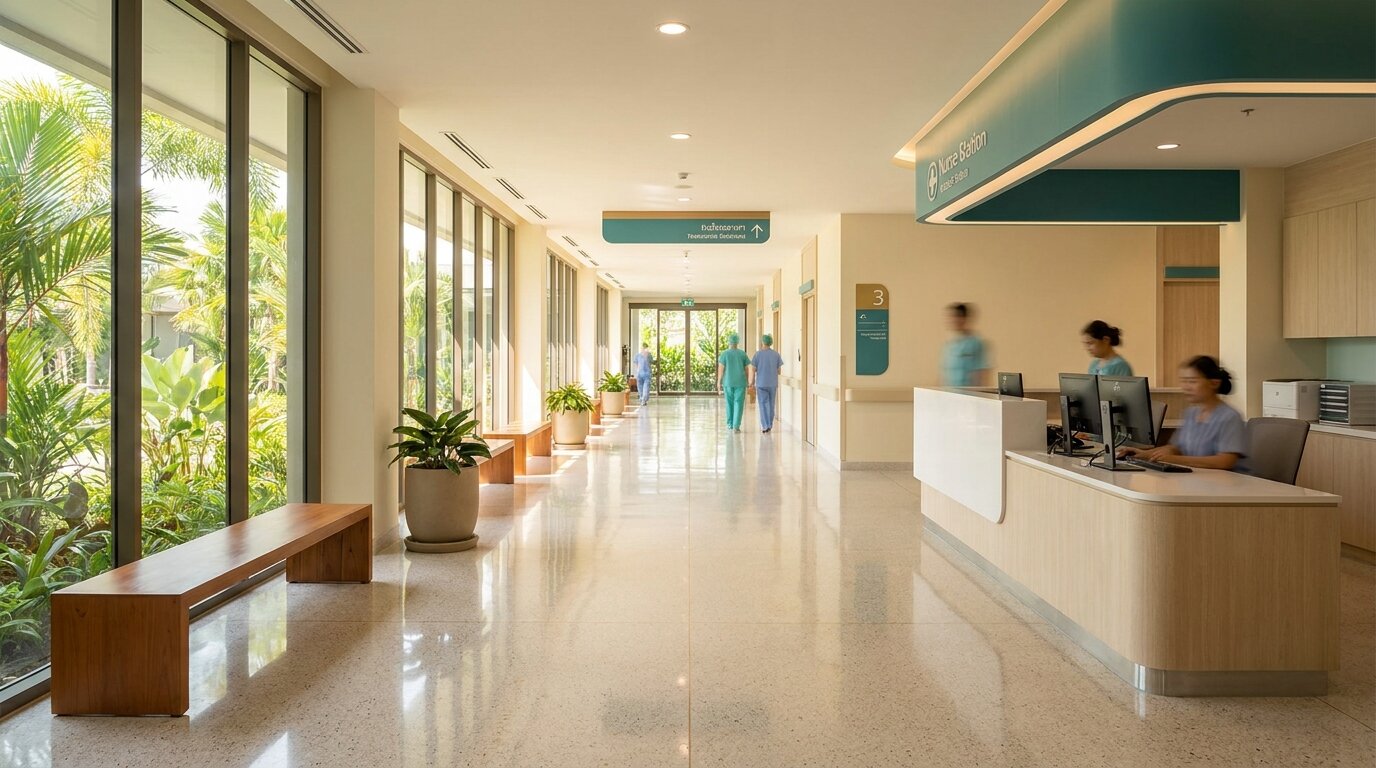
Bangkok has the deepest hospital ecosystem in Thailand. But Chiang Mai isn’t a medical backwater. Bangkok Hospital Chiang Mai is a 122-bed JCI-accredited tertiary facility, continuously accredited since 2015 and located 15 minutes from Chiang Mai International Airport. One Step uses a partner-hospital arrangement for severe medical or psychiatric situations — covering the medical scenarios most likely to escalate during rehab.
The honest version: for routine medical needs during a 30–90 day residential rehab — a chest infection, a medication review, a panic attack, a sprained ankle — Chiang Mai has it covered. For elective cardiac surgery, transplant medicine, or rare oncology, Bangkok is genuinely deeper.
How that affects your decision:
- If you have stable health and no major medical co-morbidity, Chiang Mai’s hospital cover is more than sufficient. The partner-hospital pathway handles the rare cases where rehab-level care isn’t enough.
- If you have significant medical complexity — recent cardiac event, advanced liver disease, complex psychiatric history requiring active hospital coordination — Bangkok may be the more practical choice, at least for the medical stabilisation phase.
- For severe alcohol or benzodiazepine withdrawal, we may detox you first at our partner hospital — which has intensive and intermediary intensive care units — before you transfer to One Step for the rehab programme. This option exists in Chiang Mai. It’s not a city-level limitation.
The medical-backup question matters, but it doesn’t justify the assumption that “Bangkok = safe, Chiang Mai = risky.” That’s not how the actual hospital network works in either city.
Why One Step in Chiang Mai Specifically?
One Step’s programme is built around what Chiang Mai’s environment makes possible: longer residential stays at a mid-range price point, daily mindfulness practice woven into the schedule, structured outdoor and nature time, and a staff-to-client ratio supported by northern Thailand’s cost base. We charge approximately ฿280,000/month (around $8,500 USD) for the residential programme — what that covers is published openly on our pricing page.
What the programme looks like in practice:
- Treatment structure: CBT, motivational interviewing, group therapy daily, individual counselling weekly, and 12-step facilitation as part of our treatment programme. Mindfulness practice is a daily feature, not an optional extra.
- Daily schedule: Wake 7 am, optional meditation, breakfast, group therapy 9–11, lunch, afternoon fitness or counselling, evening recovery meeting. The full breakdown is on our treatment schedule page.
- Outdoor and cultural integration: Hiking on Doi Suthep, temple visits, rural-village excursions and Muay Thai training are part of the programme, not bolted-on tourism. See our activities page for what gets scheduled into a typical week.
- Aftercare and step-down: Residential rehab works best when followed by structured aftercare and relapse prevention. We help clients build that bridge before they leave.
- Medical pathway: Visiting psychiatrist on-site, partner-hospital cover for severe situations, on-site detox for the great majority of clients who don’t need ICU-level monitoring.
What we’re not: we’re not a luxury beach resort and we’re not a private hospital. If you want infinity-edge pools and a personal chef, Phuket has options that fit better. If you want specialist medical care as the primary product, Bangkok’s hospital network is the better starting point. If you want a structured residential rehab with daily therapy, real nature access, and a calmer environment than either of the other two cities offers — that’s what Chiang Mai supports, and that’s what we run.
For broader context on choosing Thailand as a treatment destination, our overview on why people choose Thailand for addiction treatment covers the country-level case. If you’re specifically weighing premium pricing, the post on when luxury rehab in Chiang Mai matters and when it doesn’t goes into where the money actually goes. And if you’re drawn to the wellness model, our piece on holistic and wellness rehab in Chiang Mai draws the line between structured holistic treatment and spa marketing.
Who Should Choose Which City?
The honest summary: Bangkok for medical complexity and fast access. Phuket for resort-style luxury and clients who specifically want beach amenity. Chiang Mai for residential rehab where pace, environment, and longer engagement matter more than amenity. These aren’t competing — they serve different decisions.
| If your situation is… | Best fit | Why |
|---|---|---|
| Significant medical complexity or recent hospitalisation | Bangkok | Deepest specialist hospital network in the country |
| Short stabilisation stay before treatment elsewhere | Bangkok | Fastest airport access, medical-first model |
| High-budget client wanting beach-resort wellness | Phuket | Strongest luxury amenity, beach setting |
| Already done one rehab, want a softer step-down | Phuket | Vacation-adjacent atmosphere, lower clinical intensity |
| Residential rehab, 30–90 days, real engagement | Chiang Mai | Calmer environment, lower temptation density, cost base supports longer stays |
| Addiction tied to bar culture, alcohol or party drugs | Chiang Mai | Smallest nightlife footprint of the three cities |
| Drawn to mindfulness, meditation or Buddhist-style practice | Chiang Mai | 300+ temples, authentic teachers, daily monastic life |
| Mid-range budget, want longer residential stay | Chiang Mai | Cost base allows higher therapy hours per dollar spent |
If you or someone you love is struggling with substance dependence, explore how a drug addiction treatment can provide the structure, clinical support, and environment needed for lasting recovery.
Frequently Asked Questions
Common questions about choosing between Chiang Mai, Bangkok and Phuket for rehab in Thailand.
Chiang Mai is generally considered the calmest and lowest-crime of the three cities. The risk profile in rehab isn’t really city crime — it’s environmental exposure to alcohol, drugs, and party culture during early recovery. On that measure, Chiang Mai has a smaller nightlife footprint than either Bangkok or Phuket, which reduces day-to-day temptation pressure during a residential stay.
Most international clients fly into Bangkok Suvarnabhumi and connect to Chiang Mai International on a one-hour domestic flight. Chiang Mai also has some direct international routes from regional Asian hubs. The connection adds time compared with flying straight to Bangkok or Phuket, but it’s a single short hop and One Step coordinates airport transfers on arrival.
Yes, for the situations rehab clients actually need. Bangkok Hospital Chiang Mai is a 122-bed JCI-accredited tertiary facility with intensive care units and international patient services. One Step uses a partner-hospital arrangement for severe medical or psychiatric scenarios. The gap between Bangkok and Chiang Mai matters most for rare specialist medicine — for everyday rehab medical needs, Chiang Mai is well covered.
It’s a real factor. From roughly late February to mid-April, agricultural burning in northern Thailand and neighbouring countries pushes PM2.5 levels above the safe range. Outside that window — which is most of the year — Chiang Mai’s air is cleaner than Bangkok’s traffic-driven baseline. Clients with respiratory conditions or strong smoke sensitivity should plan their stay outside the burning months or use indoor air filtration during it.
On average, yes. Northern Thailand has a lower cost base for staff, food and accommodation than either Bangkok or Phuket. What that cost gap buys at a serious rehab isn’t a cheaper stay — it’s a longer one, or a higher staff-to-client ratio at the same price point. Length of stay is one of the most consistent predictors of treatment outcome, so the cost gap translates directly into clinical leverage.
We’ll tell you if we think you’d be better served somewhere else. Beach-resort wellness, premium luxury amenity, and acute medical-first models aren’t what we run. If those are your priorities, we’ll help you understand what kind of facility in Phuket or Bangkok actually fits the brief. The straight answer is what builds trust.
Mindfulness practice — daily meditation, present-moment awareness, urge-surfing — has clinical evidence behind it for addiction recovery. In Chiang Mai it isn’t a wellness add-on. The temples are active, the monks teach, and the practice is part of everyday city life. That doesn’t mean clients need to be Buddhist. It means the cultural environment supports the work rather than treating it as exotic.
Written by
Alastair Mordey
Alastair Mordey is one of the pioneers of drug and alcohol treatment globally and specifically in Asia. He has been an addiction’s professional for twenty years. He started his career as an expert in substance abuse w...
Learn more about Alastair
Medically reviewed by
Dr. Worapakthorn Kongpesalaphun
Consultant Psychiatrist · Thai Licensed Medical Doctor · Residency in Psychiatry, Somdet Chaopraya Institute · Doctor of Medicine, Rangsit University
Dr. Worapakthorn Kongpesalaphun is a Thai Licensed Medical Doctor and Expert in Preventive Medicine (Community Mental Health) with extensive experience in addiction treatment and public health management. He holds multip...
Learn more about Dr. Worapakthorn