
Key Takeaways
- Buddhist meditation helps addiction recovery by teaching you to notice a craving without acting on it — the same skill that Mindfulness-Based Relapse Prevention (MBRP) turns into a structured therapy.
- In a 2014 JAMA Psychiatry trial, people who learned mindfulness had fewer days of substance use and less heavy drinking at 12 months than those given standard relapse prevention or usual care.
- Chiang Mai is the practical home of Thai meditation: hundreds of forest and city temples run walking and breathing practice that maps directly onto craving management.
- You do not have to become a Buddhist. The techniques — breath awareness, body scanning, urge surfing — work as secular skills regardless of belief.
- Meditation is a support for therapy and medical care, not a replacement. It works best alongside counselling, structured days, and proper detox where withdrawal is a risk.
Buddhist meditation helps addiction recovery by training you to sit with a craving instead of obeying it. That single skill — watching an urge rise, peak, and fade without reaching for a drink or a drug — is the mechanism behind Mindfulness-Based Relapse Prevention, and clinical trials show people who learn it use less and relapse less than those who don’t (Bowen et al., JAMA Psychiatry, 2014).
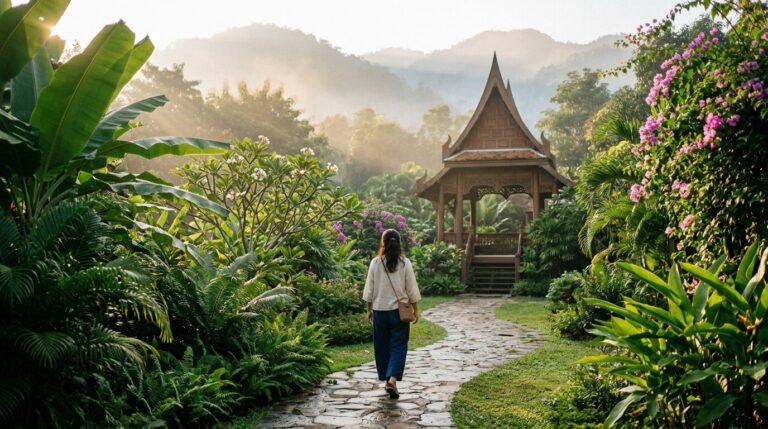
Chiang Mai is where this stops being theory. The city and the mountains around it hold hundreds of Buddhist temples where breath and walking meditation are taught the same way they have been for centuries. For someone in recovery, that means the practice is not a wellness add-on flown in from elsewhere — it is embedded in the place. Below is what the research actually supports, how the core techniques work, and how we use them at One Step without pretending meditation replaces treatment.
How Does Buddhist Meditation Help With Addiction Recovery?
Buddhist meditation helps recovery by breaking the automatic link between a craving and using. Instead of reacting the instant an urge appears, you learn to observe it as a passing sensation. This weakens the habit loop that drives relapse, and reviews of mindfulness therapies find real reductions in craving intensity and substance use (Grant et al., Journal of Addiction Medicine, 2017).
Addiction runs on a tight cue-and-response loop: a trigger appears, a craving spikes, and the brain treats using as the only exit. Meditation inserts a gap into that loop. When you have spent hours simply watching your breath, you have practised noticing an internal event without immediately acting on it. Applied to a craving, that pause is enough to choose differently. The National Institute on Drug Abuse notes that mindfulness-based interventions reduce craving by changing how people process reward and regulate their own responses (NIDA, 2024).
This is the same territory covered by cognitive behavioural work. If you want the therapy side, our post on the differences between CBT and DBT for addiction explains how structured thought work pairs with the awareness meditation builds.
What Does the Research Actually Say?
The research is cautiously positive: mindfulness meditation reliably reduces cravings and, in longer trials, lowers substance use over time — but it is not a standalone cure. The strongest evidence sits with structured programmes like MBRP rather than meditation done casually and alone, and effects on craving are consistently larger than effects on relapse rates.
The landmark trial randomly assigned people finishing addiction treatment to mindfulness-based relapse prevention, standard relapse prevention, or usual aftercare. At 12 months, the mindfulness group reported significantly fewer days of substance use and less heavy drinking than the other two (Bowen et al., JAMA Psychiatry, 2014). An earlier pilot found the same direction — lower substance-use rates at four months for the mindfulness group (Bowen et al., Substance Abuse, 2009).
| Outcome | Evidence strength | What it means for you |
|---|---|---|
| Craving intensity | Strong | Cravings feel less overwhelming and easier to ride out |
| Days of substance use | Moderate (longer term) | Fewer using days at 12 months in structured programmes |
| Stress and negative mood | Moderate | Better tolerance of the discomfort that drives relapse |
| Preventing any relapse at all | Mixed | Meditation alone won’t guarantee it — pair it with therapy |
A 2023 meta-analysis of controlled trials found a medium-to-large effect for mindfulness on craving, while noting wide variation between studies (Demina et al., BMC Neuroscience, 2023). The honest read: meditation is one of the better-supported skills for managing urges, but it earns its keep as part of a programme, not instead of one.
The clients who get the most from meditation are the ones who stop treating it as relaxation. It isn’t about feeling calm — it’s rehearsal. You sit with a small discomfort on the cushion every morning so that when a real craving hits on a hard afternoon, you already know it will pass if you don’t feed it.
Craig GagnonSenior Therapist, One Step Rehab
Which Meditation Techniques Matter Most in Recovery?
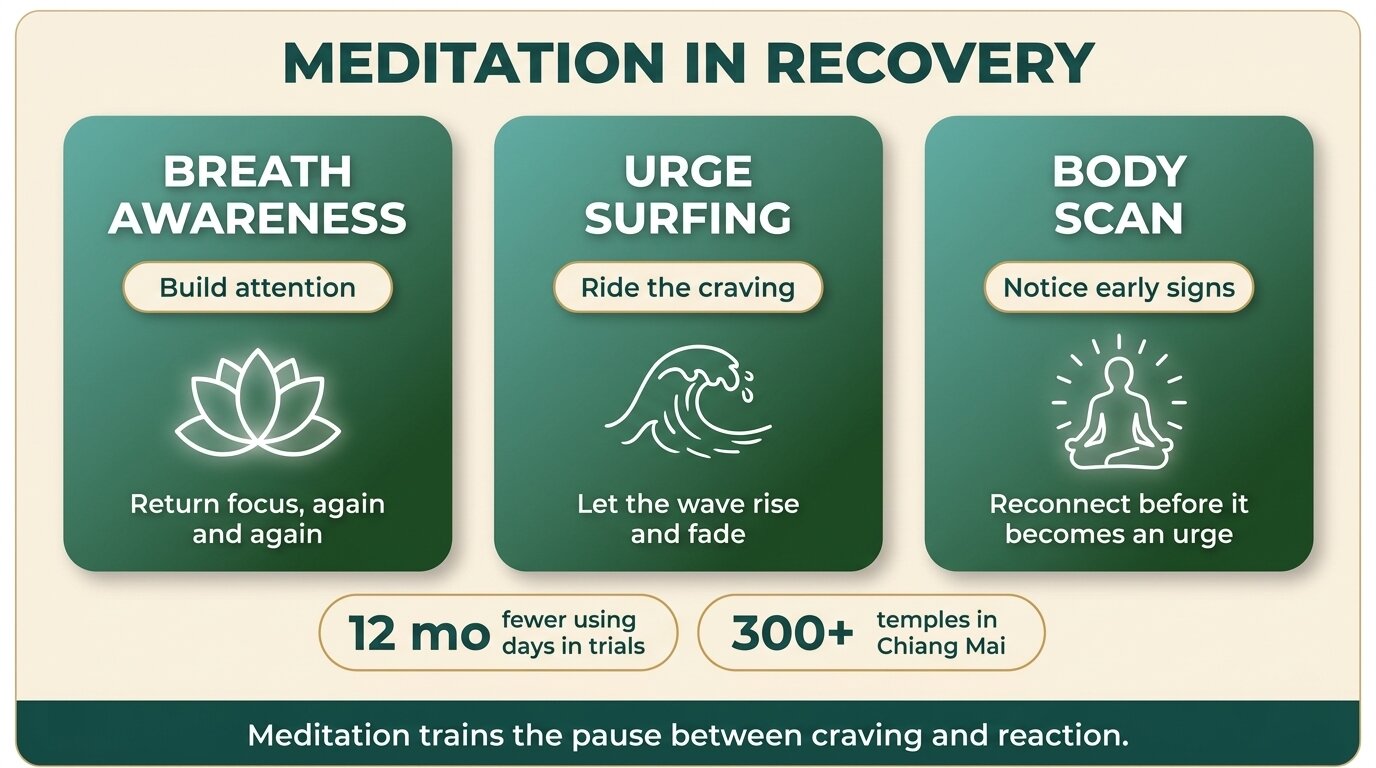
Three techniques do the heavy lifting: breath awareness to build attention, body scanning to reconnect with physical sensations, and urge surfing to ride out cravings. All three come from Buddhist practice but work as secular skills. You don’t need to adopt any beliefs — you need to practise noticing, which is trainable like any other skill.
Breath awareness (anapanasati). You rest attention on the breath and, every time the mind wanders, bring it back. That “bring it back” moment is the whole exercise — each repetition strengthens the muscle you’ll use to redirect attention away from a craving.
Body scanning. You move attention slowly through the body, noticing sensations without reacting. Addiction pulls people out of their bodies; scanning rebuilds the early-warning system that tells you stress or restlessness is climbing before it becomes an urge.
Urge surfing. This is the recovery-specific one. Instead of fighting a craving or giving in, you watch it like a wave — noticing where you feel it, letting it rise and crest, and staying with it until it recedes. We cover this technique in depth in our guide to urge surfing for cravings, and it pairs naturally with a broader relapse-trigger plan.
Not sure whether structured treatment or self-guided practice is right for you? Talk to our team — we’ll give you a straight answer, including if somewhere else would suit you better.

Why Chiang Mai for a Meditation-Based Recovery?
Chiang Mai is Thailand’s meditation heartland: over 300 temples, several well-known forest monasteries in the surrounding hills, and a long tradition of teaching Vipassana and breath practice to visitors. For recovery, that means the environment itself reinforces the skill — calm surroundings, walking meditation trails, and a culture that treats sitting quietly as normal rather than strange.
The setting matters more than it sounds. Trying to build a meditation habit in the same environment where you used is hard; the cues are everywhere. Chiang Mai’s mountains, temple grounds, and slower pace strip out a lot of those triggers while you learn the skill. We wrote about why the city beats the alternatives in our comparison of Chiang Mai versus Bangkok or Phuket for rehab, and how meditation fits a wider wellness approach in our post on holistic and wellness rehab in Chiang Mai.

How Does One Step Use Meditation in Its Programme?
At One Step, meditation is built into the daily structure, not offered as an optional extra. Most mornings start with a guided sitting practice before breakfast, and mindfulness skills are woven into group therapy through the day. We treat it as a recovery tool that supports counselling and structured routine — not as the treatment itself.
Our day is deliberately ordered: early wake time, morning meditation, group therapy mid-morning, and structured activities and excursions later. You can see how it fits together on our treatment schedule, and how meditation sits alongside counselling in our treatment programme. Some of that mindfulness carries outdoors — walking practice ties into our activities and excursions in the hills around the city.
We charge roughly ฿280,000/month (about $8,500 USD). That covers your room, meals, therapy, and the structured programme including meditation sessions. It does not cover everything — medication the doctor prescribes is billed separately, the same way flights, visas, and personal items are. You can see the full breakdown on our pricing page.
Meditation is also one of the skills clients carry into life after treatment. A morning sit is a cheap, portable relapse-prevention tool that needs no facility, which is why we build it into our aftercare and relapse prevention planning. To be clear, though: meditation supports treatment, it does not replace it. If withdrawal is a medical risk, that has to be handled properly first — a quiet mind does not manage detox.
Frequently Asked Questions
Common questions about Buddhist meditation and addiction recovery.
No. Meditation is a well-supported skill for managing cravings and stress, but the strongest evidence comes from structured programmes that combine it with counselling. It works as a support alongside therapy and medical care, not as a substitute for either.
No. The core techniques — breath awareness, body scanning, and urge surfing — work as secular mental skills regardless of your beliefs. The clinical programmes built on them, like Mindfulness-Based Relapse Prevention, are non-religious by design.
Most structured programmes run over about eight weeks, and trials show benefits building over months rather than days. A short daily practice is more useful than occasional long sessions — consistency is what trains the pause between a craving and a reaction.
Urge surfing is a mindfulness technique where you treat a craving like a wave — noticing where you feel it, letting it rise and peak, and staying with it until it fades, rather than fighting it or giving in. Cravings pass on their own if you don’t feed them.
Chiang Mai has hundreds of temples and forest monasteries with a living tradition of teaching breath and walking meditation. The calm setting removes many of the everyday triggers tied to using, which makes it easier to build the practice while you learn it.
Meditation can help with restlessness and stress, but it does not manage the medical side of withdrawal. Where withdrawal carries real risk, detox needs proper medical oversight first. Meditation becomes most useful once you are physically stable and can focus.
Written by
Craig Gagnon
Craig Cagnon is an American counseling psychologist and addiction counselor. He holds Masters degrees in community counseling and counseling psychology and completed his clinical residency at The Mayo Clinic, in Rochest...
Learn more about Craig
Medically reviewed by
Dr. Worapakthorn Kongpesalaphun
Consultant Psychiatrist · Thai Licensed Medical Doctor · Residency in Psychiatry, Somdet Chaopraya Institute · Doctor of Medicine, Rangsit University
Dr. Worapakthorn Kongpesalaphun is a Thai Licensed Medical Doctor and Expert in Preventive Medicine (Community Mental Health) with extensive experience in addiction treatment and public health management. He holds multip...
Learn more about Dr. Worapakthorn