
Key Takeaways
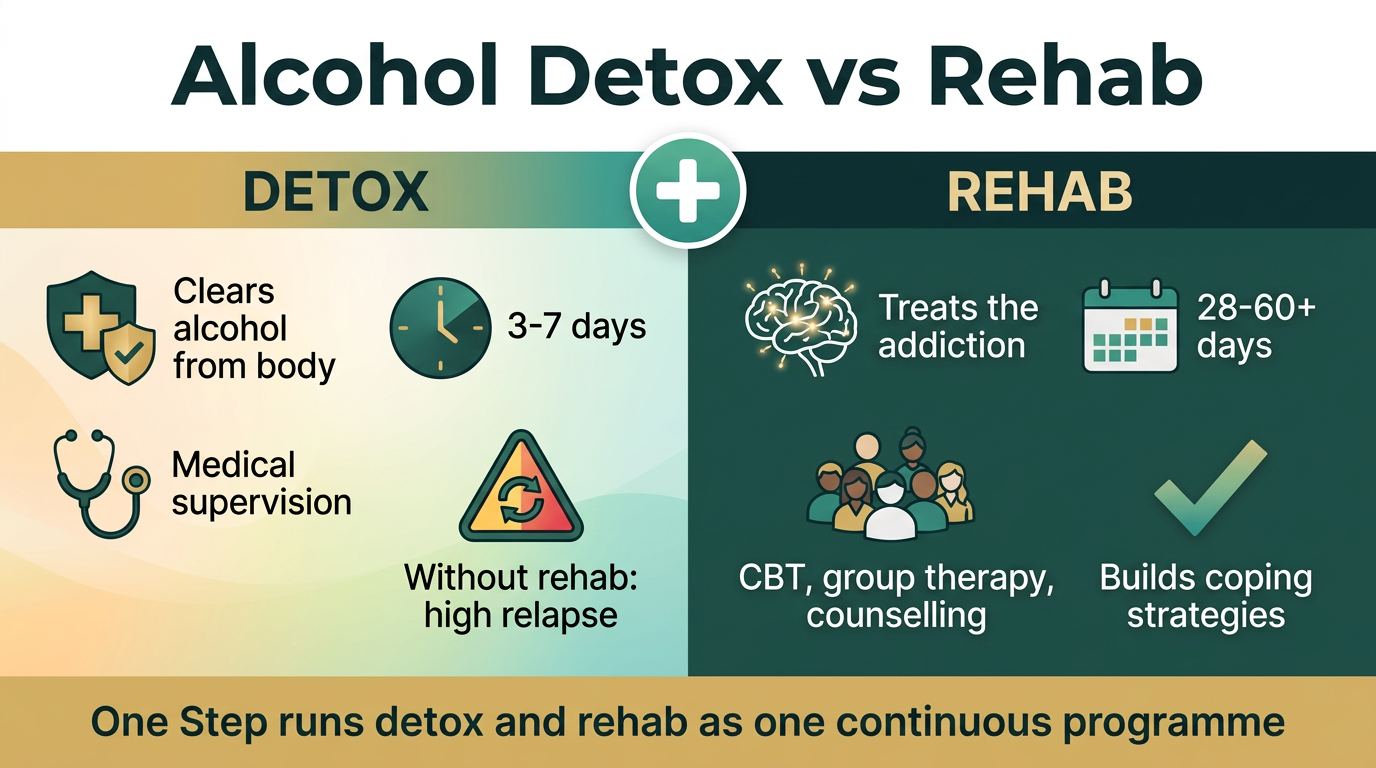
- Inpatient alcohol rehab means living at the facility for 28–60 days while completing a structured therapy programme. It’s not just “drying out” — it’s learning why you drink, building coping strategies, and restructuring your daily habits.
- You likely qualify for inpatient alcohol rehab if you drink daily and can’t stop on your own, if previous outpatient or self-directed attempts have failed, if you have co-occurring depression or anxiety, or if your home environment includes triggers you can’t avoid.
- At One Step, the programme includes daily group therapy (CBT-based), weekly individual counselling, structured fitness (Muay Thai, gym, swimming), nutritional support, and a psychiatrist who manages dual diagnosis and medication needs.
- The first 7 days focus on medical stabilisation and detox. From week 2 onward, the full therapy schedule begins — roughly 20 structured hours per week of clinical and wellness activities.
- Aftercare starts being planned from week 2, not on discharge day. This includes relapse prevention strategies, ongoing counsellor check-ins, and a transition plan for returning home.
If you’re researching inpatient alcohol rehab, you’ve probably already tried to manage your drinking on your own. Most people who contact us have. They’ve set rules, taken breaks, tried outpatient counselling, made promises. It hasn’t worked — and that’s not a moral failure. It’s a sign that your addiction needs a level of structure and support that can’t be delivered in evening sessions or self-help books.
This article will explore what inpatient alcohol rehab at One Step actually looks like — the admission process, what your days involve, who qualifies, and what happens when you leave. No vague promises about “transformative journeys.” Just the practical reality of residential treatment in Chiang Mai.
What Does the Admission Process Look Like?
The admission process is often the first meaningful step in reclaiming control. Once you contact us by phone or email, a client liaison specialist will answer your initial questions and help you decide whether One Step is the right fit. If it is, they’ll arrange a formal clinical assessment with one of our counsellors or psychologists.
Assessment and history taking. The clinical assessment covers your drinking history (how much, how long, how often), medical background, co-occurring mental health issues (depression, anxiety, PTSD), and your current life situation — work, family, stressors. This isn’t just paperwork. It’s the beginning of the therapeutic relationship, and the information feeds directly into your personalised treatment plan.
Logistics. If you’re travelling from abroad, the team helps with visa arrangements, the Thailand Digital Arrival Card (TDAC), and a packing list. You’ll receive a sheet covering our refund policy, rules, the therapy structure, and other essentials. When you’ve booked flights, the team arranges an airport pickup — you’ll be at the centre within 25 minutes of landing.
Arrival and orientation. You’re welcomed by clinical staff and given a tour of the facility, introduction to the support team, and a clear outline of the daily schedule. Our facilities feel like a wellness retreat, not an institution. We have comfortable rooms, fitness centers, and many outdoor spaces. Privacy and confidentiality are standard. We ask clients to arrive on weekdays so you can integrate into the community and therapy schedule immediately.
Rules. The basics are obvious: no drugs or alcohol. Less obvious: no romantic or “exclusive” relationships during treatment. Exclusive friendships that lock others out can harm the community dynamic that’s essential for recovery. As we say in recovery, “you’re as sick as your secrets.” Full community participation is expected and therapeutic.
Who Qualifies for Inpatient Alcohol Rehab?
You qualify for inpatient alcohol rehab if your drinking has reached a point where outpatient support isn’t enough — typically meaning daily or near-daily alcohol use, failed attempts to stop, withdrawal symptoms when you don’t drink, co-occurring mental health issues like depression or anxiety, or an unstable home environment that makes sobriety difficult.
There’s no strict formula. During your intake assessment, we evaluate:
- Drinking pattern and duration. How much, how often, and for how long. Someone drinking a bottle of wine nightly for 6 months has different needs than someone drinking a litre of spirits daily for 5 years.
- Previous treatment attempts. Most of our clients have tried to stop before — AA meetings, outpatient counselling, willpower. Failed attempts don’t mean failure. They mean you need a different level of care.
- Withdrawal history. If you’ve experienced withdrawal symptoms (tremors, anxiety, sweating) when you stopped drinking, you’ll likely need medically supervised detox as part of your programme.
- Mental health. Depression, anxiety, PTSD, and other conditions commonly co-exist with alcohol addiction. At One Step, dual diagnosis is assessed and treated alongside the addiction — not as a separate problem.
- Home and social environment. If your partner drinks, your work revolves around alcohol, or your household is unstable, outpatient treatment is fighting against your daily reality. Residential treatment removes you from that environment entirely.
You don’t need to be at rock bottom to qualify. Some clients come to us while they’re still functioning — holding jobs, maintaining relationships — but recognise that their drinking is escalating and outpatient hasn’t worked. That’s enough.

What Actually Happens During Inpatient Alcohol Rehab?
At One Step, inpatient alcohol rehab is a structured programme running from 7am to 9pm daily. It includes CBT-based group therapy every morning, individual counselling weekly, fitness sessions in the afternoon, and recovery meetings in the evening. The first week focuses on detox and orientation; from week 2, you will begin the full therapeutic program.
At One Step, our therapeutic program equals around 20 structured hours per week. The fitness component isn’t optional — exercise directly supports brain recovery from alcohol by restoring dopamine receptor function that heavy drinking damages (Robertson et al, Neuropsychopharmacology, 2016). You can read more about our weekly schedule and program structure here.
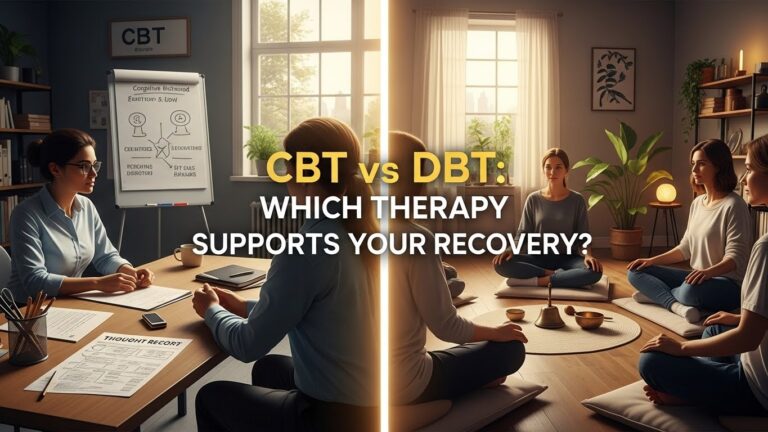
At One Step Rehab, our therapy approach is practical, not theoretical. Group sessions use CBT to identify what triggers your drinking — the activating event, the belief system around it, and the consequences (the ABC model).
- A – Activators
- B – Belief system
- C – Consequences (emotional and behavioral)
Individual one-on-one counselling addresses specific patterns: which situations, emotions, or people make you reach for a drink, and what alternative responses you can build. These aren’t abstract exercises — you practise them daily in a controlled environment before facing them at home. This is where you build your relationship with your therapist and work through things that don’t come up in group.
Therapy sessions are complemented by psychoeducation workshops — structured teaching sessions that help you understand addiction as a clinical condition, not a character flaw. Topics include:
- The neuroscience of addiction (how alcohol hijacks the brain’s reward system)
- Identifying and managing triggers and cravings
- Family dynamics and co-dependency
- Adverse childhood experiences and their role in addiction
- Narcissism and other defence mechanisms used in active addiction
CBT is the primary framework, but it’s not the only therapy modality in use. Depending on your individual treatment plan, you may also work with:
- Motivational Enhancement Therapy (MET) — particularly useful in the early stages when ambivalence about sobriety is still present. MET helps you find and strengthen your own reasons for change rather than being told what to do.
- 12-Step Facilitation (TSF) — introduces the principles of AA and peer support groups, helping you build the accountability structures you’ll need after discharge. One Step integrates 12-step principles without requiring adherence to any particular belief system.
- The Matrix Model — a structured 16-week framework combining CBT, family education, 12-step support, and relapse prevention. It’s one of the most evidence-based models for stimulant and alcohol addiction and is a core component of our group programme.
- Trauma-focused therapy — including EMDR (Eye Movement Desensitisation and Reprocessing) for PTSD and unresolved trauma, which commonly underlies alcohol addiction.
Beyond talk therapy, One Step integrates body-based (somatic) therapies that work directly on the nervous system. Chronic alcohol use dysregulates the autonomic nervous system — the body stays in a state of fight-or-flight even when there’s no threat. Body-based modalities help reset this:
- Yoga Nidra — a guided relaxation protocol that resets the body’s fight-flight mechanism. Especially effective for clients with pronounced anxiety.
- Ice baths — controlled cold exposure that trains the nervous system to handle acute stress without panic. Not compulsory, but popular.
- Breathwork — structured breathing protocols (box breathing, 4-7-8 technique) for acute anxiety and cravings management.
- Mindfulness meditation — taught by Thai and Burmese trainers from an unbroken thousand-year Buddhist tradition. This isn’t app-guided meditation — it’s learning directly from practitioners who’ve dedicated their lives to the practice.
- Sound therapy and mantra practice — progressive relaxation using singing bowls, guided sound, and breathing-based meditation for nervous system recovery.
Research consistently shows that exercise is both a deterrent to cravings and a powerful mood stabiliser — which is why fitness remains a non-negotiable component of the programme (Xue et al, Frontiers in Psychology, 2025). One Step’s fitness offering is more like a boot camp than a typical rehab: Muay Thai boxing, strength training, swimming, hiking in the Doi Suthep foothills, cycling in the countryside, tennis, pickleball, and even trips to a local waterfall. Peer interaction during fitness is itself therapeutic — one study found that treatment environments with strong peer interaction were better predictors of long-term recovery than individual therapy alone (Cochrane Review, 2020).
In the evening, the day closes with recovery meetings or group reflection — a chance to check in, share what came up during the day, and practise gratitude. These evening sessions bring the day full circle and reinforce the community connection that’s central to the programme.
How Does One Step Handle Dual Diagnosis?
Depression, anxiety, PTSD, ADHD, and other mental health conditions commonly co-exist with alcohol addiction — and treating only the addiction without addressing the underlying mental health issue is a recipe for relapse. At One Step, dual diagnosis care is integrated from day one, not treated as a separate track.
Evidence-based therapies for co-occurring conditions include:
- EMDR (Eye Movement Desensitisation and Reprocessing) — for trauma and PTSD
- DBT (Dialectical Behaviour Therapy) — for emotional dysregulation and borderline traits
- MBSR (Mindfulness-Based Stress Reduction) — for anxiety and chronic stress
Where medication is needed, our psychiatrists manage SSRIs, SNRIs, or other prescriptions and help taper them when appropriate. About 80% of clients find their mood and anxiety symptoms improve substantially once they’re sober. For the remaining 20% — particularly those with PTSD or bipolar depression — medication management alongside therapy is essential, and our team is equipped for that complexity.
The comparison with outpatient care is stark: inpatient rehab at One Step delivers 12 hours of group therapy per week, 2–3 hours of individual counselling, and 5 hours of psychoeducation and relapse prevention. Most outpatient programmes offer about 1 hour per week of each. For people with co-occurring mental health issues, that difference matters.
Our clinical team includes 2 licensed psychiatrists, 2 clinical psychologists, 4 addiction-trained counsellors, and 6 recovery coaches.

Why Thailand — and Why It Actually Matters for Recovery
Rehab in Thailand isn’t just a cost saving — the cultural context actively contributes to recovery in ways that aren’t available in Western facilities. Chiang Mai is surrounded by forested mountains, centuries-old temples, and a Buddhist culture where mindfulness isn’t a wellness trend but a daily practice.
Thai culture is built on “Nam Jai” — a concept of genuine kindness and generosity that permeates how our Thai staff interact with clients. The warmth is real, not professional politeness. Clients consistently report that the Thai cultural approach — non-judgmental, unhurried, inherently respectful — helps them let their guard down in a way that British or American clinical environments don’t.
Practical ways the location contributes to treatment:
- Meditation from the source. Learning Vipassana meditation from Thai Buddhist monks is qualitatively different from following a Headspace session. Our trainers come from an unbroken contemplative tradition and teach meditation as a life skill, not a therapy add-on.
- Muay Thai as therapy. Boxing is Thailand’s national sport. Training with experienced Thai coaches gives clients a physical outlet for anger and frustration, improves cardiovascular fitness (directly supporting brain recovery), and builds discipline. Nowhere else can you get this quality of instruction inside a rehab programme.
- Cost-to-quality ratio. The same clinical quality that would cost $25,000–$40,000/month in the US, UK, or Australia costs ~$8,500/month at One Step. This isn’t because the treatment is inferior — it’s because Thailand’s cost of living is lower. You get more therapy hours, more fitness, and longer stays for the same budget.
- Distance from triggers. Being 8,000 miles from your dealer, your drinking friends, and the pub on the corner isn’t a minor detail. Geographic separation forces a clean break that local rehab can’t replicate.
- Cultural immersion. Weekend excursions to Doi Suthep temples, elephant sanctuaries, Thai cooking classes, and local markets aren’t just entertainment — they’re structured socialisation practice. Learning to enjoy life sober, in a genuinely new environment, builds a reference library of positive sober experiences.
How Long Should You Stay?
The National Institute on Drug Abuse indicates that a minimum of 90 days in treatment is typically required to achieve meaningful and sustained reductions in substance use (NIDA). At One Step, the minimum recommended stay is 28 days. We are transparent about this: shorter stays can initiate progress, but rarely produce lasting outcomes, particularly as the first week is often focused on detox and stabilisation.
Here’s what each phase typically covers:
- Month 1 (Days 1–28): Detox (if needed), medical stabilisation, assessment, and early structure. Introduction to therapy, routine, and recovery.
- Month 2 (Days 28–56): Full programme. CBT, individual counselling, fitness, and recovery meetings. Building habits, coping strategies, and momentum.
- Month 3 (Days 56–84): Consolidation and transition. Relapse prevention, increasing independence, off-site meetings, and discharge planning.
- Months 4–15: Ongoing 12 months of aftercare. Continued support, accountability, and follow-up to maintain long-term recovery.
Most clients who stay 28 days tell us they wish they’d stayed longer. Those who stay 60 days leave measurably more prepared. We’ll give you an honest recommendation based on your situation, not what fills a bed.
What Happens After You Leave?
Aftercare planning starts in week 2 — not on your last day. Your primary therapist works with you to build a personalised discharge plan covering your major triggers, what you’ll do to manage them, where you’ll access ongoing support, and how your family will be involved (if you choose).
One Step offers a 12-month free aftercare programme — we believe this is unique in the industry. It includes:
- Weekly online group sessions every Saturday, where you reconnect with peers from your cohort and meet alumni who preceded you
- A written relapse prevention plan with specific strategies for your identified triggers
- Access to our international network of outpatient therapists and 12-step/SMART recovery meeting directories
- The option to return for booster therapy sessions if needed
The hardest part of recovery is the first 90 days after discharge — back in your normal environment, without the structure and support of residential treatment. That’s exactly why we don’t just wave goodbye at the door. The Saturday aftercare group creates continuity: you learn that recovery is a lifelong dynamic process, and you have a built-in support system that doesn’t expire after a few weeks.
Why Nutrition Matters in Alcohol Recovery
Chronic heavy drinking depletes the brain’s neurotransmitter systems — particularly dopamine, which controls motivation, pleasure, and reward. At One Step, meals are designed around what we call a “dopamine-smart menu”: high-protein breakfasts that provide the amino acid precursors your brain needs to rebuild dopamine receptors, balanced Thai meals using fresh local ingredients, and careful attention to hydration and micronutrients. Nutritional recovery isn’t a gimmick — it’s a direct contributor to mood stabilisation, better sleep, and reduced cravings during the critical first weeks of sobriety. You can read more about nutrition in recovery on our site.
During the detox phase, new arrivals are also supported by our buddy system — peers and recovery coaches who’ve recently been through the same experience and can offer informal support, answer practical questions, and help you feel less alone during the most difficult first few days.
Alcohol addiction rewires the brain’s reward system over months or years of heavy use. You can’t undo that in a week of detox. The therapy phase — learning to recognise triggers, building new responses, physically restoring brain function through exercise and nutrition — that’s what makes the difference between someone who gets sober for a month and someone who stays sober for a year. The minimum 28 days isn’t arbitrary. It’s the time the brain needs to begin forming new patterns.
AMAlastair MordeyFounder and Programme Director, One Step Rehab
What Should You Bring to Rehab?
Practical preparation reduces anxiety about arriving. Here’s what to bring and what to leave at home:
Bring:
- Lightweight, comfortable clothing — Chiang Mai is warm year-round. Think shorts, t-shirts, activewear for fitness. 2 weeks’ worth is sufficient (laundry service is included).
- Trainers / athletic shoes for Muay Thai, gym, and hiking
- Swimwear for the pool
- Personal toiletries (new, sealed — alcohol-free)
- Current prescription medications in original packaging with a doctor’s letter
- A journal or notebook (many clients find writing therapeutic)
- Passport and travel documents
- A book or two for downtime
Leave at home:
- Valuables, expensive jewellery, large amounts of cash
- Over-the-counter sleep aids or supplements (these are assessed and managed by the medical team)
- Large items, such as guitars, keyboards, surfboards (yes, we’re not kidding — sometimes people bring things like that!)
Your phone is allowed but access is restricted during the first week. After that, set times for phone use are built into the schedule. The admissions team provides a detailed packing checklist when you book.
Frequently Asked Questions About Inpatient Alcohol Rehab
Common questions about admission, treatment, costs, and what to expect from residential alcohol rehab.
One Step charges approximately ฿280,000/month (~$8,500 USD), covering accommodation, meals, all therapy, fitness, medical oversight, and aftercare planning. This is mid-range for Thailand — luxury facilities charge $15,000–$30,000+/month. Budget options start around $2,000–$5,000/month but typically offer fewer therapy hours.
Yes, but phone access is restricted during the first week to help you focus on detox and settling in. After the initial period, phone use is allowed at set times. This isn’t punitive — constant connectivity in early recovery tends to feed anxiety, trigger cravings, and prevent clients from fully engaging with the programme.
Optional family involvement is available through scheduled video calls and, where appropriate, family therapy sessions. Addiction affects the entire family system, and involving partners or family members can improve outcomes. However, family participation is never mandatory — the client’s comfort and readiness come first.
After discharge, clients are free to deliver weekly check-ins with their counsellor for the first three months, a written relapse prevention plan, and access to our alumni network. The aftercare programme is designed to bridge the gap between residential treatment and independent living — the highest-risk period for relapse.
No. One Step handles detox on-site as part of the integrated programme. You do not need to complete detox at a separate facility before arriving. If you’re still drinking on the day you arrive, that’s expected — the medical team will assess you and begin the detox process as part of your first week.

Written by
Alastair Mordey
Alastair Mordey is one of the pioneers of drug and alcohol treatment globally and specifically in Asia. He has been an addiction’s professional for twenty years. He started his career as an expert in substance abuse w...
Learn more about Alastair
Medically reviewed by
Dr. Worapakthorn Kongpesalaphun
Consultant Psychiatrist · Thai Licensed Medical Doctor · Residency in Psychiatry, Somdet Chaopraya Institute · Doctor of Medicine, Rangsit University
Dr. Worapakthorn Kongpesalaphun is a Thai Licensed Medical Doctor and Expert in Preventive Medicine (Community Mental Health) with extensive experience in addiction treatment and public health management. He holds multip...
Learn more about Dr. Worapakthorn